The Ruby of the Blacksoil: A Search for the Rare Collett’s Snake - Article published in AHS Red Bellied Courier (2019)
Posted by Ross McGibbon on 1st Mar 2019
With its dark purple body and vivid red or orange cross-bands, the Collett’s Snake is one of Australia’s most striking elapids, resembling a radioactive tiger snake. Adding to their appeal, they are rarely encountered due to their ecology and remote distribution. They inhabit a relatively small range in the Mitchell Grass Downs region of inland Queensland, where they are closely associated with the region’s expansive black-soil plains. During dry periods, the heavy clay soils become extremely hard and develop deep cracks that extend well below the surface. This labyrinth of soil cracks provides shelter from the extreme heat of summer and bitter cold of winter. During the warmer months, Collett’s Snakes emerge from these cracks to hunt when surface temperatures become more tolerable, typically between dusk and dawn.
Observing one of these snakes in the wild had been a dream of mine for many years. In March 2018, I planned my first attempt with good mates and fellow herpers Dan Bromley, Richie Gilbert and Steve Tuckey. To increase our chances of success, we each studied as much information as we could about the species’ habitat, habits and distribution. We also spoke to as many people as possible who had either succeeded or failed in locating a Collett’s. During these discussions, I was surprised to learn that some people had visited the area twenty times in search of this snake and still remained unsuccessful. To make things even harder, the region was experiencing an extreme drought. Our chances of finding one were extremely slim.
By February, all our leave and travel arrangements were locked in. All we could do now was wait and pray for good weather. Two weeks before we were due to leave, a cyclone formed in the Gulf and tracked south towards Collett’s country. This was the miracle rain we had been hoping for. As the deluge continued, our concern quickly shifted from the region being drought-stricken to the possibility of it being flooded. The region received record rainfall, resulting in widespread flooding. On the upside, we expected that many of the reptiles sheltering in the soil cracks would be forced to the surface and onto higher ground, potentially making them easier to find. On the downside, if the roads were too flooded to access the area, our trip would be ruined.
Luckily, just days before the trip, the floodwaters subsided enough for the roads to reopen. With conditions improving, we gave the trip the go-ahead. I boarded my flight from Perth, Steve departed from Cairns, Richie headed north from the Sunshine Coast, and Dan eagerly awaited my arrival in Brisbane.
The plan was for Dan and I to meet Richie near Barcaldine, while Steve would join us in Winton a day later. When I arrived in Brisbane, Dan had the Troopy packed and a cold beer waiting for me. What a legend. We wasted no time hitting the road, with a 13-hour drive ahead of us.
We were about an hour north of Tambo, Queensland, when we came across our first reptile of the trip. It was a Spencer’s monitor, but unfortunately, it had been run over and killed that morning. It was disappointing, but at least we were now within their distribution, with a good chance of finding one alive over the coming days. As the sun went down and nocturnal reptile activity commenced, we started a group chat to keep in touch and share any interesting finds along the way.
So far, Richie was doing the best with numerous curl snakes and a huge black-headed python, almost 2.5 metres long. Meanwhile, the best Dan and I could report was a Dwyer’s snake, an inland marbled velvet gecko and a few other diplodactylid geckoes. All we received from Steve was a message saying, ‘Brown tree snake and a slatey-grey. I can’t wait to get out of the tropics.’ By 1 am, we met Richie at a free camp near Barcaldine and crashed out after a big day of driving.
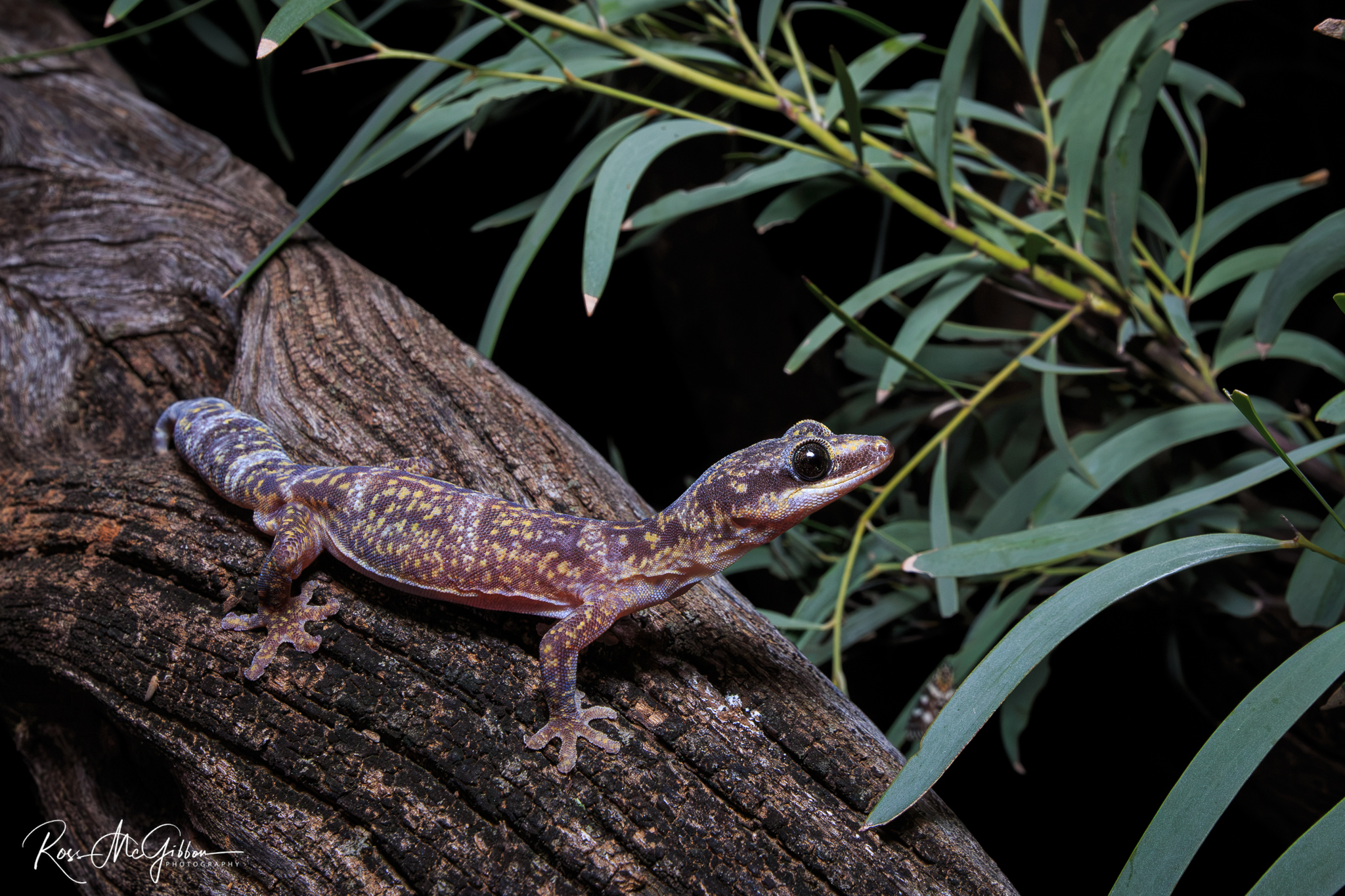
One of the first reptiles encountered on the trip: an inland marbled velvet gecko (Oedura cincta) near Barcaldine, QLD.
The following morning, Dan, Richie and I were in range of two of our target species, the blacksoil whipsnake and the speckled brown snake. Speckled browns come in three distinct colour forms: a fairly plain tan, a nice pinkish-orange, and what we considered the holy grail of speckled browns, an almost white to cream body with brown saddle-shaped bands. It was by far the best-looking form and the one we most wanted to find. We split up and scoured the roads all morning, but all we managed to find was a road-killed blacksoil whipsnake. At midday, the plan was to meet up in Longreach and formulate our next move from there.
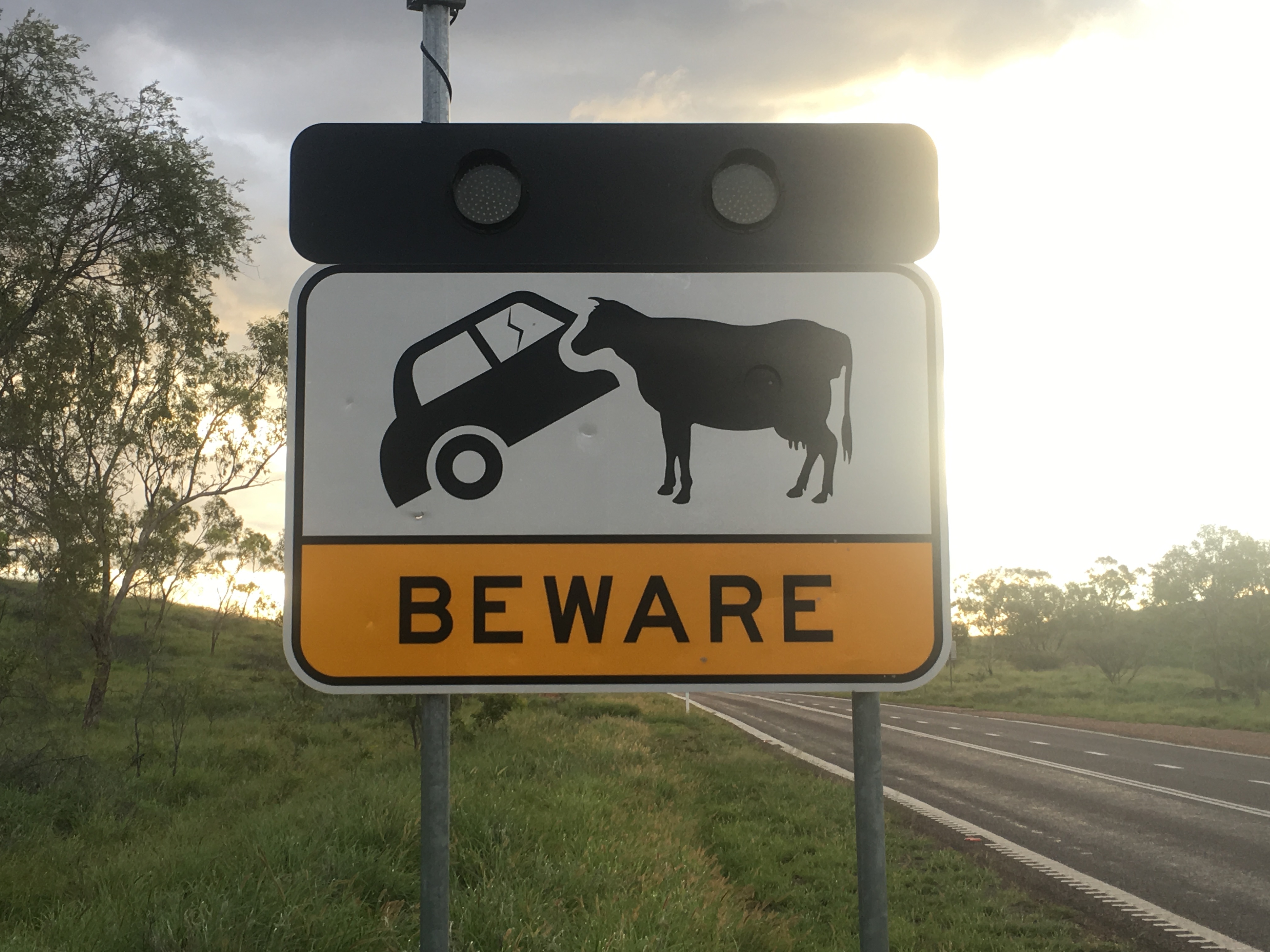
BEWARE: Cows eating cars (haha)
With Winton only two hours away, we could have headed straight there and begun stepping up our efforts for a Collett’s. However, we couldn’t come to the region without accepting the invitation to visit Angus Emmott, a legendary naturalist and co-author of Snakes of Western Queensland – A Field Guide. Visiting Angus meant we wouldn’t be able to meet up with Steve until the following afternoon, giving him the first night to search for a Collett’s by himself. We joked nervously that Steve might find one and head back to Cairns before the rest of us even made it to Winton.
After following a mud map for 200 km along dirt roads, we arrived at Angus’ station. Angus, his wife Karen and son Fergus made us feel right at home with some good old-fashioned country hospitality. After afternoon tea and an hour discussing reptiles, Angus suggested we go and poke around some tin on the property while dinner was being prepared. We didn’t hesitate, especially with Steve already bragging in the group chat about finding a few Eyrean earless dragons and a Spencer’s monitor.
We began flipping tin and found a few skinks and a Stimson’s python (Antaresia stimsoni), now A. childreni. Richie’s back was giving him some grief, so Dan and I took over most of the lifting. One particular piece of tin was quite large and needed Dan and me at either end. As we lifted it, a freckled monitor shot out, displaying stunning purple and orange dorsal markings. We dropped the tin and, as most monitors do when alarmed, it bolted for the nearest tree. The only problem was that the nearest tree was actually Richie’s left leg. It settled halfway up his thigh, and we all stood there in amazement for a second before I yelled, ‘Grab it, Richie!’ After a quick photo shoot with the pretty little monitor and the Stimson’s python, we returned them to their respective pieces of tin and headed back to the homestead for a beautiful roast dinner, some wine and a few good yarns before retiring for the night.
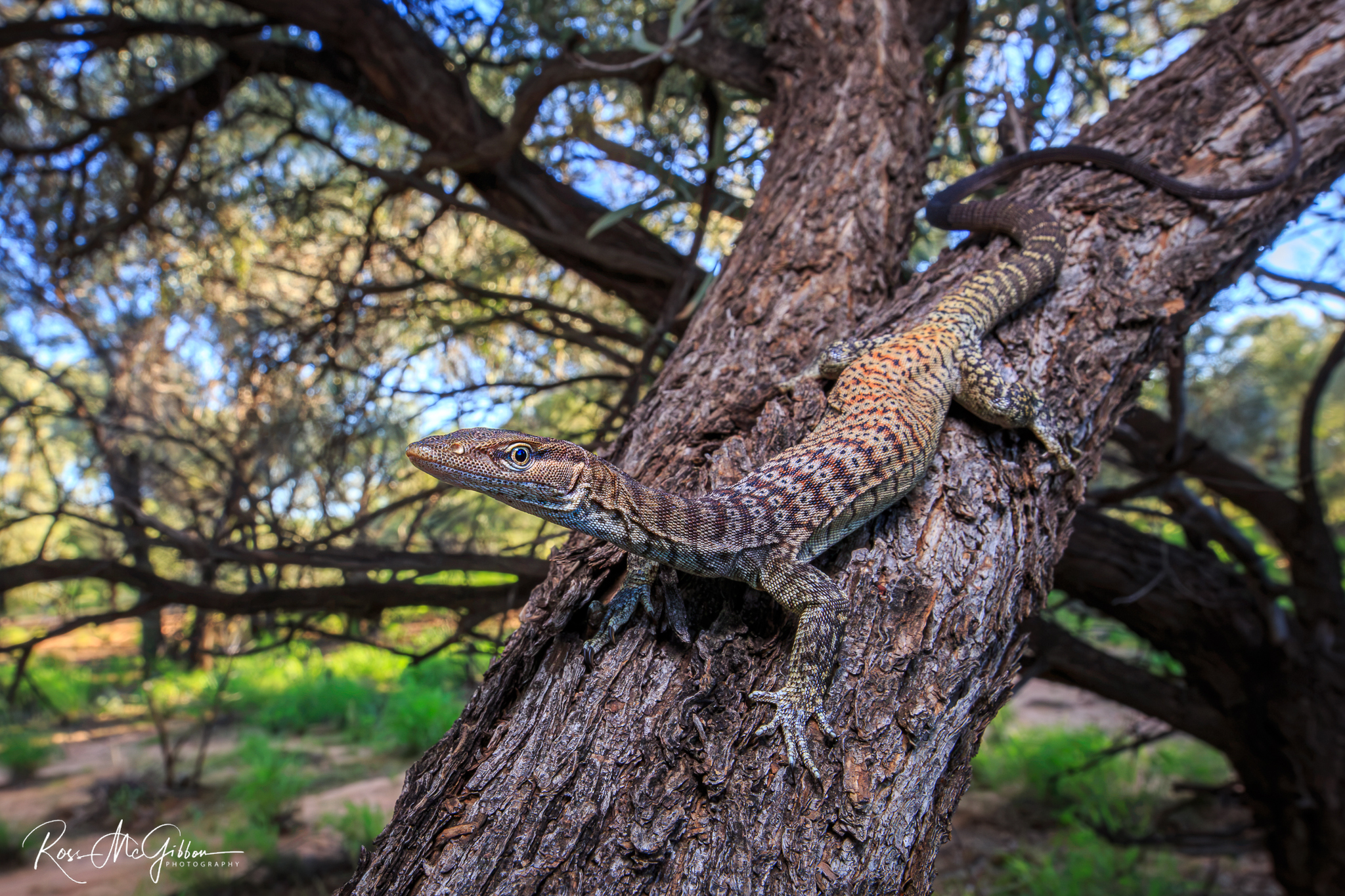
The striking freckled monitor (Varanus t. orientalis) that ran up Richie’s leg at Angus’ station near Stonehenge, QLD.
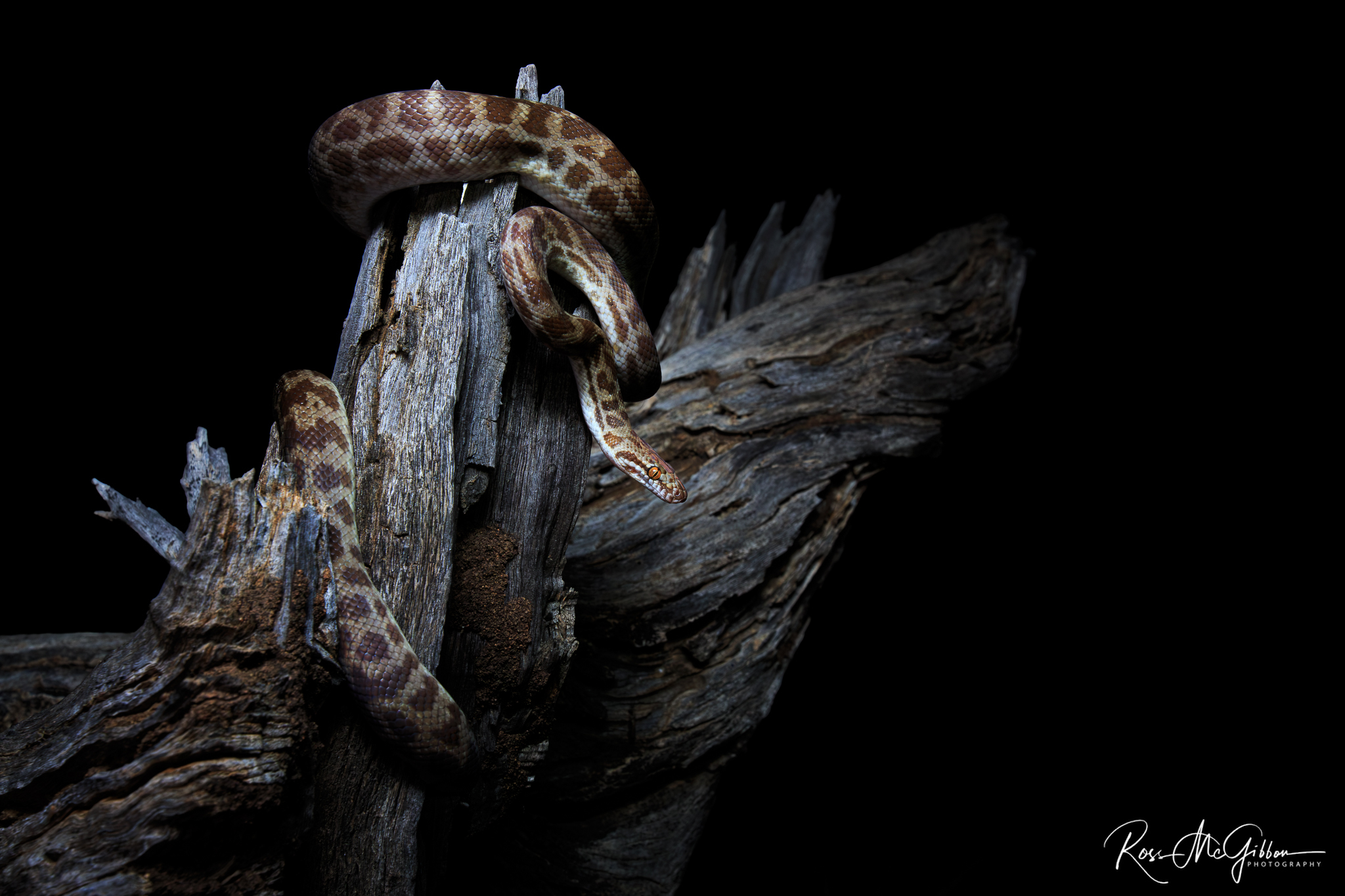
A Stimson’s python (Antaresia s. orientalis) now A. childreni from Angus’ station near Stonehenge, QLD.
The next morning, we bid farewell to Angus, Karen and Fergus and thanked them for their hospitality. Before leaving, Angus asked us a small favour. The staff at the local radio station in Longreach had spotted a brown snake in their office the day before and were desperate for Angus to come and search for it. Longreach was a long way to go for a snake callout, so Angus asked if we wouldn’t mind dropping in on the way through. The chances of it still being there were slim, but we agreed on the off chance it might be a speckled brown.
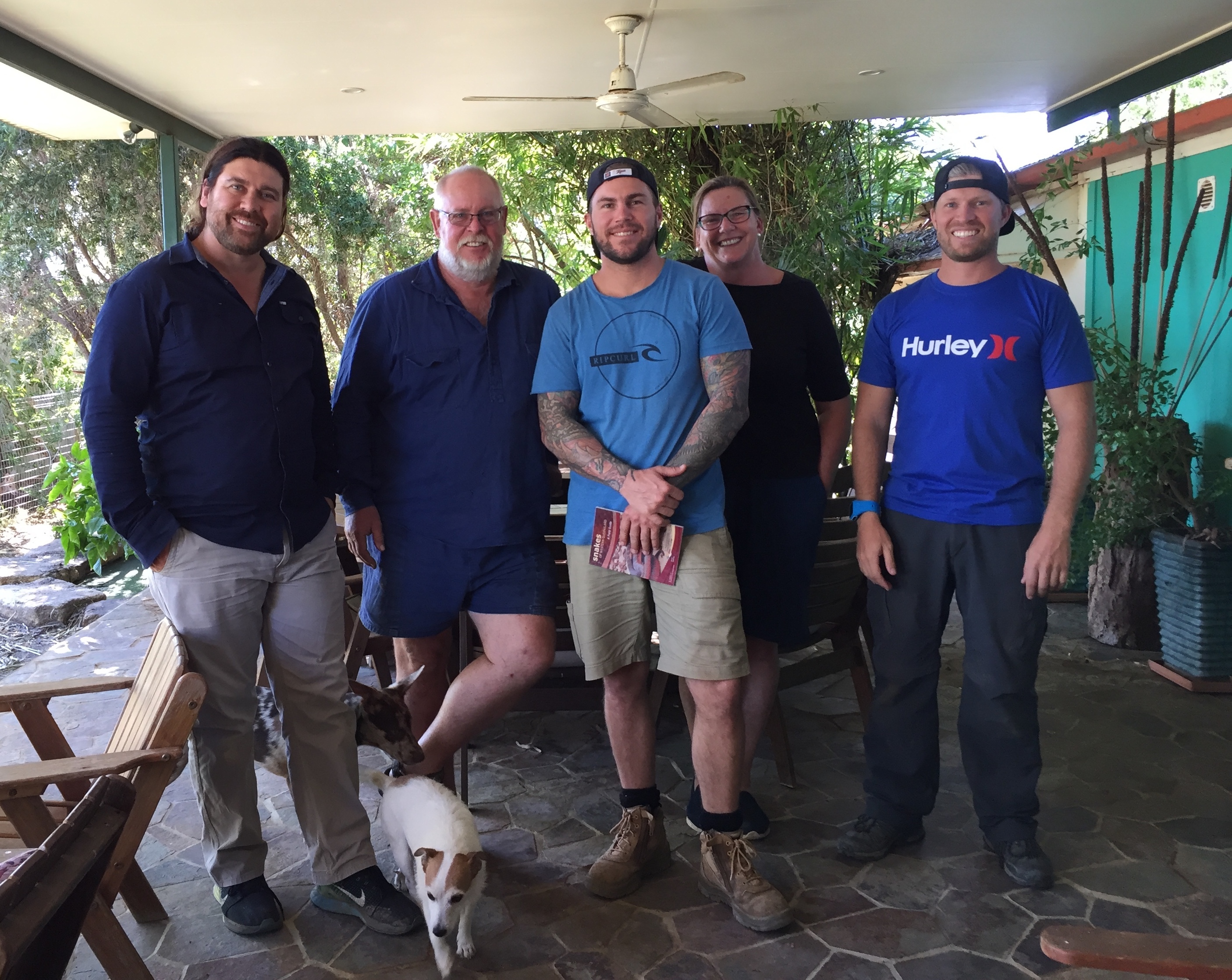
A worthwhile stop-off to visit local legend Angus Emmott. From left: Dan, Angus, Ross, Karen and Richie.
When we arrived, the staff were extremely pleased to have not one, but three crazy snake-loving blokes there to help search for their mystery brown snake. We came up empty-handed despite a thorough search, but at the very least, we gave them the reassurance they needed to continue working. Our next stop was Winton.
We arrived by mid-afternoon and met up with Steve, who was only just putting his clothes back on after a quick swim in a creek. As this was the first time Richie and Steve had met, we joked that they were now good mates after seeing Steve naked on their first introduction. Meanwhile, conditions were becoming ideal for afternoon snake activity. Dan and I teamed up and left Richie and Steve to get to know each other better, fully clothed of course.
To cover all bases, Dan and I road-cruised for active reptiles crossing or basking on the road, while Richie and Steve searched areas of high ground, targeting culverts, timber piles and any other places that might be harbouring snakes. By nightfall, a few Eyrean earless dragons were all Dan and I had seen, while Richie and Steve had come up empty-handed despite a solid effort.
After sunset, we kept the teams the same and picked a few roads we each wanted to work, looking for nocturnal species. We kept in touch throughout the night, but there wasn’t a lot of activity to report. By midnight, Richie and Steve had turned up the most species, including a bandy-bandy, an eastern hooded scaly-foot, a few orange-naped snakes and an eastern brown snake. Meanwhile, Dan and I had struck out, finding only two eastern hooded scaly-foot lizards and a few common Gehyra geckos. With the area not really firing, we called it off around 2 am and got some rest for the next day.
A nicely patterned eastern hooded scaly-foot (Pygopus schraderi) with beautiful facial markings near Winton, QLD.
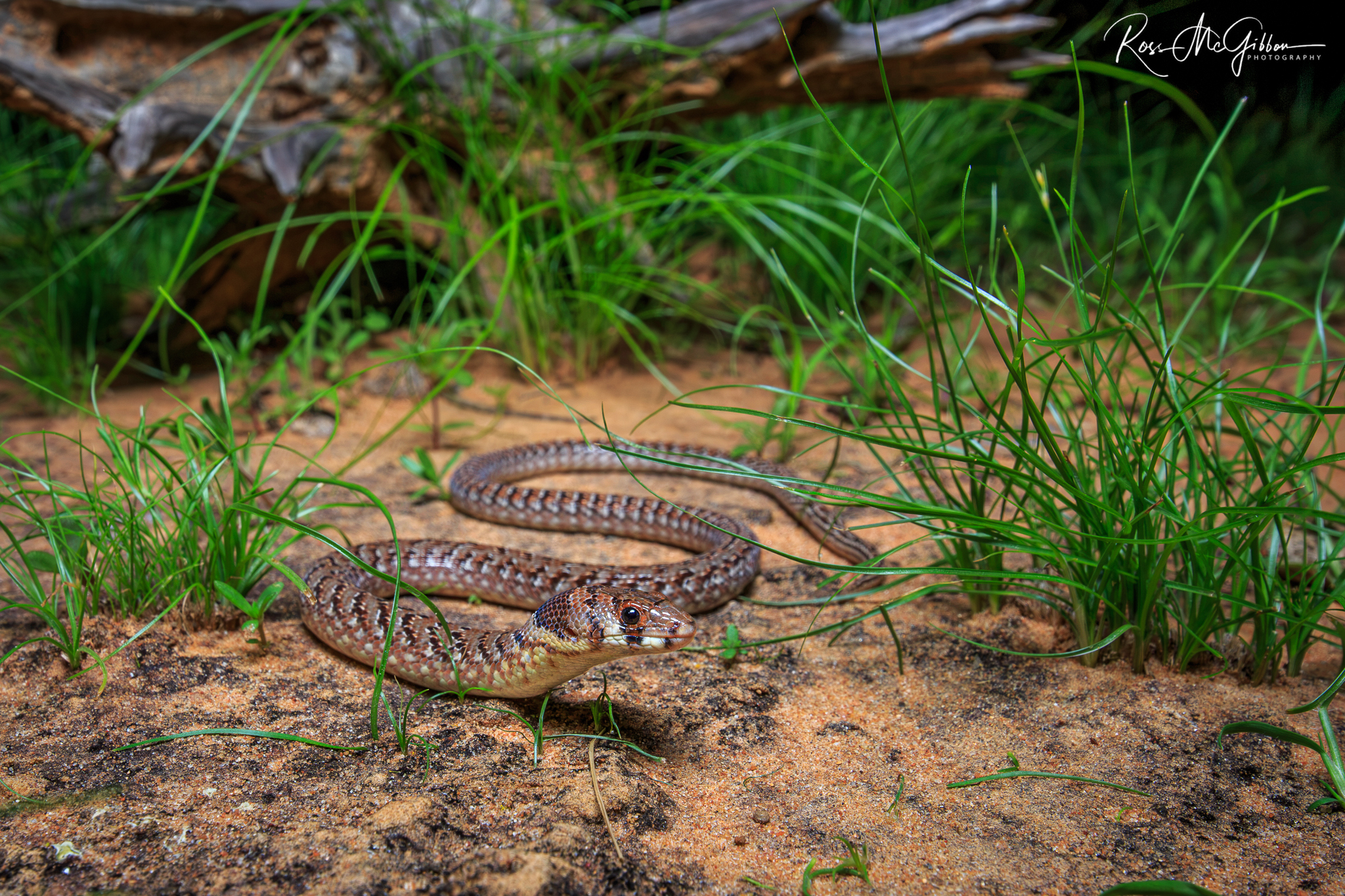
Another intricately patterned eastern hooded scaly-foot (Pygopus schraderi) near Winton, QLD.
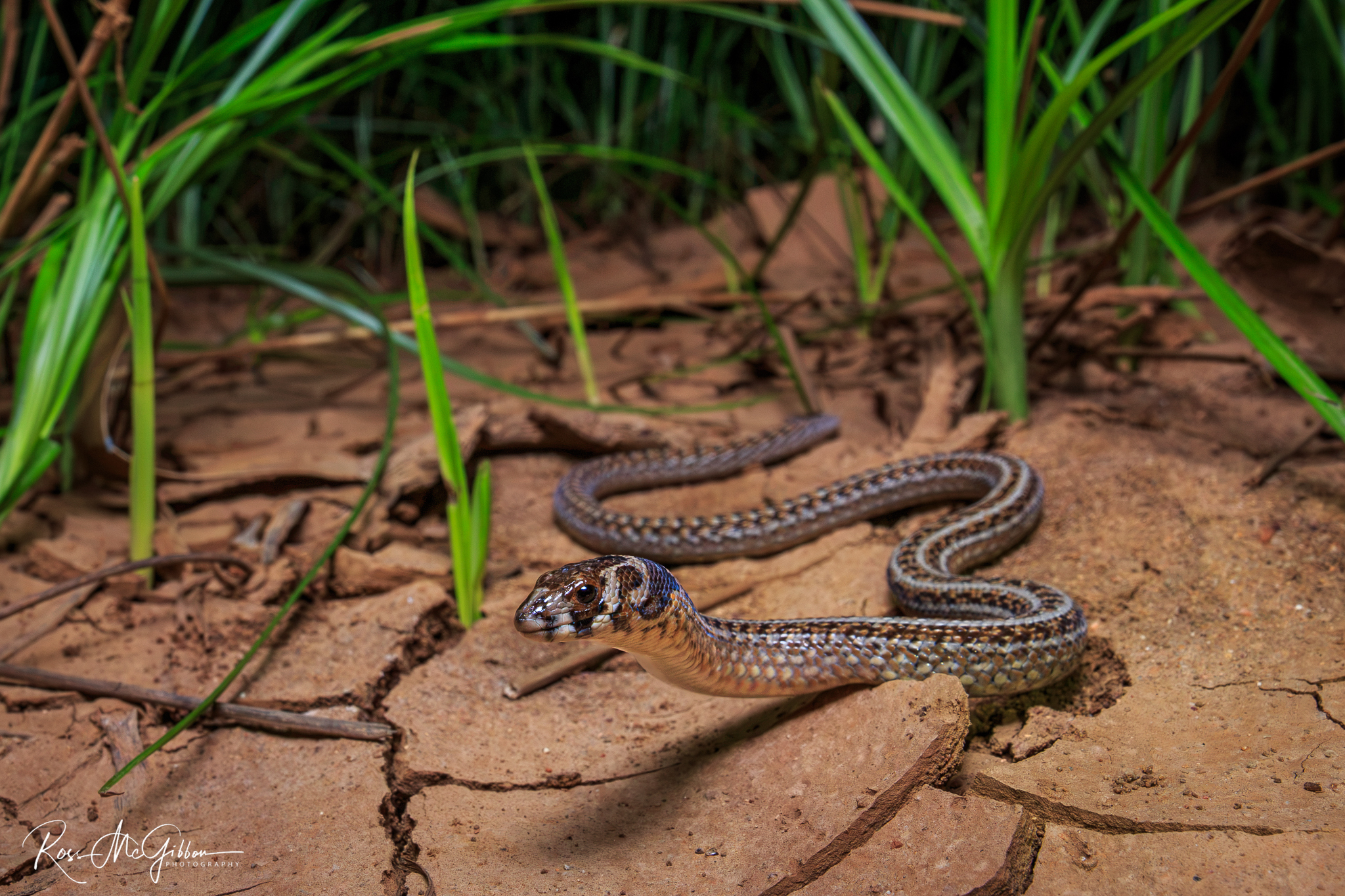
I woke just before sunrise to answer the call of nature, grabbed some toilet paper and made my way down to a dry creek bed. After finishing, I reached down to pull up my pants and, to my surprise, there was a De Vis’ banded snake lying perfectly still next to my foot. I’ve spotted reptiles while having a number one before, but this was the first time it had happened while taking a number two. Over breakfast, I informed the guys of my surprise encounter. Steve wittily replied, ‘Hey, maybe that’s why they’re also called mud adders, ha ha.’ Following a quick breakfast, we packed up camp and recommenced our search for a Collett’s. Dan and I opted to cruise the roads again, while Steve and Richie decided to part piles of old railway sleepers on the high ground, looking for any reptiles still sheltering in them after the flooding.
The prime time for snake activity passed without Dan or me seeing a single one. Around 10:30 am, we spotted a dam and decided to take a look for any speckled browns that might be hunting frogs around the banks. As we approached, we noticed a reptile, but it wasn’t a snake. It was a Downs bearded dragon. We were extremely happy to encounter this charismatic little lizard, as it was a new species for both of us. As we approached, the beardy tried to evade us by darting a few metres across the shallows to a small island, where it hid in a bush, so I volunteered to go in and retrieve it. I removed my boots and entered the muddy water. After a few steps, I sank up to my knees in sticky brown mud and immediately regretted my decision. I struggled over to the lizard and removed it from the spikiest bush imaginable. I emerged from the dam and attempted to walk a few metres over to Dan, only to realise that the ground was covered in cat-head prickles. ‘We better get a bloody good shot of this thing,’ I said to Dan as I picked several out of my feet.
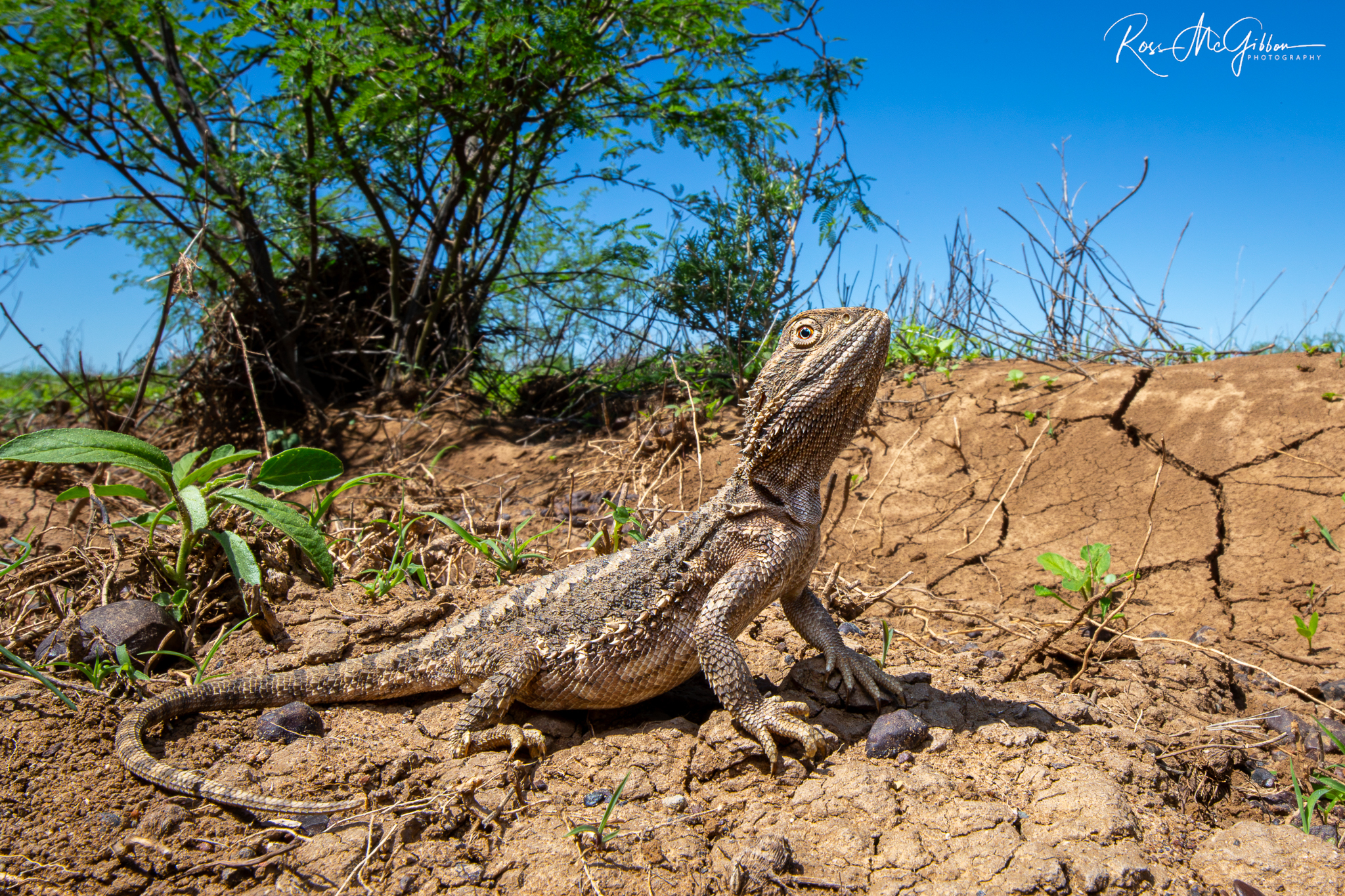
The cheeky Downs’ bearded dragon (Pogona henrylawsoni) that had me fighting through mud and picking doublegee, or cat’s-head prickles, out of my feet after catching it.
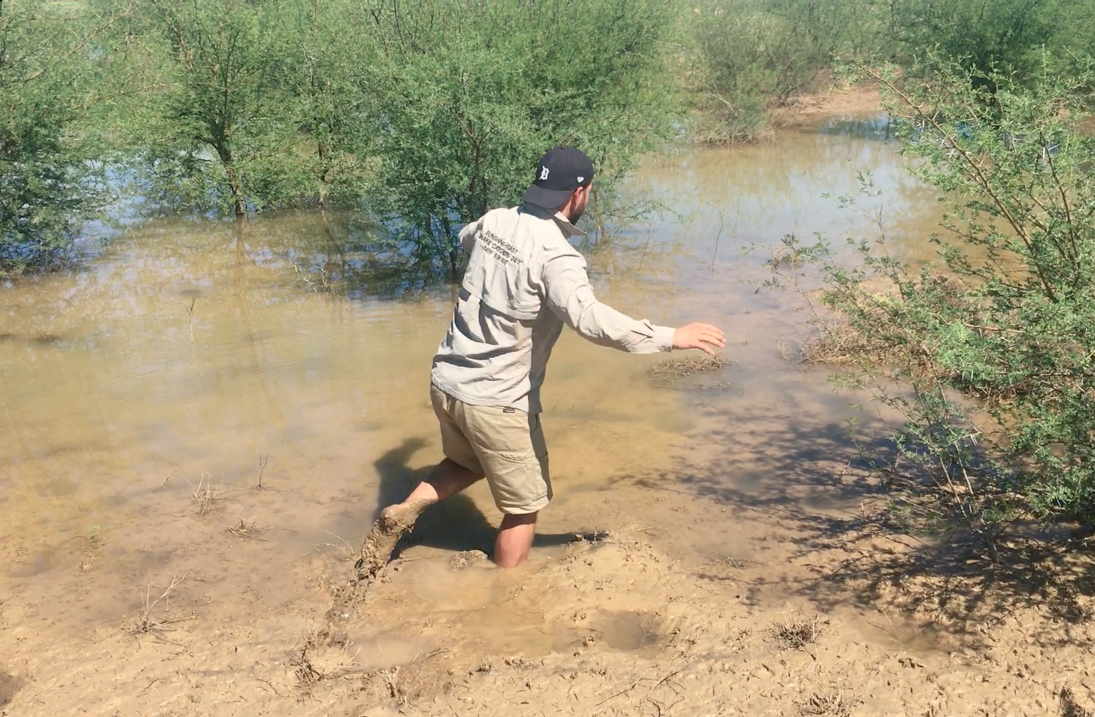
Me, struggling through the mud to reach a Downs’ bearded dragon.
Following our encounter with the beardy and an otherwise dismal morning of reptile activity on the roads, Dan and I met up with Steve and Richie to help them search through more sleeper piles. So far, they had uncovered a few different species, including a Stimson’s python, a De Vis’ banded snake and a yellow-spotted monitor. As we approached the next pile of sleepers, I noticed the tail of a brown-coloured snake slip quietly back into the sleepers. I knew it wasn’t a Collett’s, but there was a good chance it might be a speckled brown. We eagerly parted the pile, only to discover it was another eastern brown. Even though they were such a common snake, I decided to photograph this individual beside the sleepers to document how reptiles were utilising them as a source of shelter, particularly after the flooding when they may have provided some of the only available shelter on high ground.
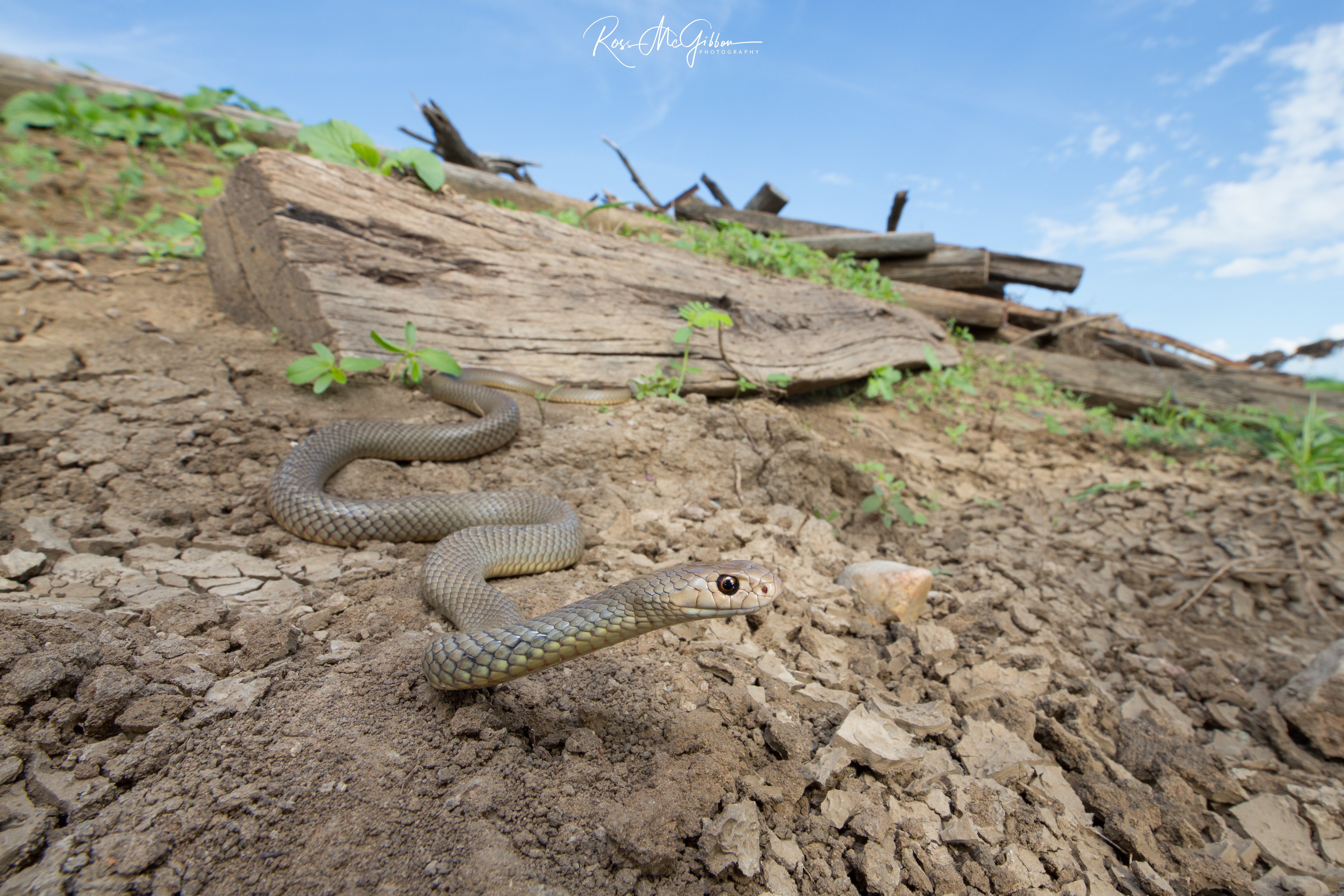
An eastern brown snake (Pseudonaja textilis) near Winton, QLD. One of many reptile species utilising piles of old railway sleepers for shelter on high ground during the flooding.
On the way back to the cars, we discussed the obvious lack of reptile activity in the area despite the weather conditions being ideal. We agreed it wasn’t producing enough to warrant persisting any longer and decided to move on to our next location a few hours’ drive northwest. It appeared that the region had been too heavily affected by the recent flooding, with reptiles either still bunkered down, displaced, or simply yet to return to their normal habits. We went with our gut feelings and moved on. About an hour and a half out of Winton, Dan and I noticed several road-killed speckled browns spread over a distance of about 15 km. They were the nice pinkish-orange colour form too. ‘Let’s GPS these locations and we’ll hit this area tomorrow,’ said Dan.
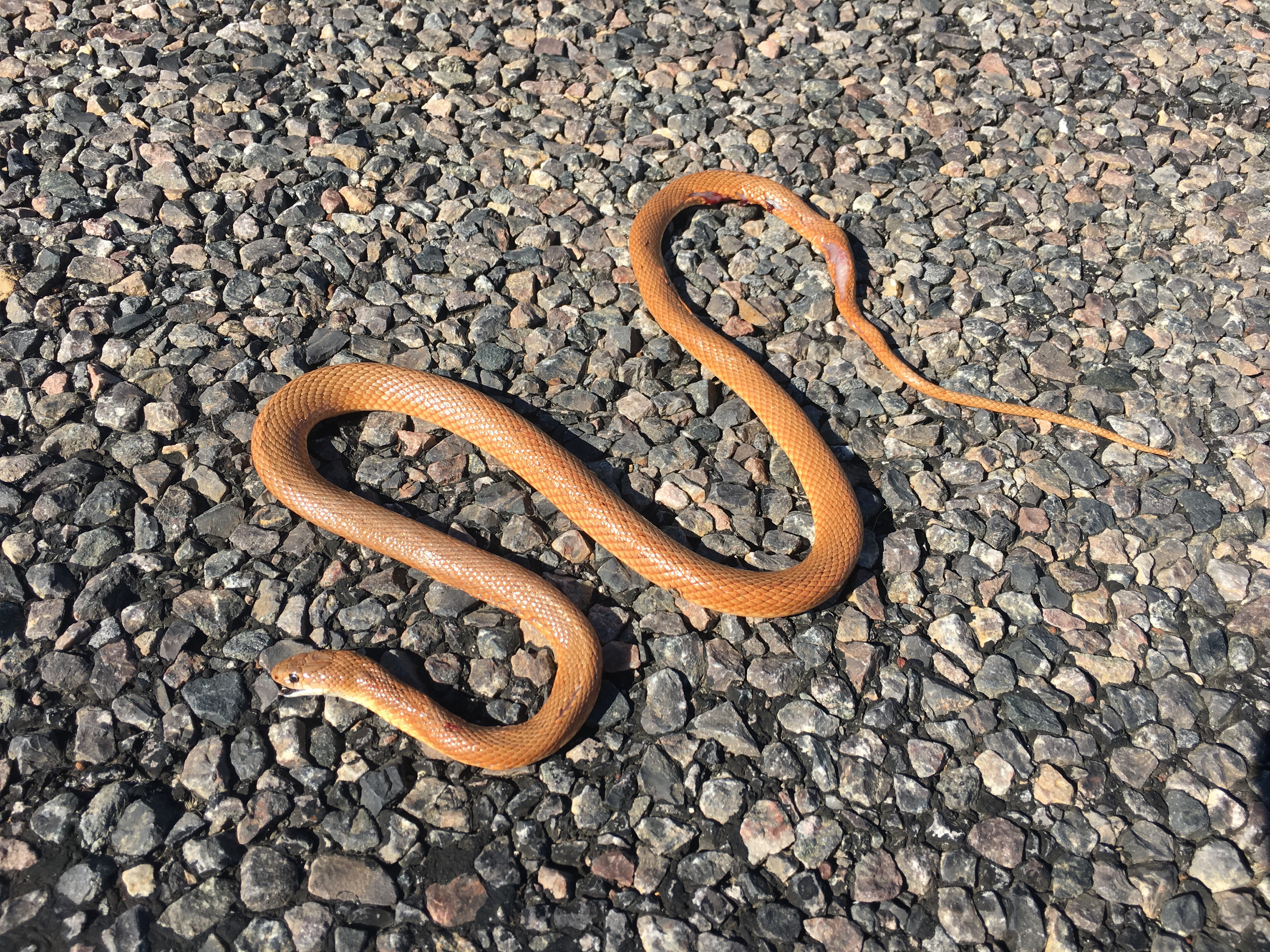
Always disappointing to find your target species as roadkill. However, these records can provide useful data for identifying areas worth targeting for live animals.
We arrived at our next spot just before sunset. Within minutes, we were driving around more Eyrean earless dragons than we could count. A few more kilometres on, we added several centralian blue-tongues and another Downs bearded dragon to our tally. It appeared the area had received the perfect amount of rain to stimulate the wildlife. With the temperature still hovering around 30°C that evening, we had a feeling we were in for a good night of herping. Our predictions proved correct, and we turned up a diverse range of reptile species over the course of the night, including several Stimson’s and black-headed pythons, an unbanded shovel-nosed snake, a few eastern hooded scaly-foots, a big olive python and numerous curl snakes, one of which was a monster at around 85 cm. Unfortunately, the elusive Collett’s snake didn’t show itself, but the area was clearly firing and the weather predictions were just as good over the next few days. This boosted our confidence that we might find one yet.
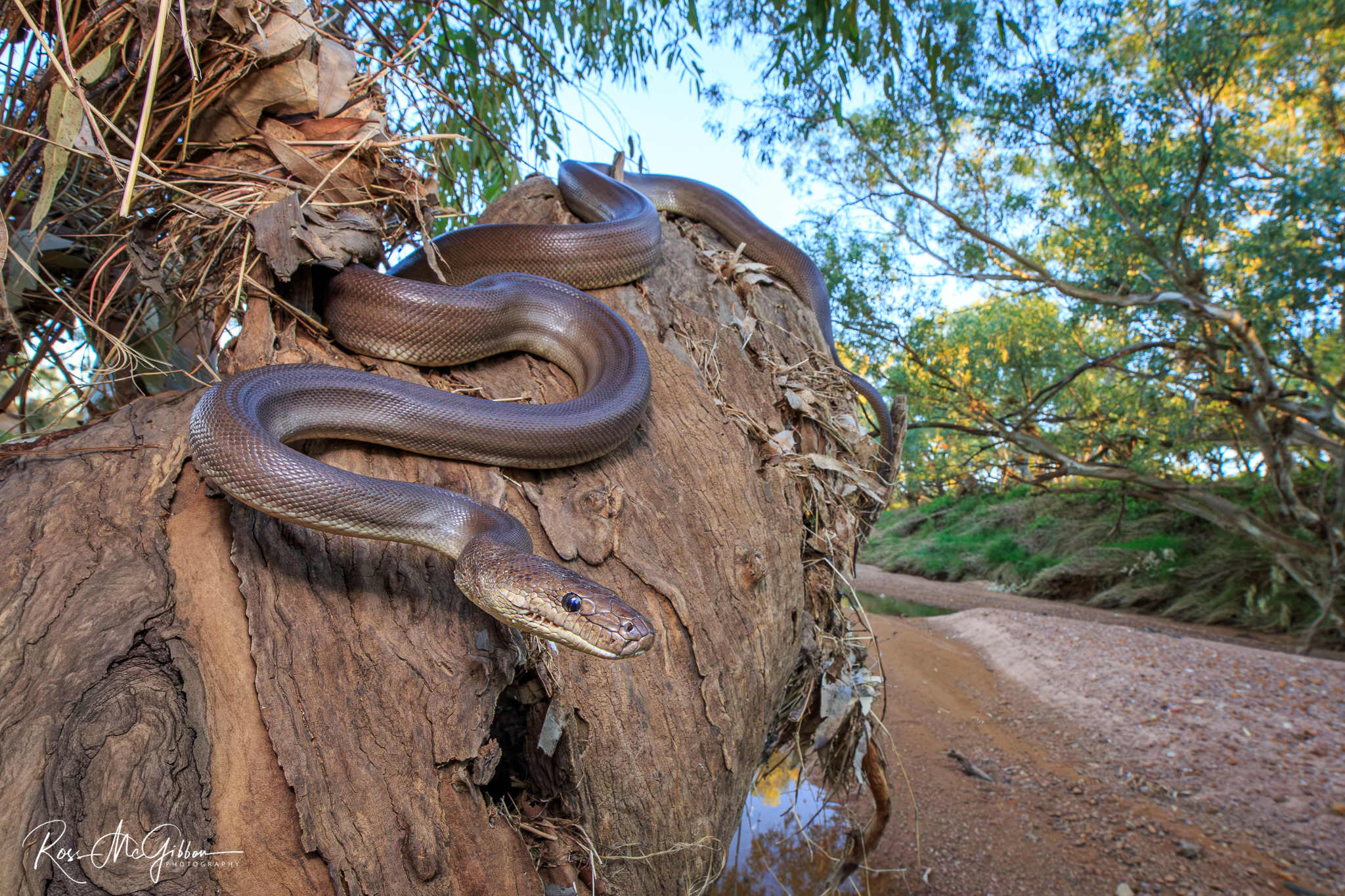
In regions that have been heavily cleared for agriculture, riparian environments provide olive pythons (Liasis o. olivaceus) with vital resources such as food, water and shelter.
As the temperature dropped, the reptile activity diminished, so we called it quits around 1 am. We needed to find somewhere to camp for the night, so we followed a random dirt road for a few kilometres to a river and set up camp on the bank. Still on a high from a solid night of herping, we drank a few beers before bed. It was almost 2 am when we noticed the headlights of a vehicle coming down the road towards us. Rather than continuing past, the car angled towards us and stopped, lighting up our camp with its headlights. After a few minutes, the driver still hadn’t exited the vehicle and I started to imagine a scene from Wolf Creek unfolding. We couldn’t just sit there like deer in the headlights all night, so Dan and Richie offered to investigate. After a brief chat with the driver, the car slowly drove away. Dan and Richie returned to their seats and informed Steve and me that it was just a drunk farmer coming home from the pub. Apparently, we were camping on his property, but he agreed to let us stay after Dan explained that we were wildlife photographers and would be gone in the morning.
The next morning, I jumped in the car with Richie while Steve hopped in with Dan. We each chose a direction and began our morning reptile run. It wasn’t long before Richie got my adrenaline going by yelling, ‘SNAKE!’ It was a blacksoil whipsnake, but by the time we pulled over, it was long gone. In black soil habitat, you have to be quick, otherwise they are off the road and down a crack in the soil before you have a chance to pull over. We slowed down a little so we wouldn’t overshoot any more snakes. A few kilometres farther on, a long dark shape appeared on the road. At around 1.5 m long, it was unmistakably a large elapid. We exited the car and rushed over, only to realise it was another eastern brown.
The remainder of the morning didn’t produce any new species for Richie and me, so we headed to a nearby pub to meet up with Dan and Steve for lunch. Before heading inside, however, I spotted a juvenile yellow-spotted monitor confidently foraging around the grounds at the back of the pub. Yellow-spotted monitors weren’t a new species for me, but this was the smallest individual I had ever seen in the wild, so I took the opportunity to photograph it. It was completely unfazed by our presence as it confidently worked its way around the grounds in search of a meal.
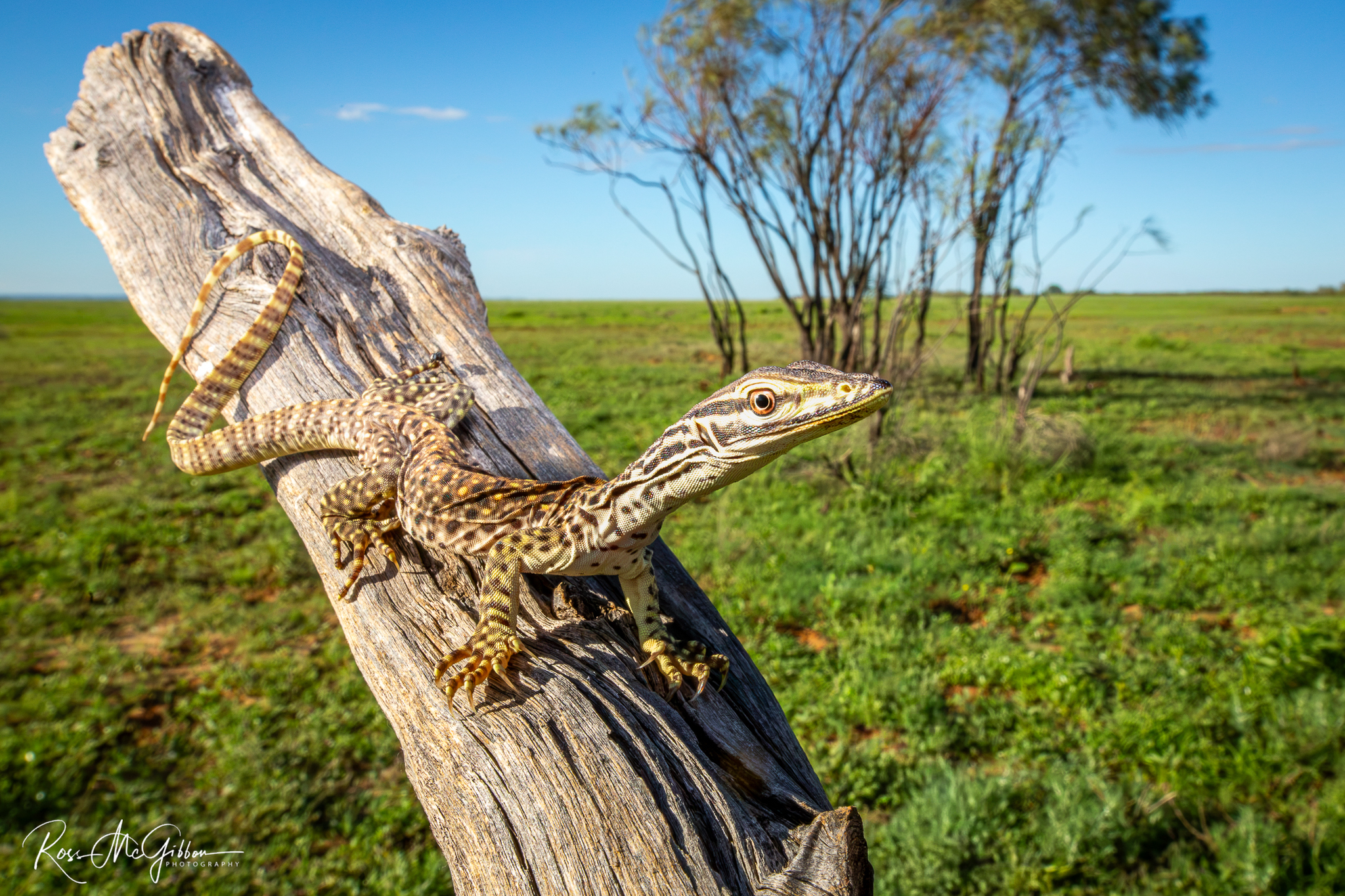
A tiny yellow-spotted monitor (Varanus panoptes) found confidently foraging around the grounds behind the pub near McKinlay, QLD. Not a new species for me, but the smallest individual I’ve encountered in the wild.
Over a beer, Dan filled us in on their eventful morning. Shortly after leaving us, they had spotted a yellow-bellied sheath-tailed bat caught in a barbed-wire fence. They sacrificed an entire morning of herping to track down a wildlife carer for the bat, as well as convince the nurse at the local medical centre to give them a syringe so they could rehydrate the poor thing. She was reluctant because they ‘might use it for drugs’. I joked that Dan was a pretty wholesome-looking guy, but looking at Steve, I could see she had a point.
Apart from offering a good place for lunch and a beer in the heat of the day, the pub also had air-conditioned rooms. We booked a couple for the night, which ensured we wouldn’t have any more Wolf Creek scenarios at two in the morning. Over lunch, we planned out the remainder of the afternoon. Richie and Steve were keen to herp north towards Julia Creek, while Dan and I opted to check out Combo Waterhole, the billabong referred to by Australian poet Banjo Paterson in his famous Australian ballad, Waltzing Matilda.
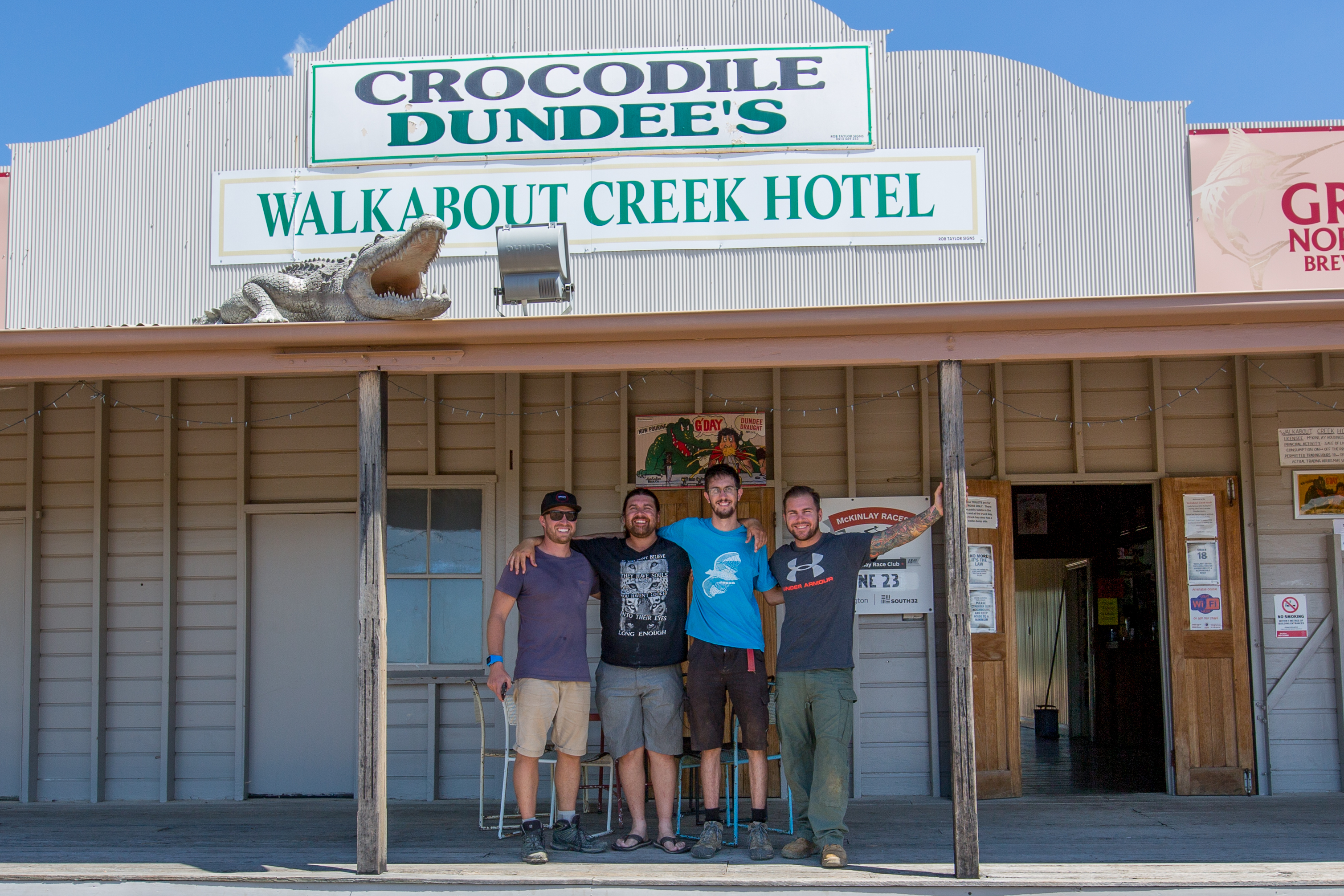
The ‘Collett’s crew’. From left: Richie, Dan, Steve and Ross, at the Walkabout Creek Hotel, where scenes from the iconic Australian film Crocodile Dundee were filmed.
On the way to the waterhole, we noticed a monitor lizard crossing the road. ‘Yes, it’s a Spencer’s!’ yelled Dan. The Spencer’s monitor was our target monitor species for the trip, and this was the first live individual either of us had seen in the wild. We pulled over and got out for a closer look. As we approached, the monitor took off across a paddock and settled behind a small bush. When we caught up, it took a different approach. This time, it stood high on all four legs, hissed loudly and whipped at us with its tail. After capturing some footage of its impressive defensive behaviour on my phone, I left Dan to keep an eye on it while I retrieved our cameras from the car.
When I returned, Dan was on his hands and knees filming it on his phone. He looked up at me and said, ‘Hey Rossco.’ He then leaned over to one side, angling his butt towards the lizard. Right on cue, the monitor tail-whipped Dan across the butt, to which Dan replied, ‘Yeah baby.’ The timing was flawless, and it had me in fits of laughter every time I thought about it throughout the rest of the day. After photographing the Spencer’s, we continued on to Combo Waterhole and soaked up a bit of iconic Aussie history.
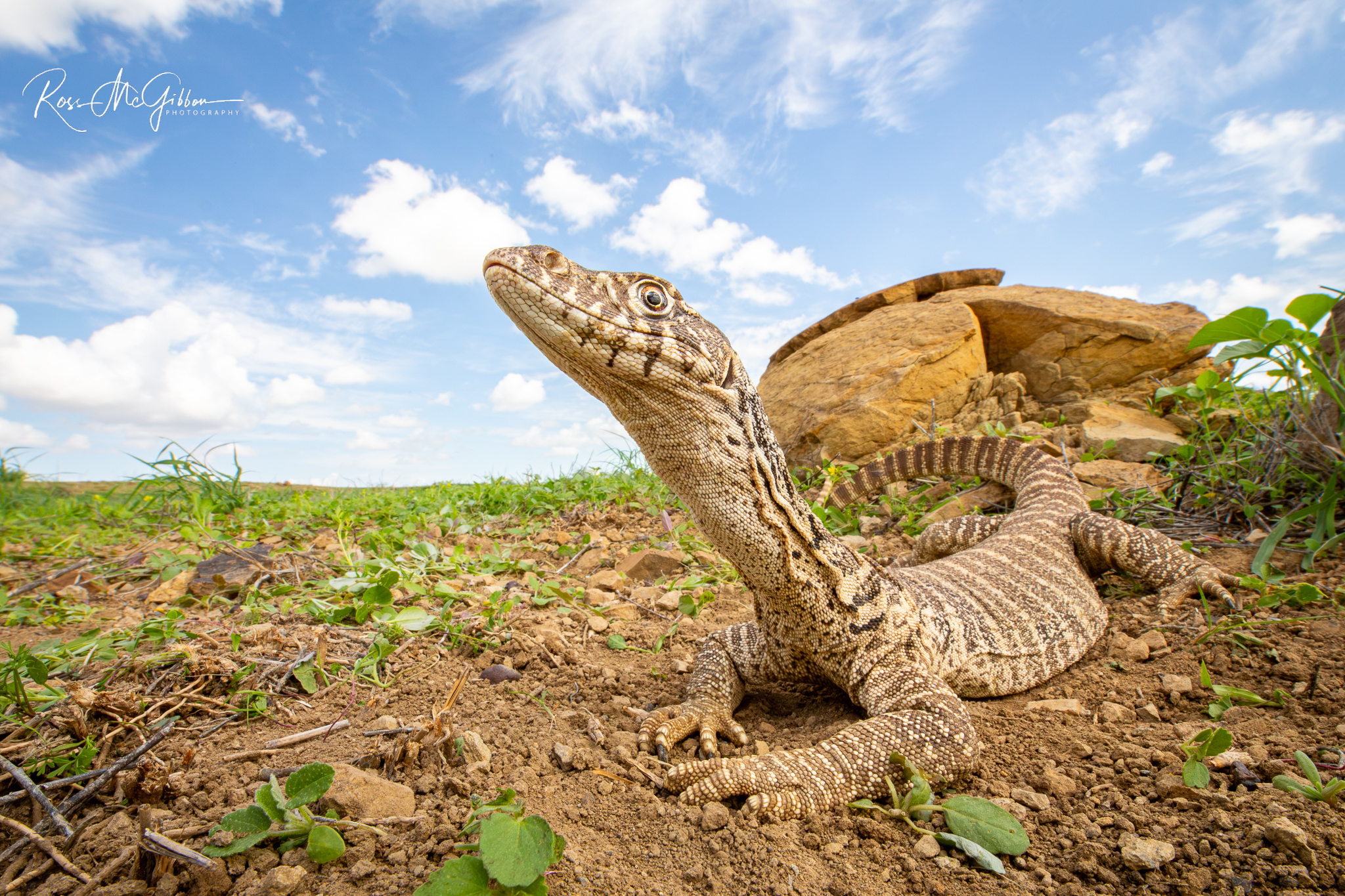
Spencer’s monitors (Varanus spenceri) are a handsome species of terrestrial monitor endemic to the black soil plains of inland QLD and the NT. Photographed near Kynuna, QLD, this was one of the main targets of the trip.
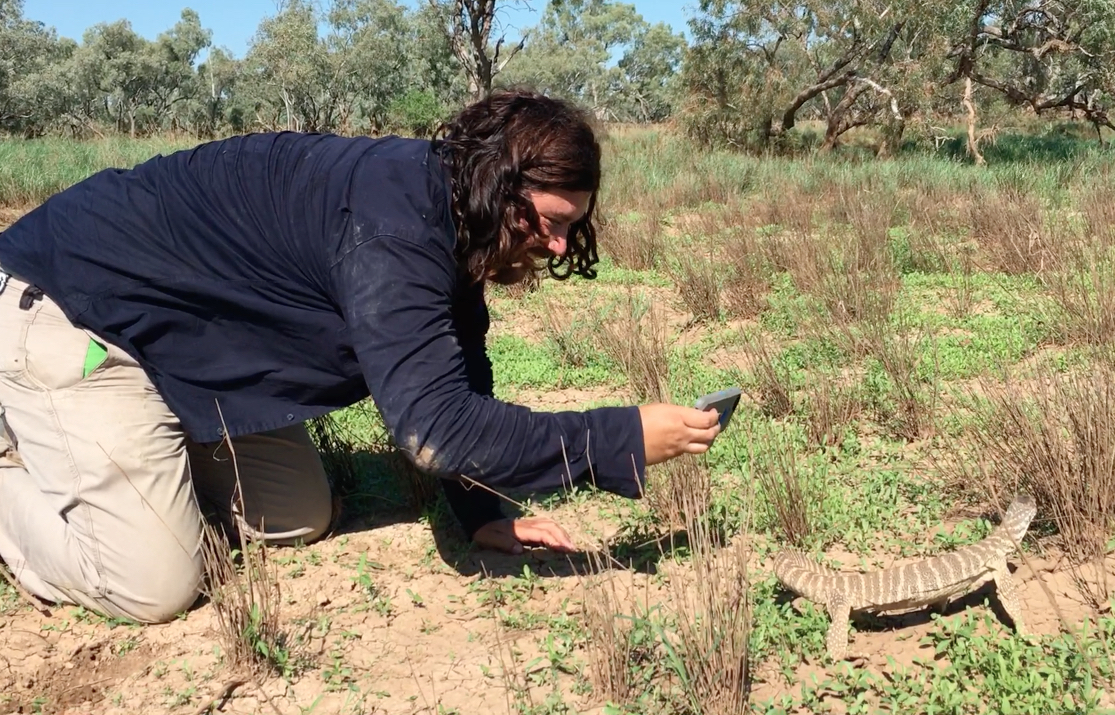
Dan capturing video footage on his phone of the defensive behaviour of a Spencer’s monitor.
On the drive back that afternoon, we patrolled the stretch of road where we had taken the GPS coordinates of the road-killed speckled browns the day before. Twenty minutes into our search, Dan hit the brakes for our first snake. It was the pinkish-orange form of speckled brown, but we overshot it and, within seconds, it was off the road and into the grass. We slowed down and focused intently on the road ahead. It was a warm afternoon, so we needed to stay alert if we were going to get to one before it disappeared into the grass. A few minutes later, we were on to another speckled brown. To our amazement, it was the stunning pale-cream, banded form we most wanted to photograph. I got to it as fast as I could, but it was quick to get off the road. I frantically tried to track where it had gone, but the grass was too thick and there were too many soil cracks for it to escape into. I cursed all the way back to the car and then some.
Only minutes later, speckled brown number three was in sight, and this one wasn’t as quick to get off the road. On closer inspection, it unfortunately turned out to be the least attractive colour form, the plain tan. Having already found three in such a short time, we gambled that we’d find a better-looking one to photograph and moved on. Twenty minutes passed and I was beginning to worry we wouldn’t find another. Suddenly, Dan slammed on the brakes for speckled brown number four. It was a nice pinkish-orange one, and this time I got to it before it could escape into the grass. For safety reasons, and so we wouldn’t lose it, we repositioned it away from the road and took a series of shots. I included part of a nearby fence in the background, still covered in flood debris, to help tell the story of the recent flooding.
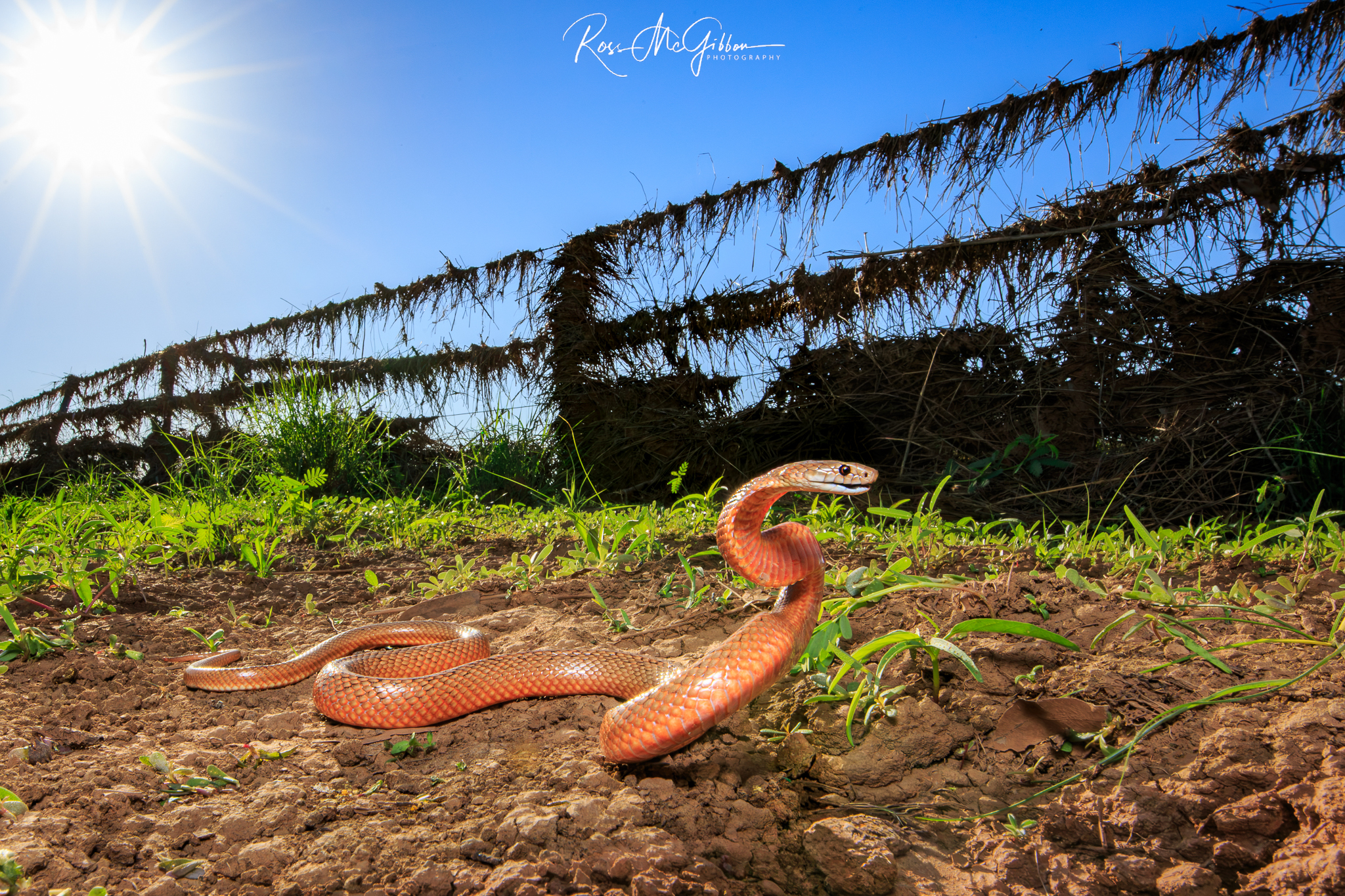
Speckled brown snakes (Pseudonaja guttata) come in three distinct colour forms. Above is the pinkish-orange form found near Kynuna, QLD. Evidence of the recent flooding persisted on fences throughout many low-lying areas. One of my favourite images from the trip.
Following a successful photo shoot, we headed back to the rooms to meet up with Richie and Steve. They hadn’t had any luck and were a little bummed that we had found a Spencer’s and the speckled browns without them. To ease their minds, we promised to take them back to the spot the next morning. For now, the sun wasn’t far from setting, and it was time to recommence our search for a Collett’s.
The temperature was hovering around 30°C, ideal for reptile activity. Our afternoon began almost identically to the day before, with us dodging a myriad of Eyrean earless dragons soaking up the last of the warmth on the road. As the sun dipped below the horizon, our headlights picked up part of a snake with vivid bands along its body, foraging among the grass on the side of the road. We all got really excited, thinking it was a Collett’s, until the snake revealed itself to be a black-headed python. We pushed on, and it wasn’t long before Steve got our adrenaline going again by yelling, ‘Snake!’ Excitement levels went through the roof as we realised our eyes weren’t playing tricks on us. It was exactly what we had come all this way for: the Collett’s snake.
We poured out of the car and rushed over for a closer look. After years of hoping to see one in the wild, months of planning, and a lot of hard work and effort over the course of the trip, we were finally able to appreciate how amazing these snakes are in their natural environment. To make things even better, this individual was in great condition and as vibrantly patterned as they come. We each had smiles from ear to ear and celebrated our achievement with plenty of high fives and the manliest of hugs.
Due to the number of road trains regularly barrelling down the road, we repositioned the snake a safe distance from the road to photograph it. I asked the guys if I could go first because I wanted to attempt to capture the remaining colour in the sky. The snake started out quite defensively, with a temperament similar to what you would expect from the closely related mulga or spotted black snake. As it got darker, it wasn’t able to see us as well and, to our surprise, completely relaxed and began to sit perfectly still. I took this rare opportunity to attempt a long-exposure shot. With the shutter speed slowed down, I succeeded in capturing the remaining colours in the dusk sky, illustrating the time of day when Collett’s snakes become active in warm weather.
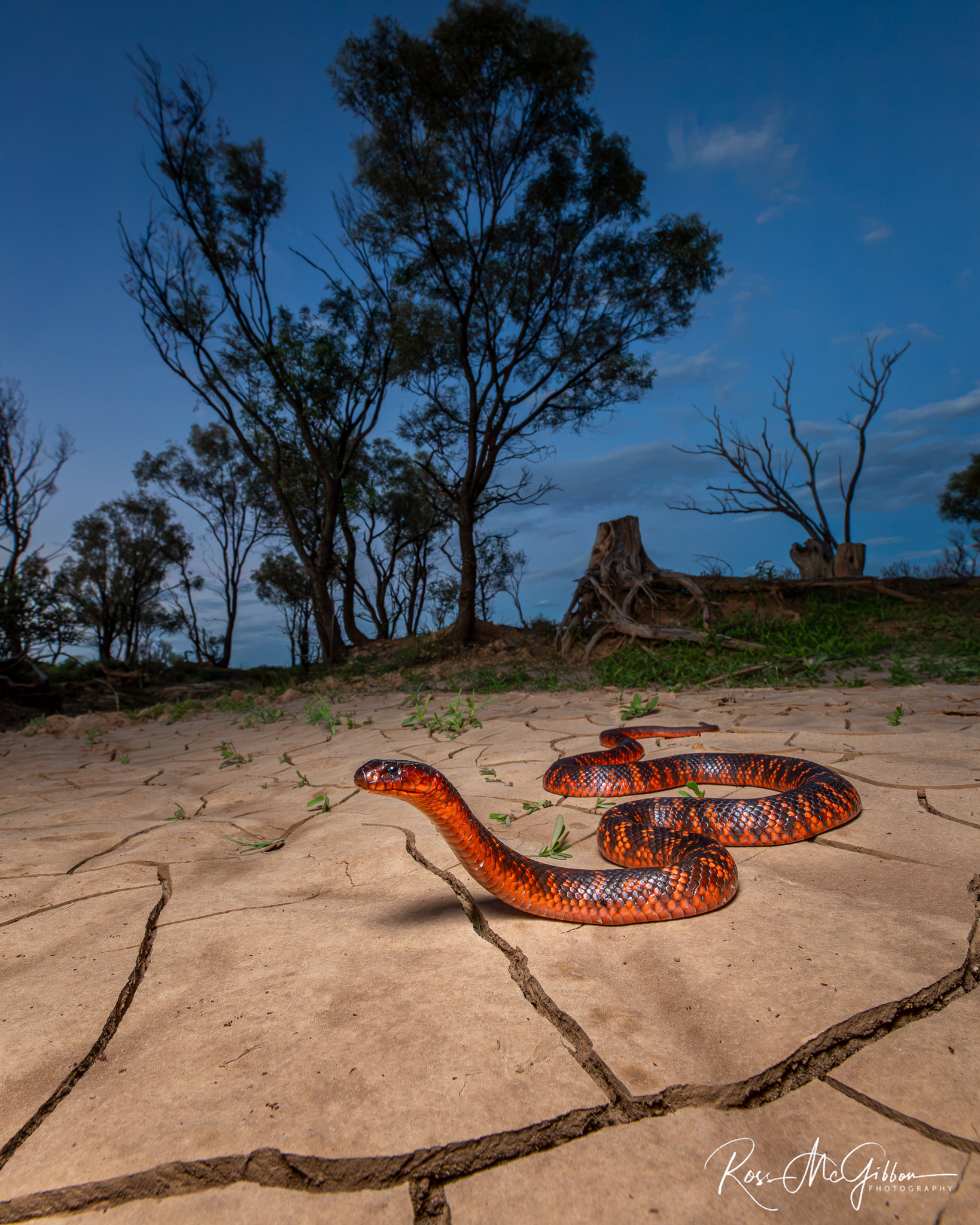
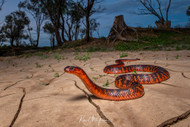
The Ruby of the Black Soil: the prized Collett’s snake (Pseudechis colletti) from the black soil plains of Central Western QLD, and the species that sparked our desire for the entire trip.
After capturing some good photos of our prized Collett’s, we returned it to where we had found it and said goodbye to a species we may never be lucky enough to see in the wild again. Once the encounter was over, the feelings of anticipation that had fuelled such a big effort to find this species were replaced by a sense of pure accomplishment, the kind you can only experience when you have found a species as rare and beautiful as this. The Collett’s snake is truly the Ruby of the Black Soil.