
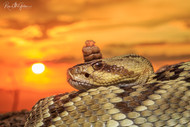
Crotalus, Cactus & Coronas: Arizona, Here We Come
Posted by Ross McGibbon on 31st Mar 2020
Originally published in the Australian Herpetological Society’s Red Bellied Courier in 2020, this article recounts a week of herping across Arizona with my mate Dan Bromley. From encountering my first Sonoran Sidewinder to finding a wild Gila Monster and photographing a Black-tailed Rattlesnake beneath an Arizona sunset, the trip delivered unforgettable encounters with the reptiles of the American Southwest.
Crotalus, Cactus & Coronas: Arizona, Here We Come
By Ross McGibbon
After months of anticipation, we arrived in Los Angeles and collected our hire car. “So, what are your plans while you’re here?” the desk clerk asked. I opened my mouth to respond, but Dan quickly chimed in, “We’re here for a road trip and to see some sights.” Wanting to avoid the clerk thinking we were clinically insane, we kept the part about chasing rattlesnakes to ourselves.
“Just wait until you see how amazing the habitat is in the desert, and even better, your first rattlesnake,” Dan said excitedly as the concrete jungle of L.A. disappeared into our rear-view mirror. On the drive, we outlined a rough plan for our week and discussed which species we were hoping to find. It was the middle of summer and the temperature was going over 40ºC every day. In this heat, rattlesnakes would be active in the early morning, late afternoon and at night. We decided to follow a similar routine and spend the middle of the day by the pool with a Corona beer.
Six hours after leaving L.A. we arrived in Phoenix. The first order of business was to check into our hotel and obtain the hunting licence required by the Arizona Game and Fish Department to legally capture reptiles. Like just about everything in America, it was as easy as popping down to Walmart.
The sun was an hour from setting when we arrived at our first herping location. Rocky hills peppered with cactus glowed in the afternoon sun. Dan wasn’t wrong when he said the Arizona desert was amazing. As I marvelled at the landscape, a wave of excitement rushed over me as I imagined all the photos that were possible in such a beautiful landscape. I couldn’t wait to find my first reptile. Unlike Dan, who had been here on multiple occasions, this was my first time in Arizona; every species of reptile would be a brand-new experience for me.
As we wound down a rocky range, I was snapped out of admiring the landscape when Dan hit the brakes for a lizard on the road. It was a Regal Horned Lizard (Phrynosoma solare). We performed a U-turn and raced back up the hill. To our amazement, the only car we had seen in the last hour came racing down the hill behind us, flattening the lizard before we could reach it. “You’ve got to be kidding,” I yelled at the car as it continued speeding down the hill.
Day gave way to night as we lapped the road looking for more reptiles. I cheered up when we spotted another Regal Horned Lizard on the road. This time, we got to it before any other cars did. On first impression, they looked like the love child of a thorny devil and a bearded dragon. Having grown up catching so many bearded dragons as a kid, I instantly grew fond of these charismatic little lizards.
Back in the car, Dan waged a friendly bet on which species of rattlesnake we would encounter first. The two most common species in this area were the Western Diamond-backed Rattlesnake (Crotalus atrox) and the Sonoran Sidewinder (Crotalus cerastes cercobombus). Dan opted for the diamond-back, while I went for the sidewinder. With the sidewinder’s unique horn-like supraocular scales and distinctive sidewinding locomotion, I anticipated seeing them the most.
Before long, our headlights picked up a snake on the road. “Gibbo, it’s a sidewinder,” said Dan. “You’re on the money.” Eagerly, I exited the car for a closer look. There was no hiding how excited I was as I gazed down at my first sidewinder. Suddenly, its rattle went off like a cicada on too much Red Bull. In the blink of an eye, it took off in its trademark sidewinding motion, darting across the road and changing direction abruptly whenever we got between it and its escape route.
After capturing some footage, we returned to the car, eager to see what would cross our path next. For the next few minutes I rambled on about how amazing sidewinders were, to which Dan replied, “You think they are impressive. Wait until a big diamond-back is staring you down. I’ll be surprised if we don’t come across one tonight. I was here around this time last year and the place was crawling with them.”
At 2am we decided to call it quits. The only reptile we’d seen in the last two hours was a little Spotted Leaf-nosed Snake (Phyllorhynchus decurtatus), one of the many non-venomous colubrids in the area. “It appears diamond-backs aren’t moving tonight, but don’t worry, we still have plenty more opportunities,” Dan said reassuringly. “They are the most common rattler on the right night.”
Early the next morning we were on foot, back among the cactus in search of any reptiles that were active before the sun sizzled most of them back into hiding. One of the species we hoped to find was the Desert Horned Lizard (Phrynosoma platyrhinos), the other species of horned lizard that inhabits this region.
It wasn’t long before we spotted a horned lizard, but the arrangement of cranial spines identified it as another Regal Horned Lizard. I picked it up for a closer look. Immediately, I felt something sticky shoot up my hand. I looked down to see the remnants of blood around each of the lizard’s eyes and two bright red streaks of blood on the back of my hand. I called out to Dan, “Come check this out.” Dan was excited and just as surprised as I was. The horned lizard’s ability to squirt blood from the orbital sinuses around its eyes is one of nature’s most unorthodox defence mechanisms, and very few herpers get to observe this in the field.
I later read that, out of a study sample of 65 horned lizards collected by William S. Parker in 1971, only three out of 65 squirted blood in defence during collection. We, on the other hand, were lucky enough to observe it from our second-ever lizard. After we captured some video footage, I snapped a few quick head shots of the lizard with my macro lens. We rinsed the blood from around its eyes, gave it some water and placed it back where we found it.
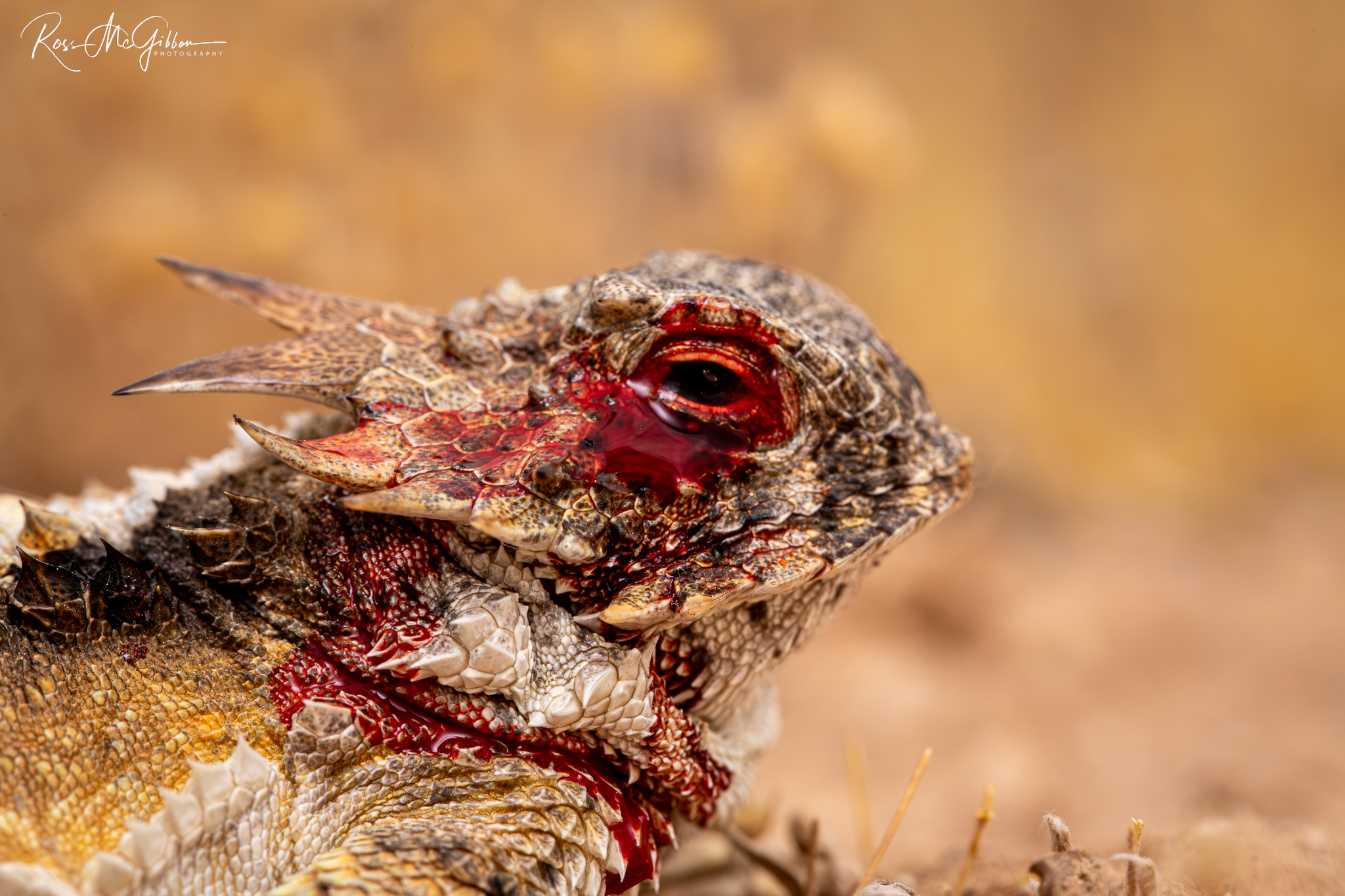
A Regal Horned Lizard (Phrynosoma solare) unleashes one of its most bizarre defensive tactics, squirting blood from its eyes.
Our next stroke of luck appeared in the form of another sidewinder. It was a little overcast, making the light ideal for photography, however, lying down in the exfoliated cactus prickles was another story. If the snakes weren’t able to penetrate your skin with their fangs, then the flora made sure it would find a way. Despite the hostile substrate, I managed to capture a nice wide-angle shot detailing the sidewinder in its natural habitat.
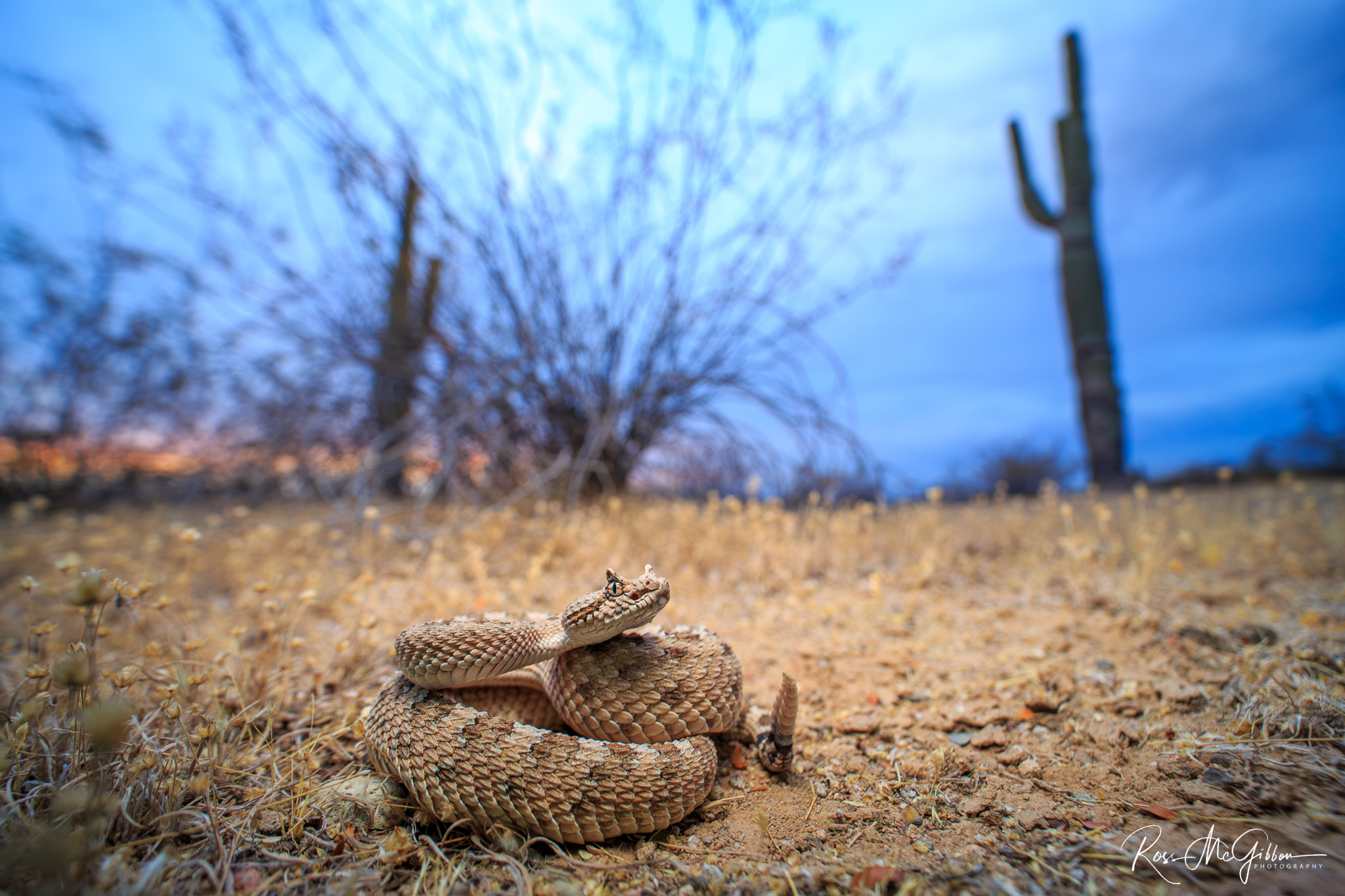
Above: A Sonoran Sidewinder (Crotalus cerastes cercobombus) beneath the soft, diffused light of an overcast Arizona sky, nicely framed against the rugged desert landscape.
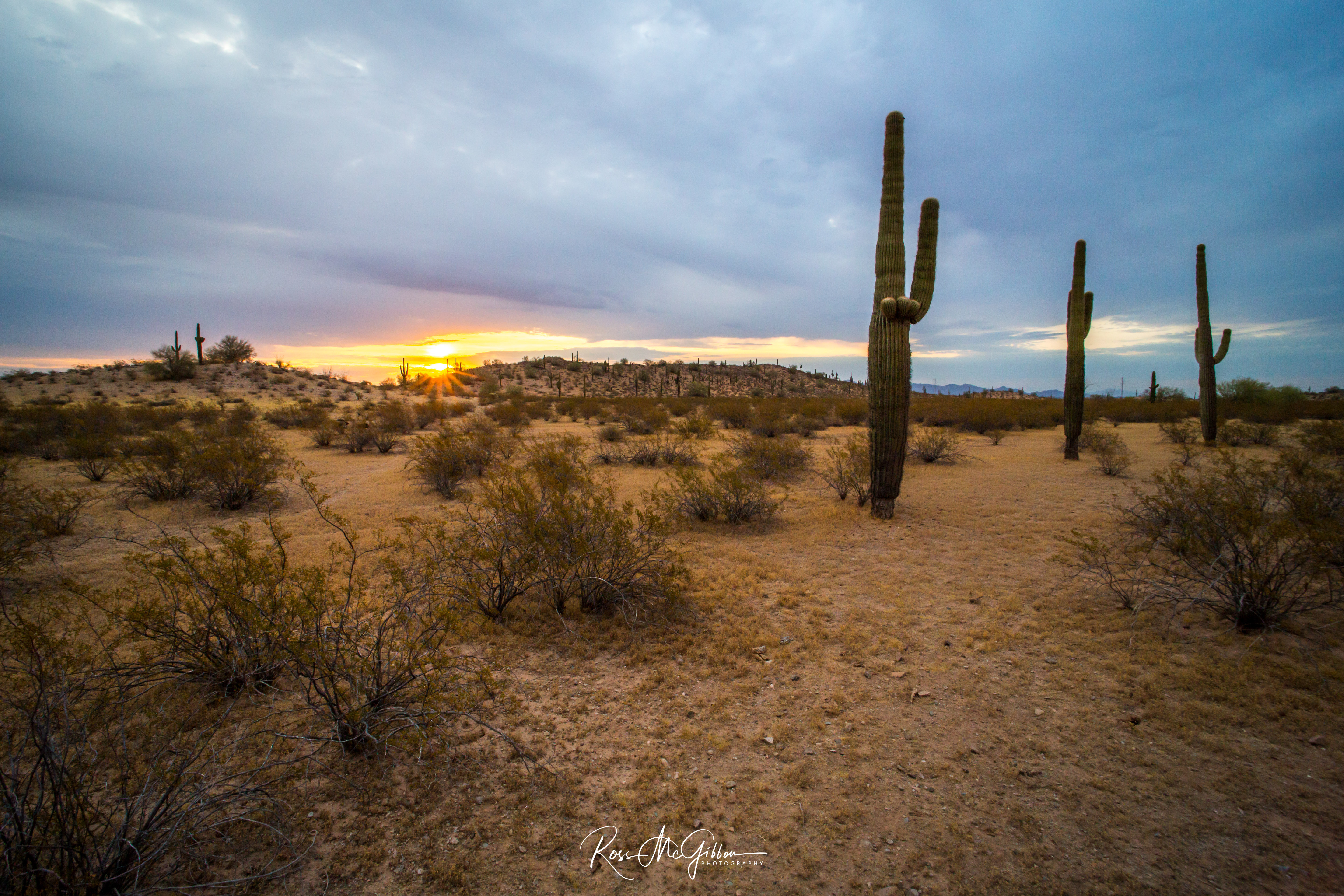
Below: The sun just starting to peek over the horizon, lighting up the Arizona desert and making for a pretty spectacular start to the day.
Following a successful morning, we headed back to our hotel for a few hours before setting off for our next destination, about three hours’ drive away. This night, we were targeting one of the rarer snakes in Arizona; a small and elusive rattlesnake known as the Desert Massasauga (Sistrurus tergeminus edwardsii). The highway knifed through scenic mountain ranges until we reached open grasslands, the preferred habitat of the Desert Massasauga.
We studied the road with keen eyes as the sun slipped below the horizon. “Look, there’s a tarantula,” Dan pointed out. “And there’s another, and another.” We pulled over for a closer look. Dan explained that most of them were pretty placid. “If you want to handle one, just lay your hand down flat in front of it and let it walk onto your hand.” Dan attempted to demonstrate, but the tarantula began to show signs of agitation by avoiding his hand and raising its abdomen in the air. “Of course, you’re going to make a liar out of me,” Dan grunted at the tarantula. “We’ll try again later with a different one.”
Over the next two hours, the area failed to produce a single reptile. Despite the habitat being suitable and weather conditions favourable, the night was shaping up to be what every herper dreads, devoid of activity. Another thirty minutes passed, and we were beginning to think the worst when, finally, we spotted a snake. At around 40cm long, it could very well be a massasauga. On closer inspection, though, it was just a small venomous colubrid called the Desert Nightsnake (Hypsiglena chlorophaea). It was the equivalent of spending three hours searching for a Barkly Death Adder in Australia and coming up with a boring old Curl Snake instead.
At midnight we gave up searching and made a start on our three-hour drive back to our hotel. “We’re still in with a chance to find a diamond-back on the way home,” said Dan optimistically.
He was right, technically. We found not one, but two diamond-backs on our way back. The only problem was, they were both roadkill from earlier in the night. At this point, it was beginning to feel personal.
We crawled into bed at 3am feeling pretty defeated.
We took the following morning off and enjoyed a much-needed sleep-in. Later in the afternoon we noticed the sky to the north filling with big black storm clouds. Rain could be exactly what we needed to get the reptiles moving tonight. If we were lucky, the storm might hit right where we were herping tonight.
It was late in the afternoon when we arrived at the same location as our first night. The storm clouds had already blackened the sky and we could smell imminent rain on the wind. We lapped the roads until the wind and rain were so ferocious that they forced us to pull over.
When the storm passed, we recommenced our search. As we’d hoped, the rain brought out the reptiles. Our first snake was a California Kingsnake (Lampropeltis californiae), a non-venomous colubrid with a shiny black body and white crossbands. Interestingly, the California Kingsnake is highly resistant to rattlesnake venom, allowing it to prey on venomous snakes. “It’s a great find in this area,” said Dan. “I didn’t get one last time I was here.”
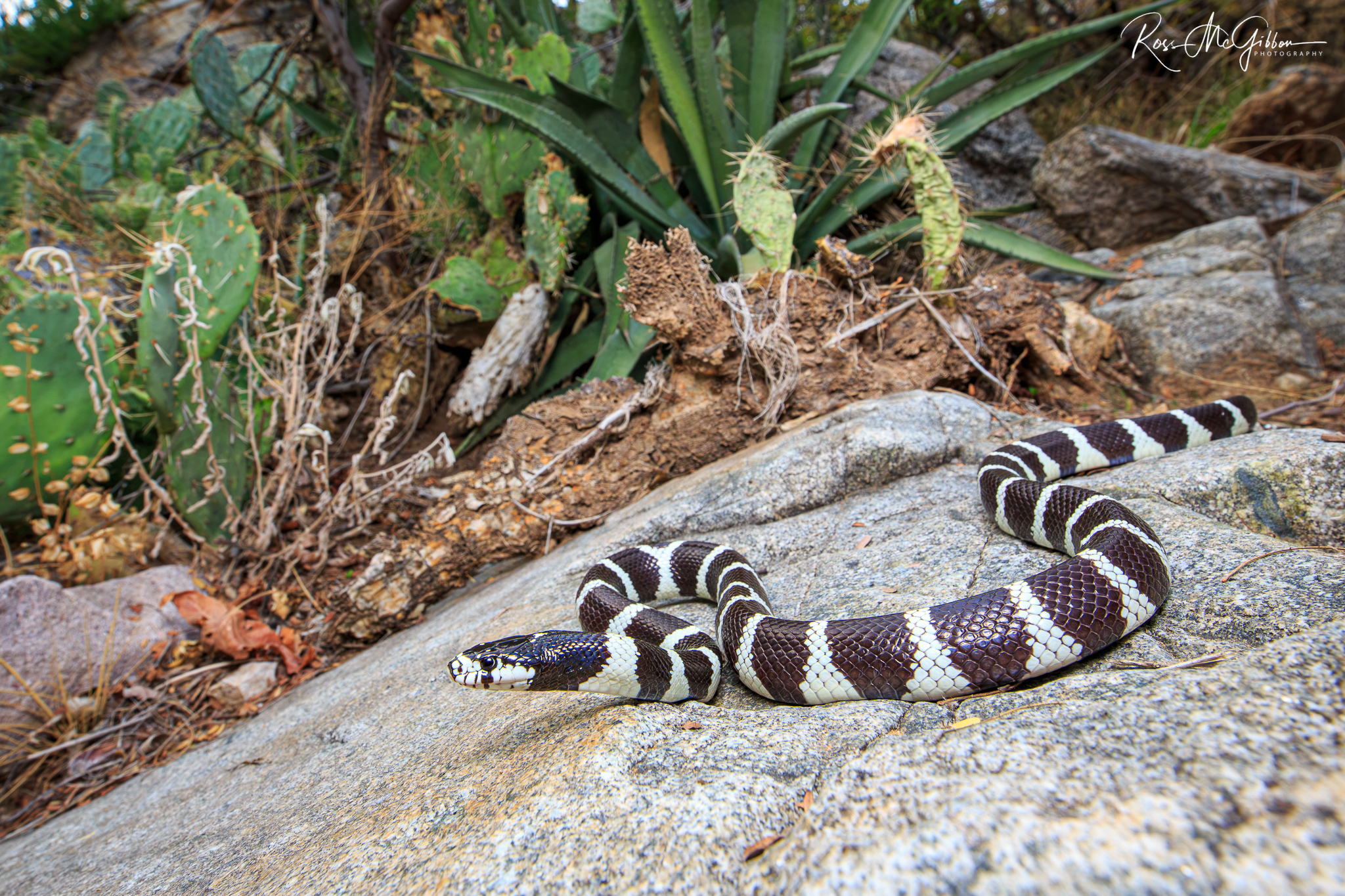
A California Kingsnake (Lampropeltis californiae) that looks a bit like an American version of Australia’s bandy-bandy, only a whole lot more hardcore thanks to their ability to prey on rattlesnakes.
The roads continued to produce reptiles until well after midnight. By 1am we had racked up a substantial number of species, including Long-nosed Snakes (Rhinocheilus lecontei), Gophersnakes (Pituophis catenifer), Spotted Leaf-nosed Snakes (Phyllorhynchus decurtatus), a Sidewinder, a Regal Horned Lizard and another California Kingsnake. It was a good haul, but we were surprised that none of the more common rattlesnakes, such as the Black-tailed Rattlesnake (Crotalus molossus) and the diamond-backs, were active. We kept going until 3am just to make sure.
“The rain will probably stimulate the diurnal stuff as well,” said Dan. “We’d be mad not to hit this spot again in the morning.” “Okay,” I said, “but at this time of the night, it’s not worth driving an hour back to our hotel only to come back out here again in the morning. How about we sleep in the car for a few hours and pick it back up again when the sun wakes us up?” Dan agreed, so we crashed out.
After a less-than-comfortable sleep, I was happy to get out of the car when the sun beamed through the windows. I scrounged around for some breakfast and found a muffin and some jerky. It wasn’t flash, but it would have to do until we got back into town.
As we set off on foot to see what we could find, we discussed an exciting night ahead. We needed to be in Tucson by tonight because we’d been invited to help with a survey at a study site for Tiger Rattlesnakes (Crotalus tigris) and the elusive Gila Monster (Heloderma suspectum). Seeing a wild Gila Monster would be a dream come true for both Dan and me, and there was a good chance we’d get to see one that night. “Even though they are wild gilas at this study site, if the only ones we see are from here, it would feel a bit like cheating in my book,” I explained to Dan. “I’d really like to herp one by ourselves on this trip.” “Well,” Dan replied, “we’re in the right habitat for them now. Anything could happen.”
The area was thick with cactus. Within minutes, each of us had brushed too close to some Cholla cactus, which spawned golf-ball-sized, spiky balls from hell. Their spines were so sharp, the slightest contact embedded them deep into your flesh. I struggled to remove one ball lodged at least a centimetre into the end of my middle finger, while Dan was experiencing a similar thing in his left calf muscle. “And they say everything in the Australian bush is trying to kill you. It’s got nothing on Arizona,” I said to Dan.
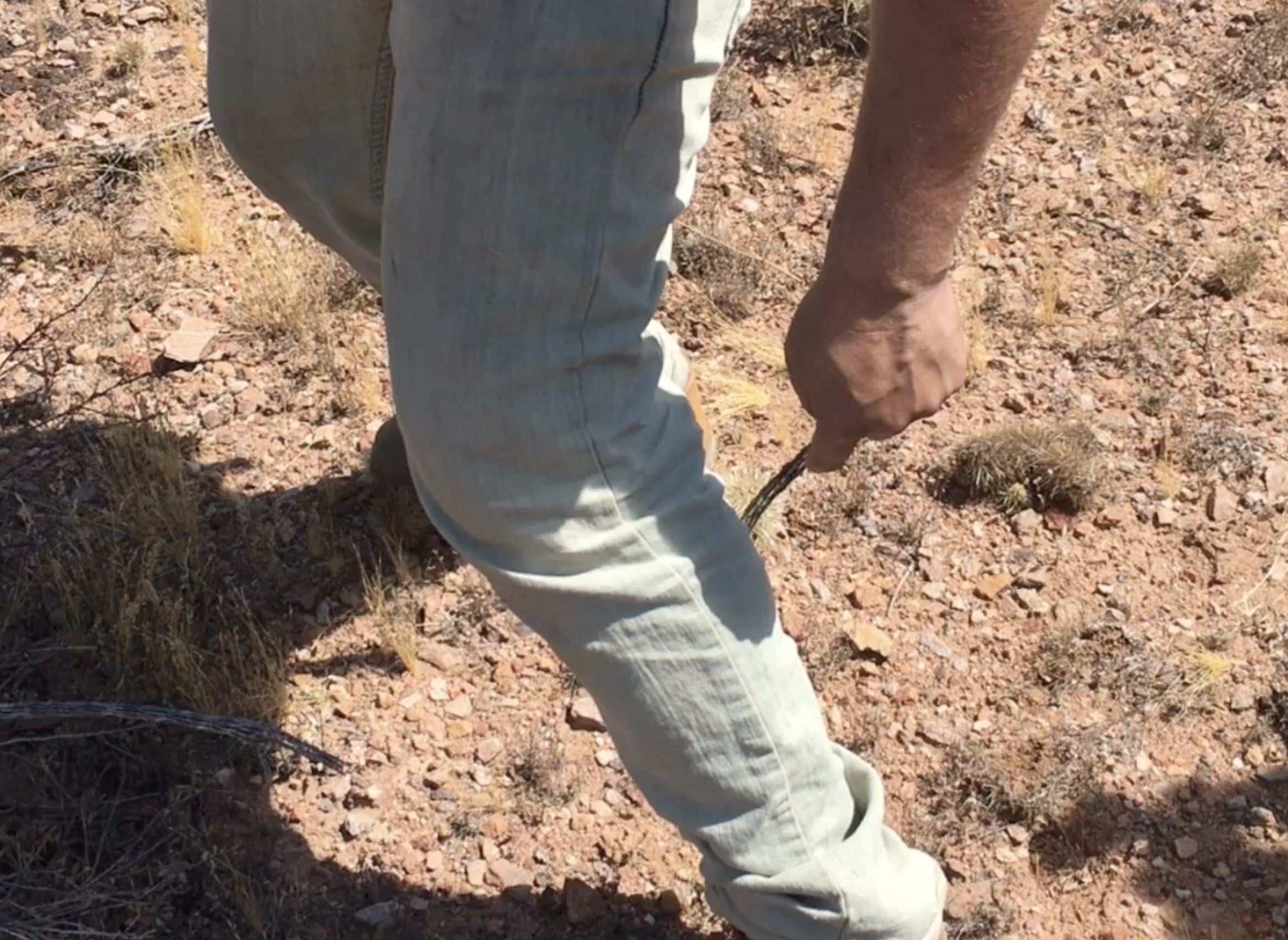
Dan getting a painful reminder that, despite what they say about the Australian bush, Arizona has plenty of ways to hurt you too.
We got back on task after our painful lesson to be more careful around the cactus. Soon, I noticed some movement near the base of a bush. When my eyes focused, I spotted a small, well-camouflaged horned lizard. With shades of pink and purple, it was much prettier than the ones we’d found so far. On further inspection, I was pleased to identify it as the very species we were hoping for, the Desert Horned Lizard.
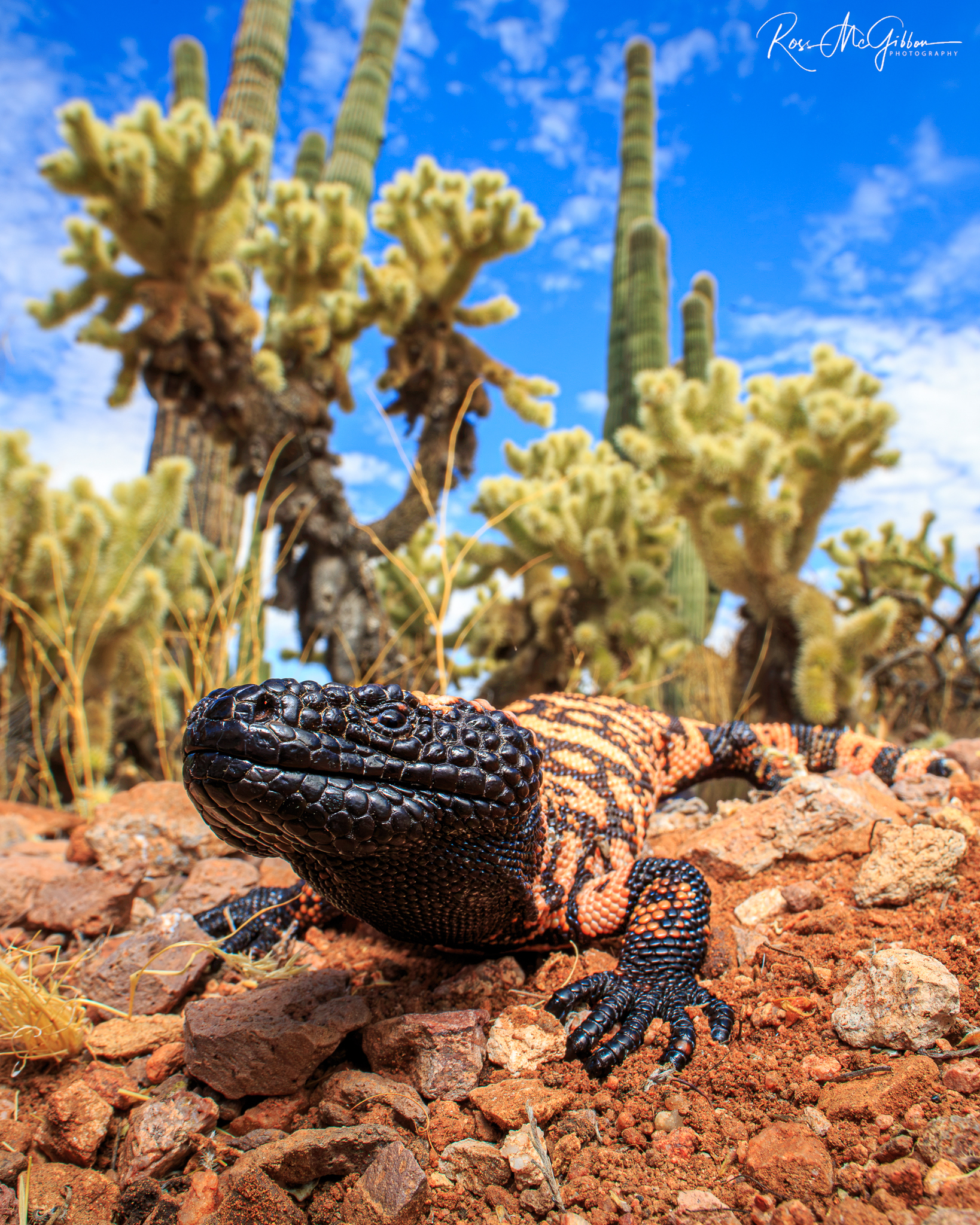
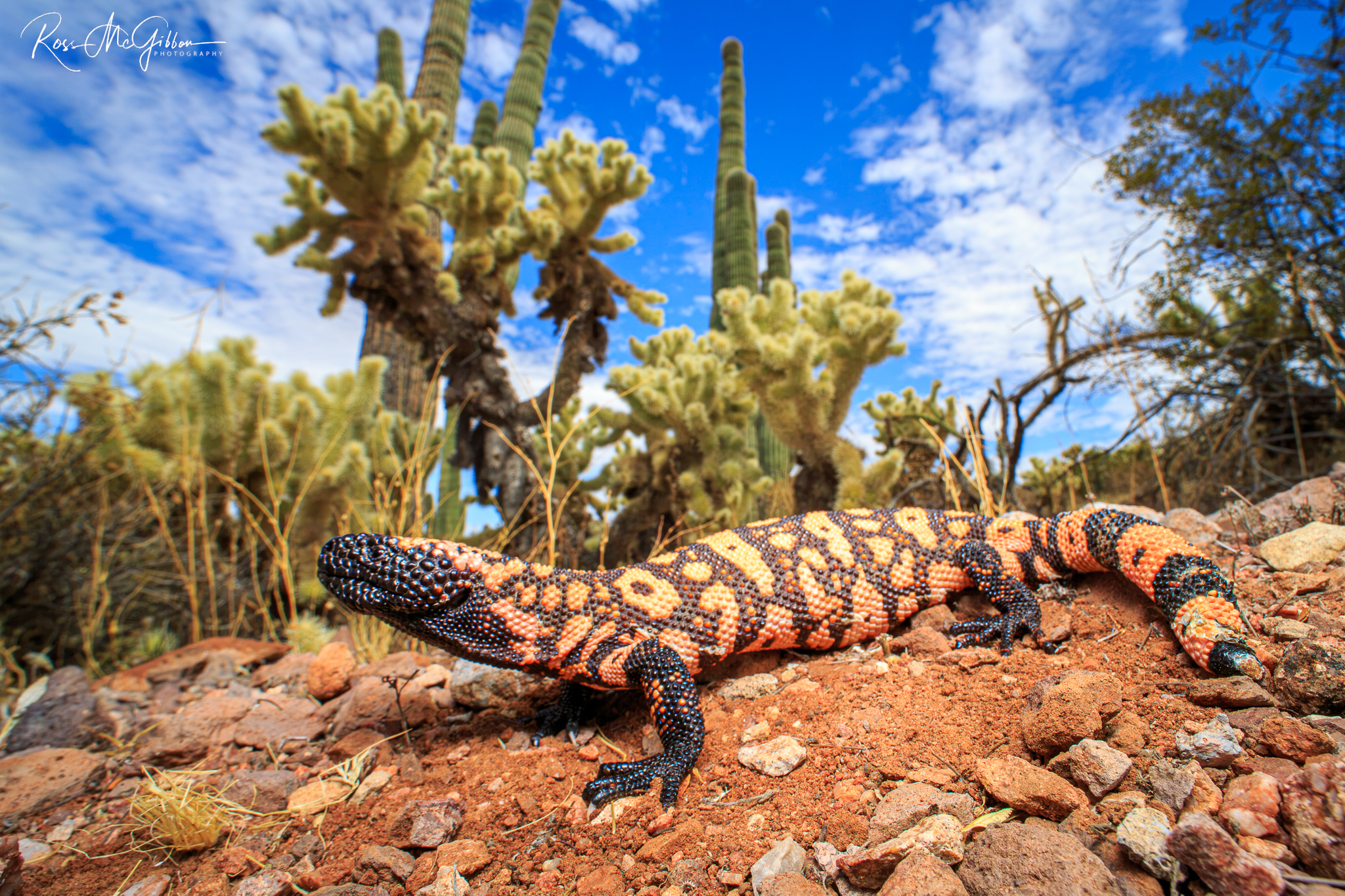
While I photographed it, Dan had a scout around to see what else he could find. I was almost finished when I heard Dan shouting out to me from a dry riverbed about 40m away. “Gibbo? Gila! Get your arse over here!” I bolted to where Dan was, following a beautiful sub-adult Gila Monster cruising along the riverbed, presumably in search of water or a meal. Neither of us could believe our luck. We were so fortunate to be here during some recent rain.
When we each had a photo we were happy with, we watched the beautiful lava-coloured lizard disappear into a burrow in the river bank. Finding a Gila Monster ourselves was as good as it gets. Now, if we encountered one tonight, we wouldn’t feel like cheats.
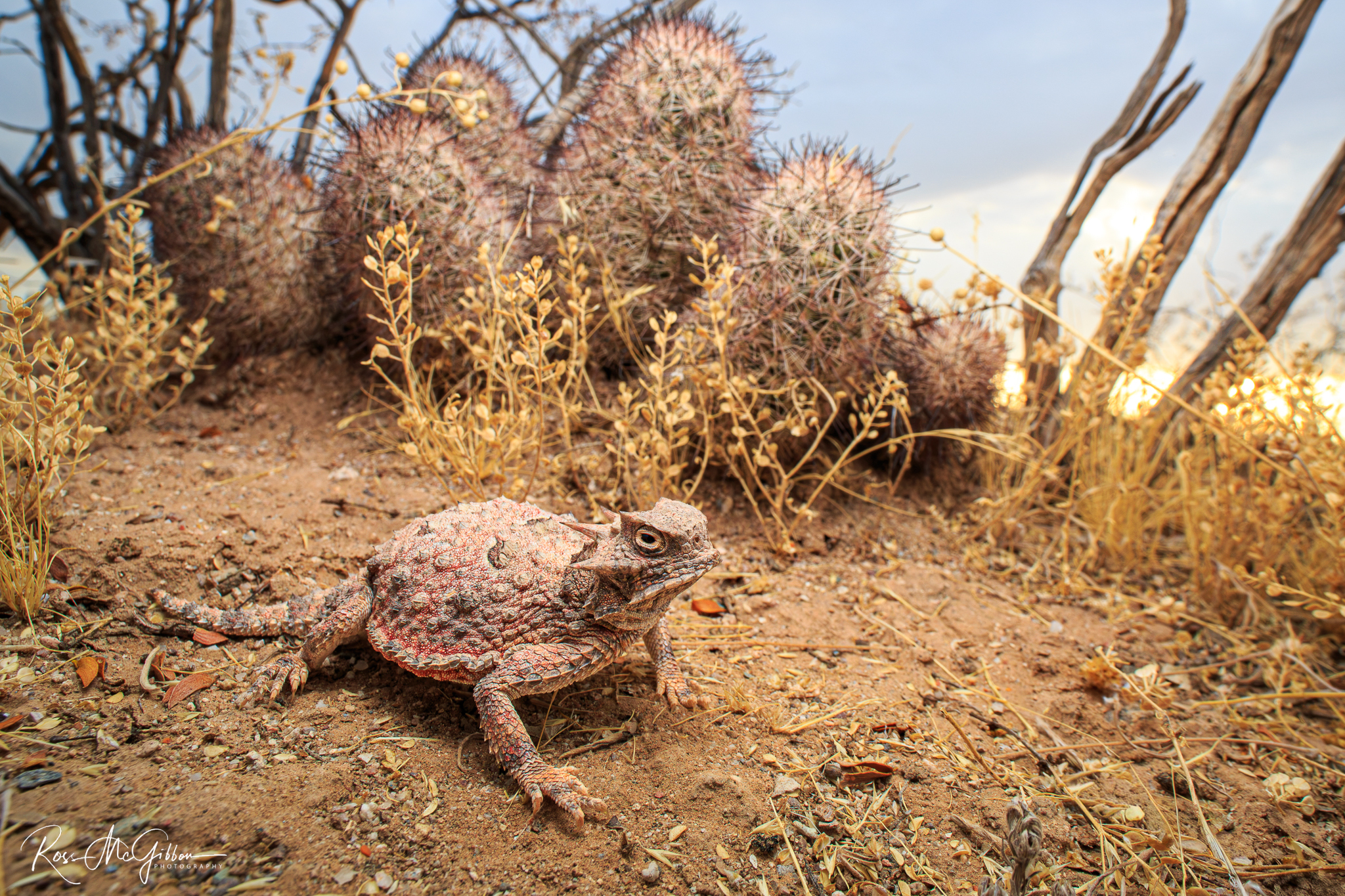
Above: A beautifully coloured Desert Horned Lizard (Phrynosoma platyrhinos), with pink and purple tones that almost perfectly match the surrounding cactus. It’s easy to see where the inspiration for their camouflage comes from.
Below: Our number one target outside of rattlesnakes, and one hell of a bucket-list species. Finding this wild Gila Monster (Heloderma suspectum) was a huge moment for both of us.
On the way to Tucson, Dan and I discussed the possibility of what else we might get to see. “Apart from gilas and Tiger Rattlesnakes, there should be Black-tailed and Diamond-backed Rattlesnakes in the area,” explained Dan. The sun had just dipped behind the mountains as we drove into the study site. “Wow, is that a cougar?” I asked, pointing to a large wildcat crossing the road 50m up ahead. “No, it’s a bobcat,” Dan replied excitedly as we scrambled for our phones. We managed to record a few seconds of it leaping a 2-metre stone wall and disappearing into the growing night. What an awesome way to start the night.
On arrival, Dan’s friend Alexus greeted us and gave a run-down of the night. We were thrilled to discover that we’d be herping on golf carts. All we needed to do was follow her and keep our eyes peeled for Gila Monsters and rattlesnakes. Any Gila Monsters or Tiger Rattlesnakes we found needed to be caught and processed. Anything else we encountered would be a bonus.
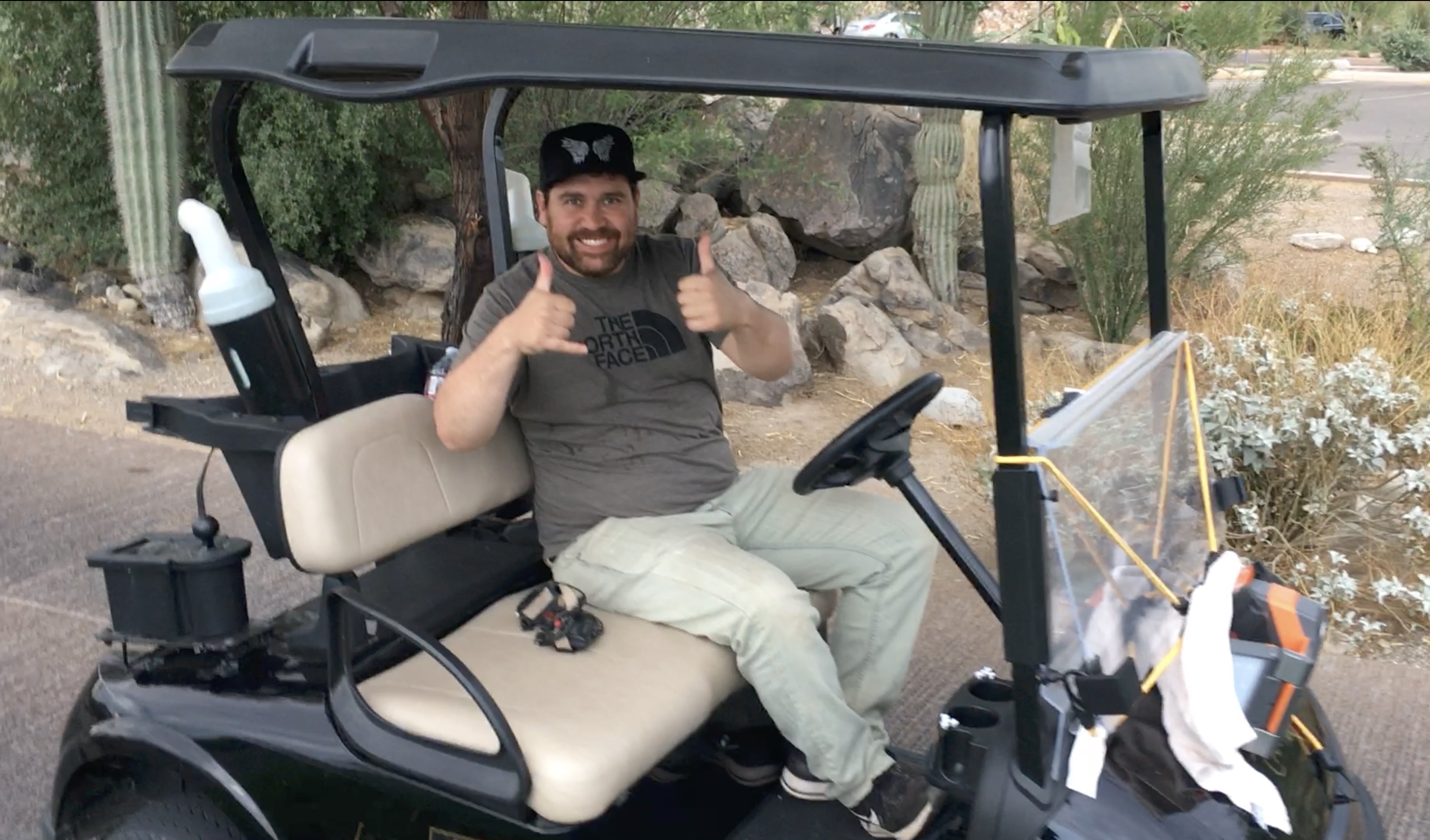
Herping on golf carts was definitely a first for me. Not a bad way to cruise around the Arizona desert looking for rattlesnakes and Gila Monsters.
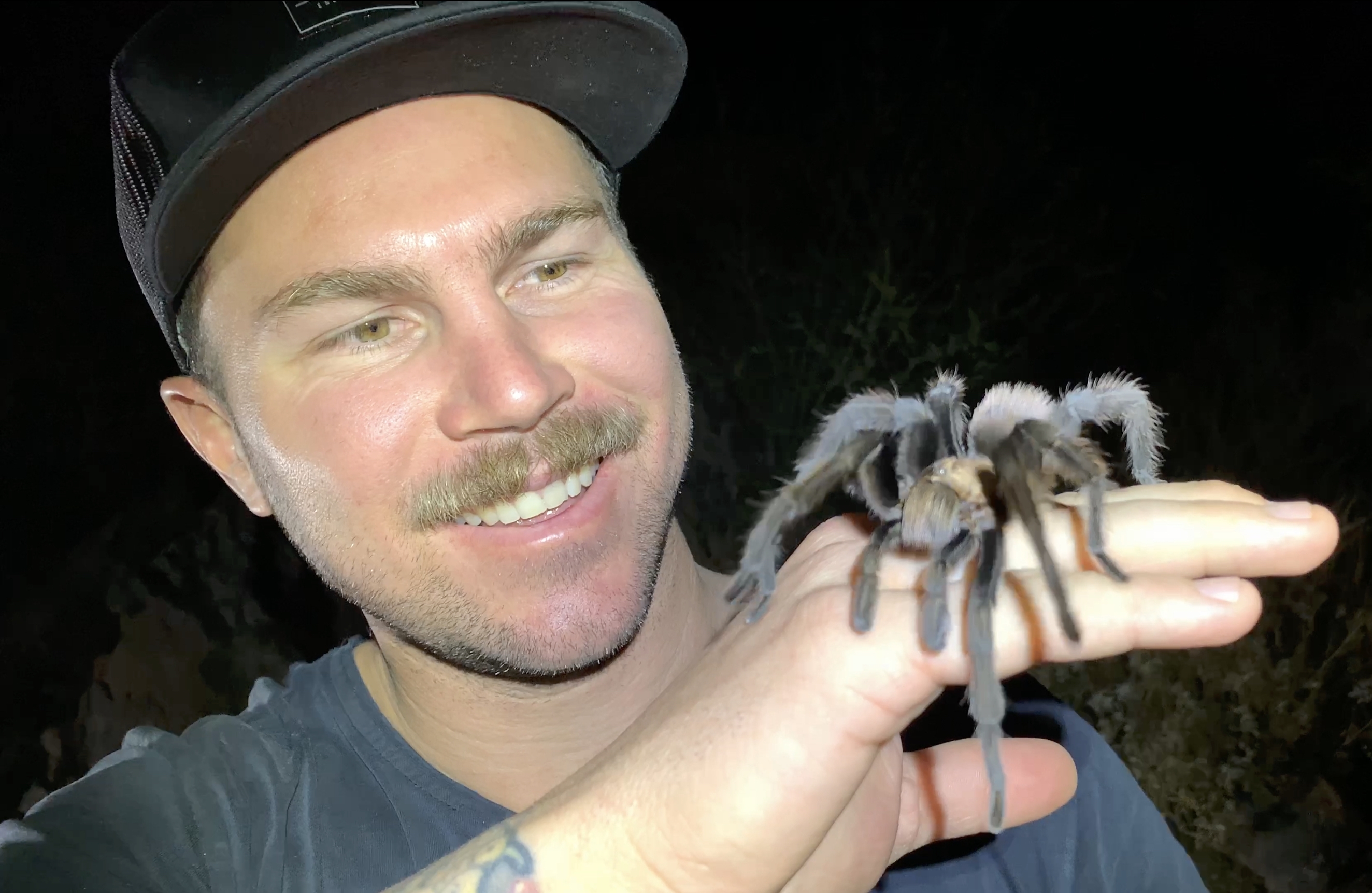
The next three hours were some of the most action-packed and enjoyable herping I’ve had. We found horned lizards, a Sonoran Desert Tortoise (Gopherus morafkai), a Black-tailed Rattlesnake, four Tiger Rattlesnakes, and, amazingly, three Gila Monsters. I even got to handle my first tarantula and got up close, but not too close, to a wild skunk. Surprisingly, a Diamond-backed Rattlesnake still eluded us, despite generally being common at the site.
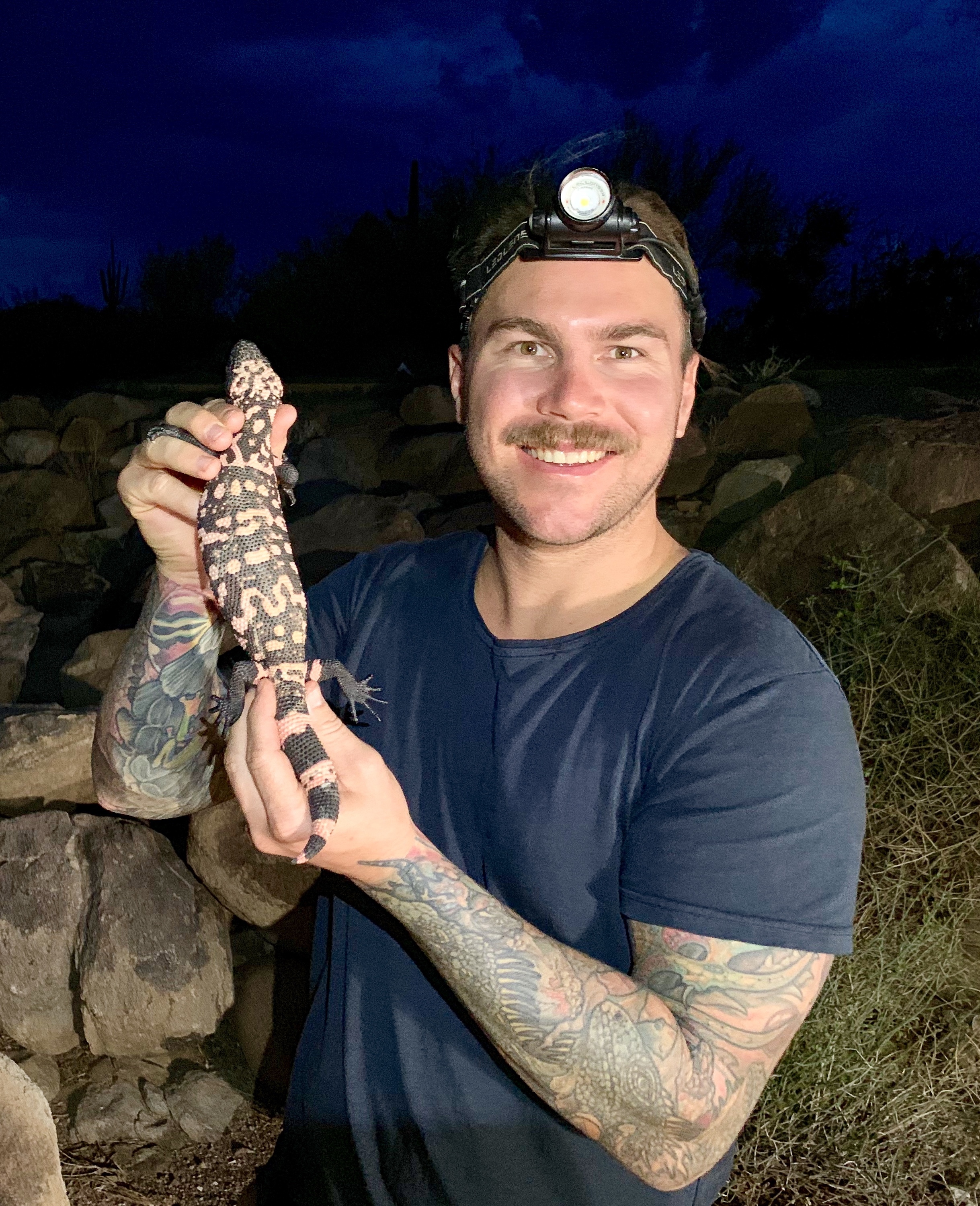
Above: Feeling incredibly fortunate to have encountered three Gila Monsters (Heloderma suspectum) at the study site, including the opportunity to get up close and hold this incredible animal.
Below: One of the unexpected highlights of the trip, getting to handle my first tarantula. Definitely not something I get to do back home in Australia.
On the way home, we found yet another road-killed Diamond-backed Rattlesnake. It was a bittersweet end to an otherwise perfect night.
Early the next morning we set off on a two-hour drive that would bring us to the start of a walking trail at the base of a mountain. Here, we were going to search for three species of montane rattlesnakes: the Twin-spotted Rattlesnake (Crotalus pricei), the Arizona Ridge-nosed Rattlesnake (Crotalus willardi willardi) and the Rock Rattlesnake (Crotalus lepidus).
Of these three species, Twin-spotted Rattlesnakes are found at the highest elevation and are the least common. Dan suggested we hike straight to the top while it was cooler and try our luck with them first. “We can search for the other two species on the way back down,” he said. “Oh, and watch out for Poison Ivy. It’ll really ruin your day.” He showed me how to identify it by the leaves before telling me the story of how he’d made the big mistake of lying in some last time he was here while wearing shorts.
At the top of the mountain, we came up empty-handed for the Twin-spotted Rattlesnake, so we headed back down to look for the other two species. Dan and I were working our way down a rocky riverbed when, BOOM, a loud gunshot rang out too close for comfort. To our knowledge, it wasn’t hunting season and there was no hunting permitted in the reserve we were in. Dan suggested that we leave immediately, but I was hoping they were just hunters. I yelled out, “Oi, there are hikers here, stop shooting!” Five minutes later there was another BOOM. This time, it sounded even closer. “Gibbo, no rattlesnake is worth catching a bullet for. Let’s get out of here.” I agreed, and we beelined for the car.
By the time we got back, the temperature was over 40ºC, so we spent the middle of the day with a few Coronas by the pool, deciding what to do with our last two nights of herping. On one hand, a 30-minute drive from our hotel put us in the right habitat for Diamond-backs, Black-tails and Tiger Rattlesnakes. On the other hand, we still had unfinished business with the Massasauga. Another attempt at them meant we had a three-hour drive each way, coupled with the risk that it could be as fruitless as last time. Despite the risk, our guts told us to take a chance on the Massasauga tonight and save our last night for the other more-common species.
By sunset we were back in Massasauga habitat. It was almost completely dark when our headlights picked up our first snake. “You’re kidding,” Dan muttered curiously as we exited the car for a closer look. Then he erupted into a cheer. “You beauty! It’s a Massasauga.” We couldn’t believe our luck. Every herper dreams of finding their big target species on the first lap of the night. “Well mate,” I said to Dan, “the pressure is off now. After we grab some photos of it, we can just have a leisurely herp and head back when we feel like it.”
Our next snake was another Desert Nightsnake, but we decided not to photograph it so we could maximise our time searching for the second-best species in this area, the Arizona Black Rattlesnake (Crotalus cerberus). A little further down the road, our decision not to waste time filming the Nightsnake proved extremely rewarding when we stumbled across a beautiful Arizona Black Rattlesnake. We moved in for a closer look. Greeting us was a rather defensive snake. It recoiled into a defensive posture, hissed repeatedly and let fly with several defensive strikes to the tune of a loud and frantic rattle. It was astonishing how blindingly fast their strikes were. Even on the slow-motion setting, my phone struggled to do it justice.
Now that we had what we came for, we began our three-hour drive back to our hotel. “I can’t believe we found an Arizona Black Rattlesnake and a Massasauga tonight,” I said to Dan. “I can’t believe we found a Gila Monster and a Massasauga before a live Diamond-back,” Dan replied in disbelief. “You’ve seen the rarest species before the most common.”
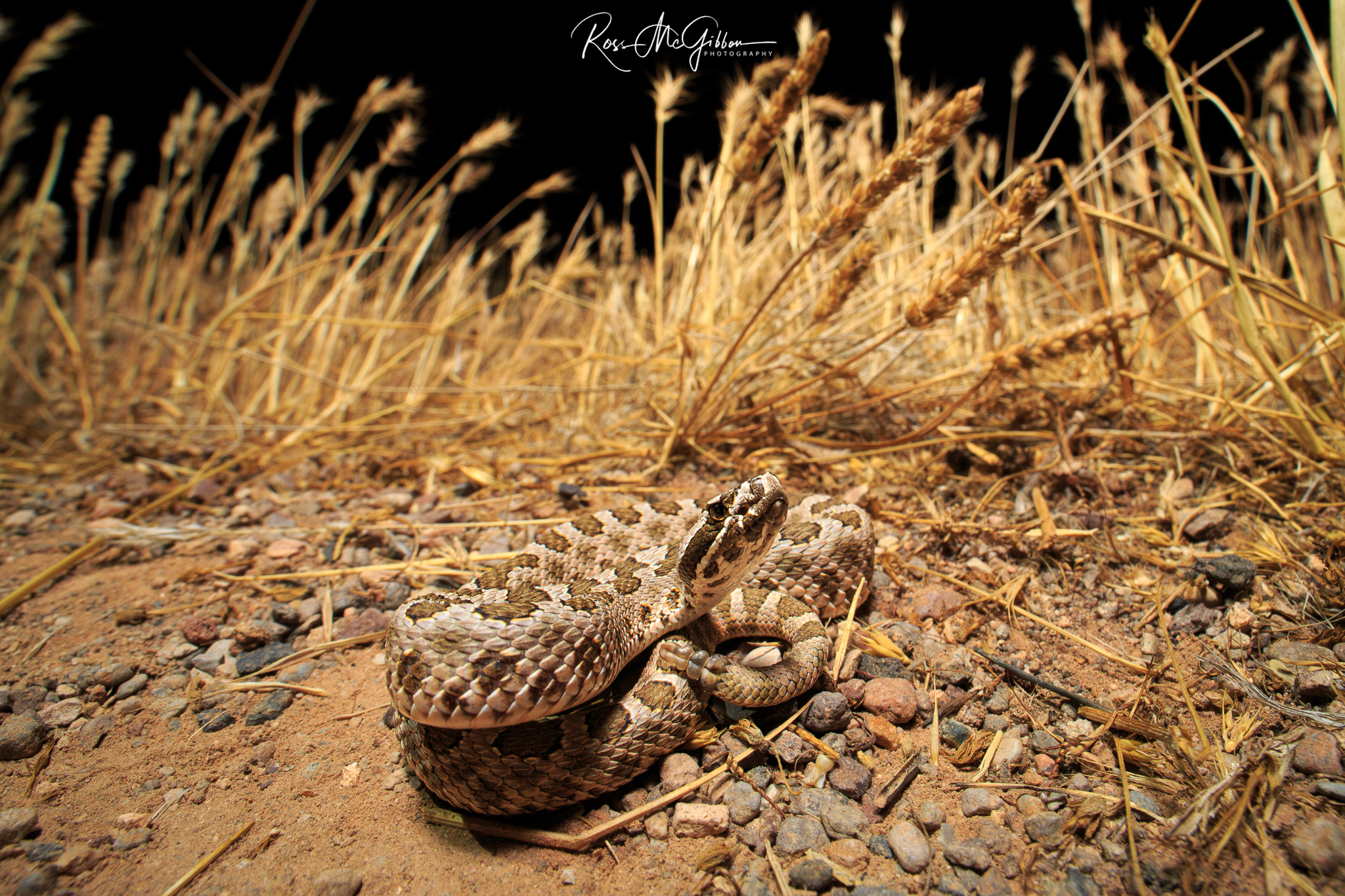
A Desert Massasauga (Sistrurus tergeminus edwardsii), one of the big targets of our Arizona trip. After missing it on our first attempt, finding one on the very first lap of our final evening in Massasauga habitat was a pretty special moment.
The next morning Dan and I set off on our last day of herping in Arizona. We still needed to find a Diamond-back that hadn’t been run over, and although we had seen Black-tailed and Tiger Rattlesnakes at the study site, I still wanted to find them ourselves and capture some nice images of each species. “Well, lucky for you,” said Dan. “All of them can be found where we’re going now, and we still have this afternoon and the entire night if we need it.”
To our surprise, we spotted a large rattlesnake on the road as we came around the next bend. Before we could stop the car, Dan shouted, “It’s a Diamond-back, Gibbo.”
It was a big old snake with faded markings, battle scars and only one eye. Generally speaking, Diamond-backs are usually quite defensive, but this old snake wasn’t fazed by us at all. Luckily, this snake wasn’t putting up a fight because three cars were headed our way at speed. We removed the snake from the road with minimal fuss, just in time to watch three SUVs come barrelling past in the same lane the snake had been in.
If we had come along a few minutes later, this old battle-axe would have seen its last sunrise, and I would have been staring down at my fourth road-killed Diamond-back of the trip.
After a quick photo shoot, I watched it slip into the safety of a burrow. Watching it disappear, I sincerely hoped the old snake avoided car tyres for many days to come. By now, it was too late in the morning for Tigers and Black-tails to be moving, so we headed back to our hotel and waited for the day to cool off.
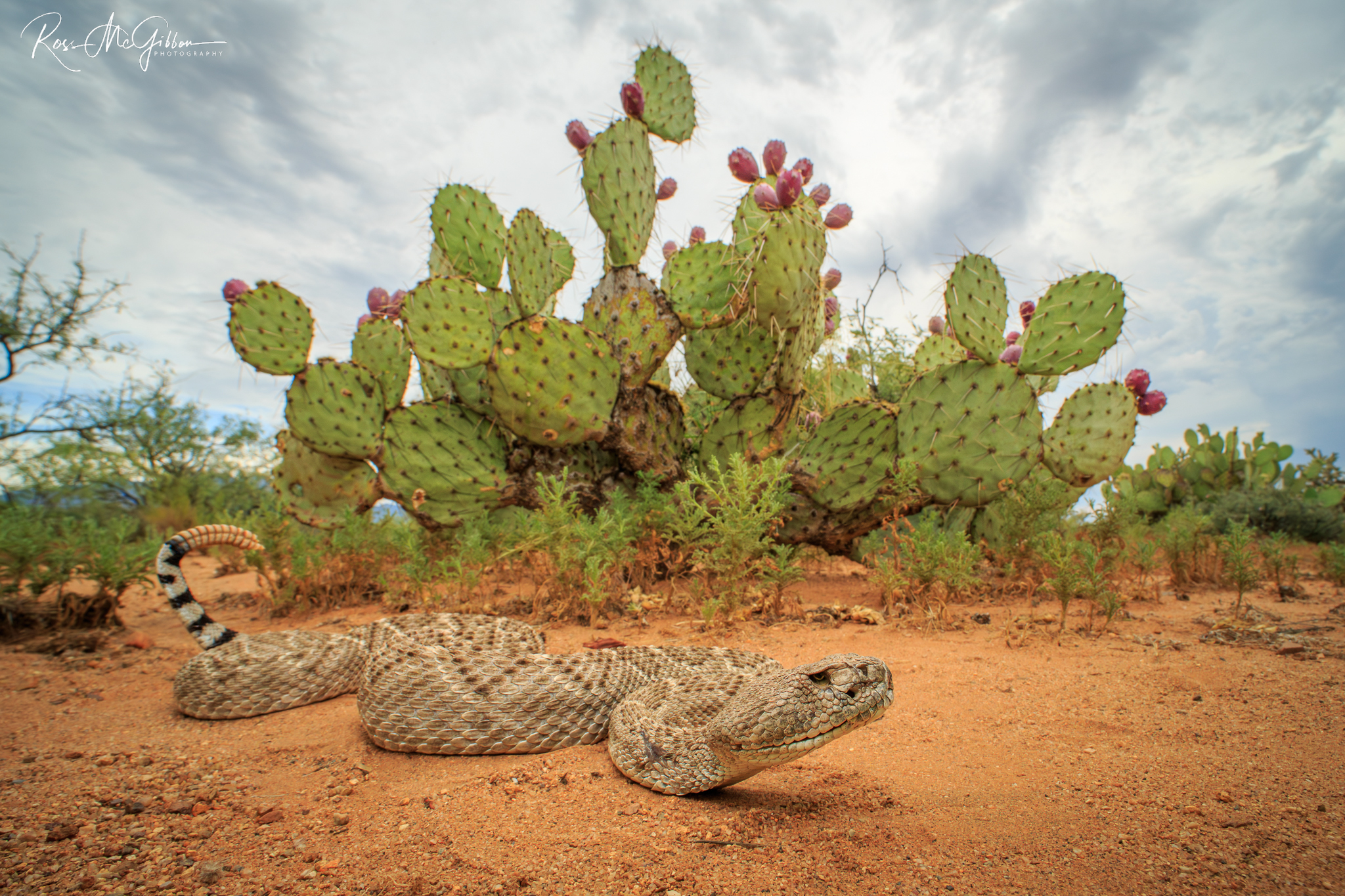
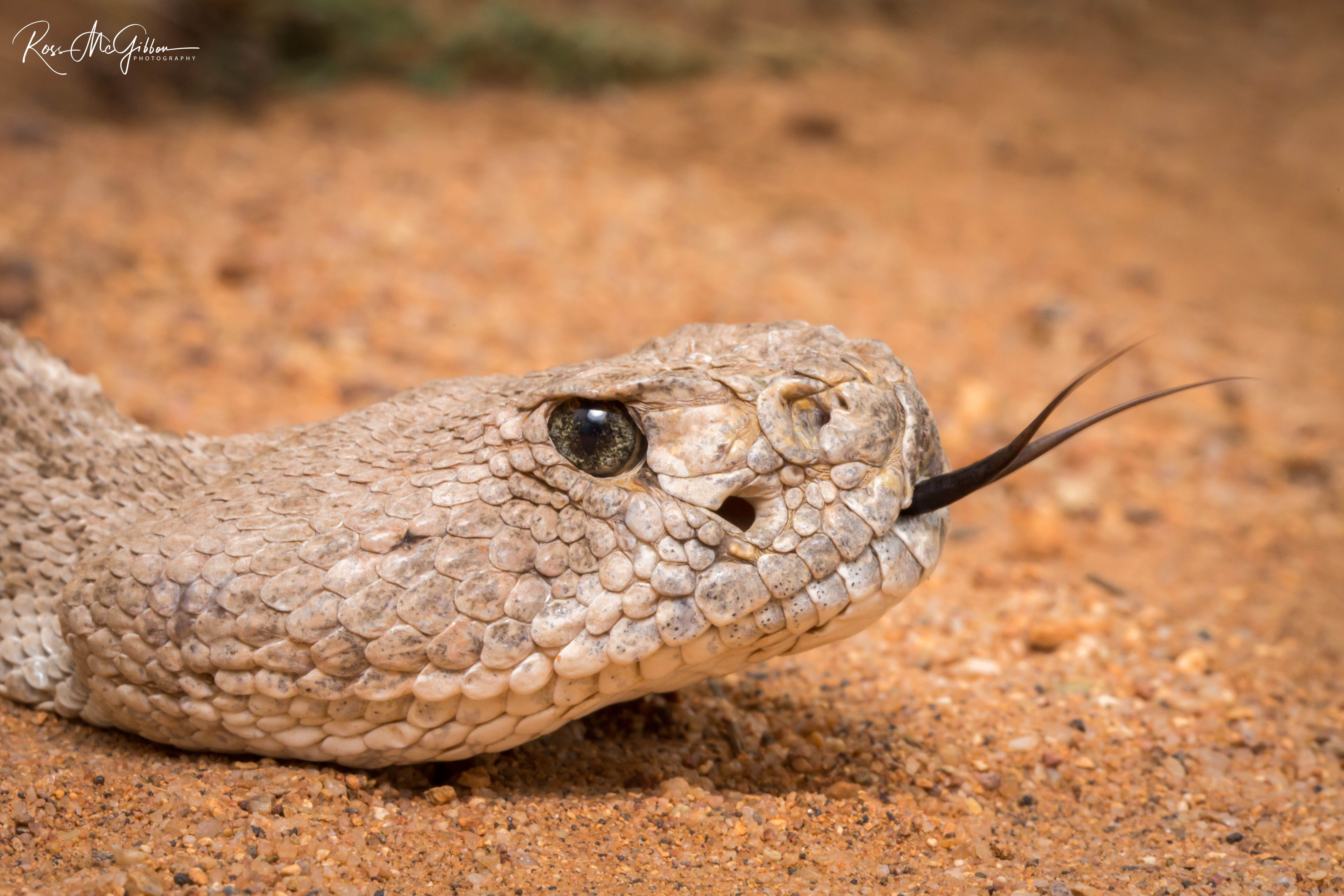
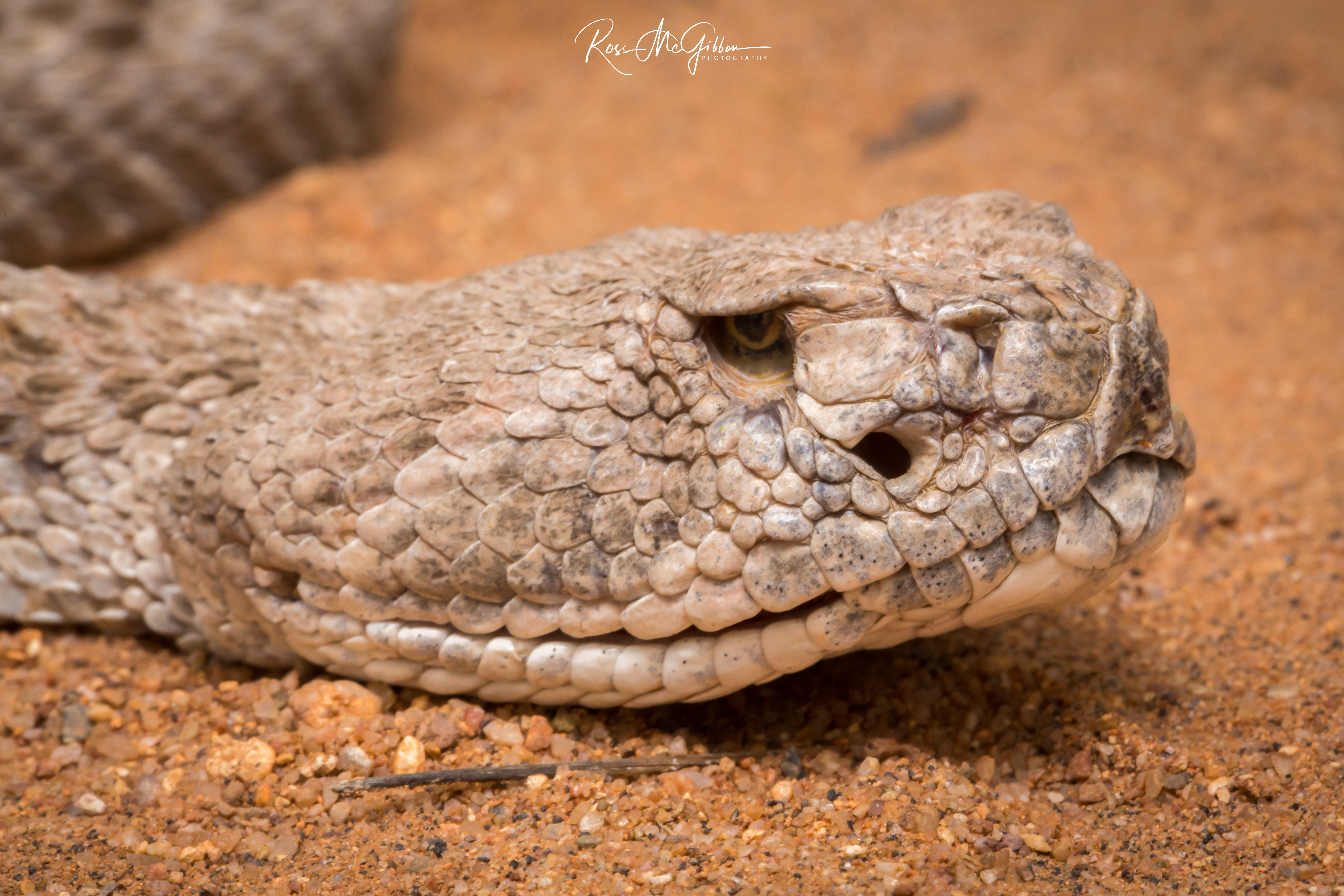
An old Western Diamond-backed Rattlesnake (Crotalus atrox) missing an eye and sporting plenty of character. After finding nothing but road-killed Diamond-backs all week, saving him from the oncoming SUVs was the real highlight and certainly one worth waiting for.
Late that afternoon we were back in the hills and on the hunt for Tigers and Black-tails. Some cloud cover was taking the bite out of the sun and conditions appeared ideal for snakes to be active. It wasn’t long before we spotted a Black-tailed Rattlesnake on the road. To my dismay, it was on its last legs after being recently run over. “Man, this is frustrating!” I shouted. “There isn’t a bloody car for miles and this poor bugger manages to get nailed by one just minutes ago.” Before we left, I did the best thing I could for it and ended its suffering.
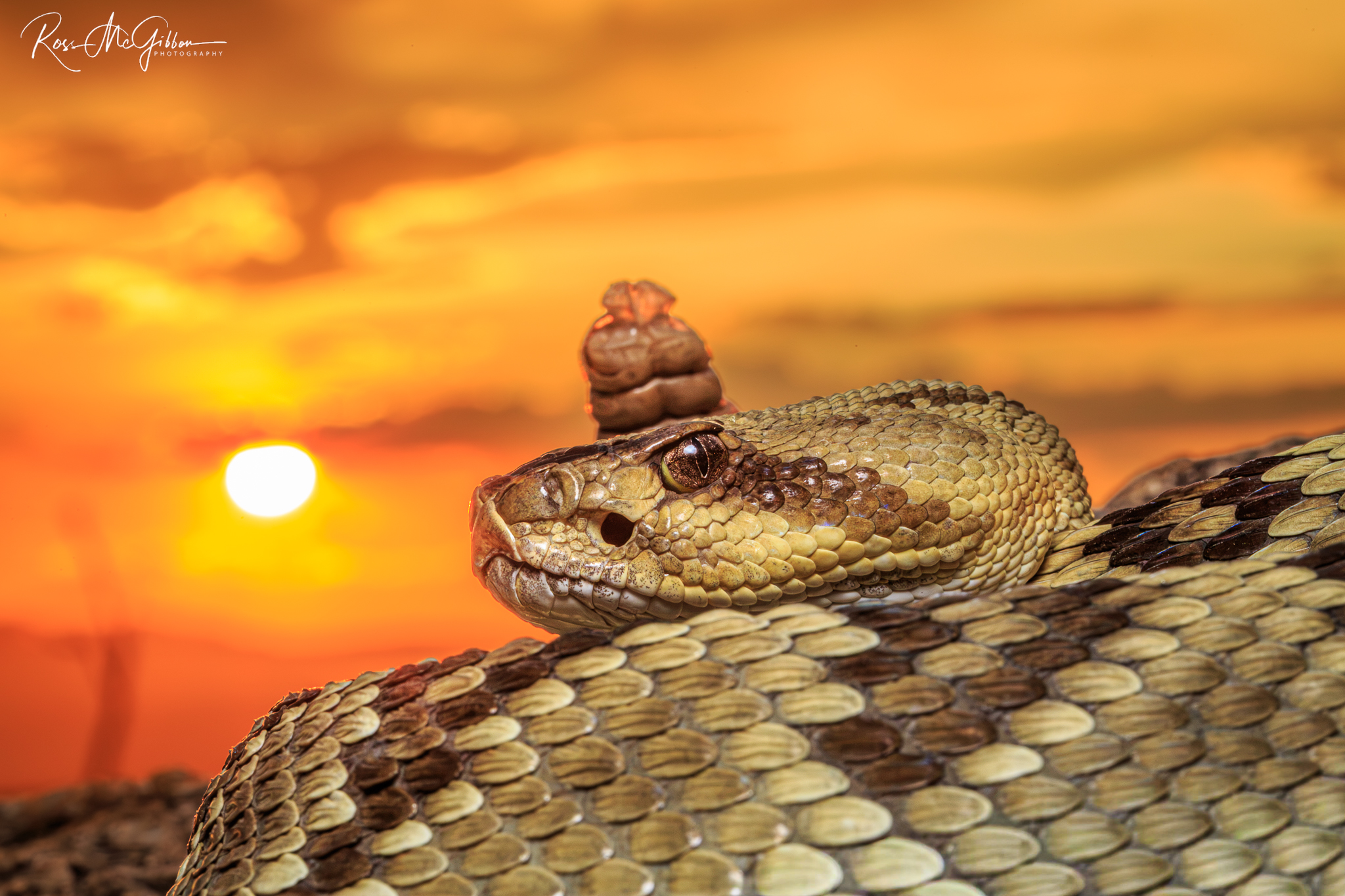
I felt pretty disheartened until another Black-tailed Rattlesnake appeared on the road about 15 minutes later. This one was alive and well. After observing it for a while, I moved it off the road to photograph it. As I did, the sun was dropping below clouds on the horizon, giving rise to an impressive purple and yellow backdrop. Apart from a few initial defensive strikes, the snake was well-behaved. A cooperative subject, coupled with the best sunset I’d seen all week, produced my favourite shots of the trip.
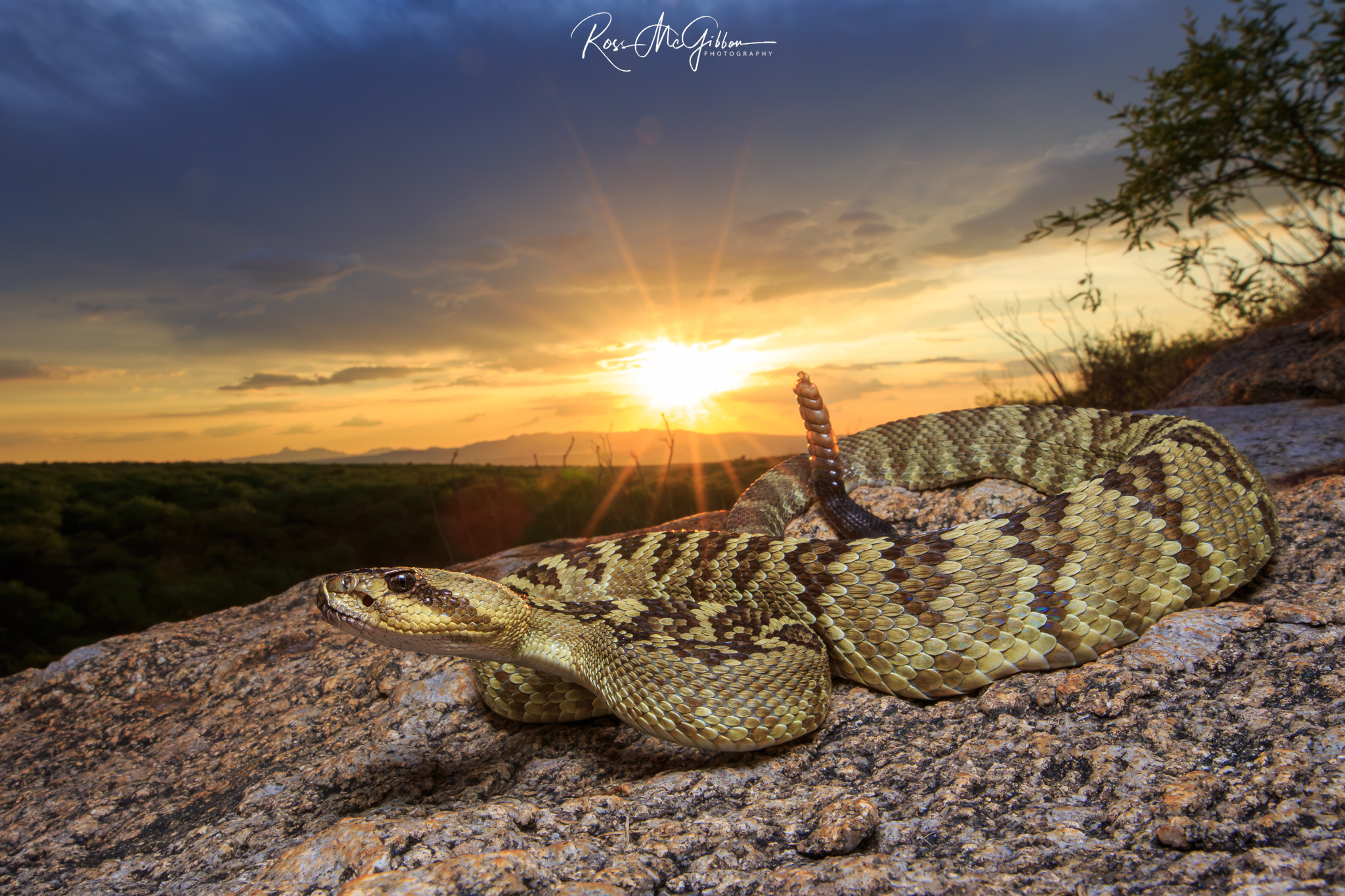
A Black-tailed Rattlesnake (Crotalus molossus), perfectly framed against the incredible colours of an Arizona sunset. Definitely my favourite shots from the trip.
Back in the car, the sun had almost set and the snakes were certainly on the move. Our next snake just so happened to be the final species I was hoping to find: the Tiger Rattlesnake. Using a macro lens, I captured some portrait-style shots before attempting a wide-angle shot as the last of the light faded on the horizon. “I’ll do another lap while you’re filming,” shouted Dan. “And watch out for mountain lions.” The only thing scarier than being bitten by the rattlesnake you’re photographing is getting mauled by a mountain lion in the process. For this reason, I didn’t take too long on the photos before joining Dan in the car. “How did you go?” I asked Dan. “You didn’t miss much, just another tiger.”
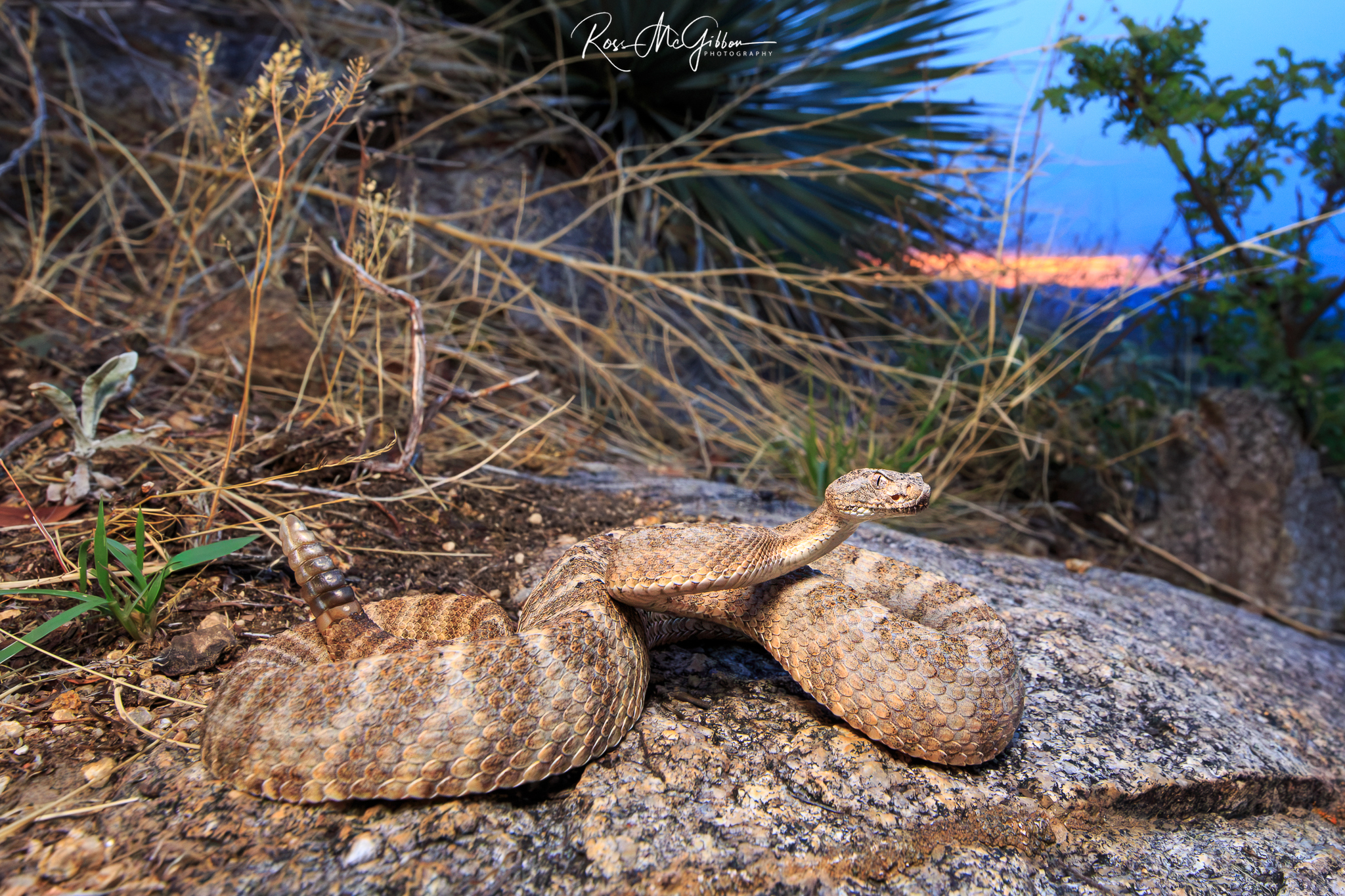
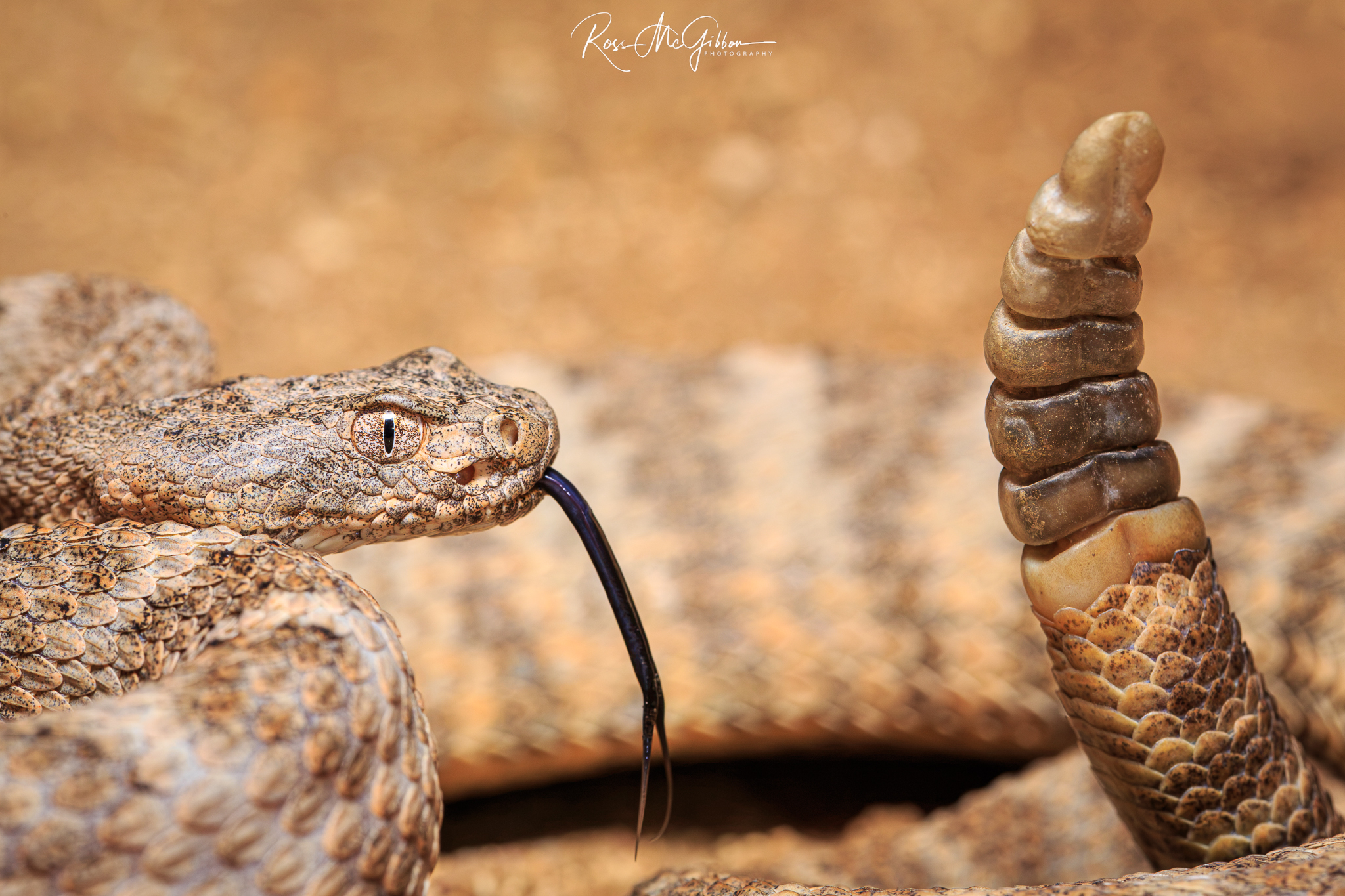
A Tiger Rattlesnake (Crotalus tigris) and the final snake of the trip. Luckily, rattlesnakes are pretty straightforward to photograph compared with our large, mobile Australian elapids, because the thought of a mountain lion lurking nearby was definitely in the back of my mind.
With most of our major targets located and shots of each species in the camera, we headed for our hotel, where some celebratory beers awaited. Tomorrow, we were off to Las Vegas to celebrate Dan’s birthday, but the week already felt like a birthday present in its own right.
We had struck out on a few of the species we came looking for, but we had spent seven days chasing snakes through the Arizona desert, driving for hours, sleeping in cars, crawling around in cactus and getting excited over every set of headlights that revealed something on the road. We had found species I had only ever dreamed of seeing, experienced some incredible behaviour and somehow managed to turn even the search for a common Diamond-backed Rattlesnake into an adventure of its own.
Looking back, though, it wasn’t the number of species we found that made the trip memorable. It was the unexpected moments, the laughs, the frustrations, the long nights and, most of all, getting to share it all with a good mate. We had come to Arizona looking for rattlesnakes, but we left with far more than a few snakes and some photographs.
It had been one hell of a trip.

After a week of chasing rattlesnakes through the Arizona desert, what better way to top it off than a Slipknot concert. An epic end to an epic trip.
Several photographs from my Arizona expedition are available here as fine art prints.