
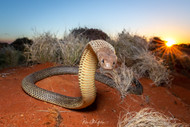
TRACKING TEMPORALIS: Search for the Mysterious Western Desert Taipan
Posted by Ross McGibbon on 31st Aug 2018
In 2017, Ross McGibbon and fellow wildlife photographer Tim Squires ventured into Western Australia’s remote Great Victoria Desert in search of the elusive Western Desert Taipan (Oxyuranus temporalis). Commissioned by Australian Geographic, the expedition brought an unforgettable encounter with one of Australia’s least-known snakes, followed by an unexpected Mulga Snake bite and an RFDS evacuation that took the adventure in a very different direction.
Tracking Temporalis
The Search for the Mysterious Western Desert Taipan
An unforgettable expedition into the Great Victoria Desert to find and photograph one of Australia’s least-known snakes.
By Ross McGibbon
Imagine that you are obsessed with surfing. You talk about it to anyone who will listen, read every book and magazine you can find, study weather and swell forecasts, and spend your spare time travelling to remote coastlines in search of the perfect wave. Now translate that obsession to finding and photographing reptiles in the wild and you’ll begin to understand my particular brand of madness.
For me, the reward has never simply been ticking off a species. It is the entire experience: the research and anticipation, the journey into somewhere wild, the search, the uncertainty and, eventually, that moment when you first lay eyes on it. And the photograph is the trophy you get to keep and look back on for years to come.
In 2017, that obsession led fellow wildlife photographer and reptile enthusiast Tim and me deep into Western Australia’s Great Victoria Desert in search of one of the continent’s most mysterious snakes, the Western Desert Taipan (Oxyuranus temporalis). At the time, very little was known about the species. It had only been formally described by scientists in 2007, and recorded encounters were few. For a reptile photographer, it was the sort of target that could consume months of planning and still end in failure.
We were also heading into the desert with a particularly sobering reminder of what we were dealing with. Less than a year earlier, Tim had nearly died after being bitten by an Inland Taipan (Oxyuranus microlepidotus), during our first taipan expedition. Most people would probably take that as a sign to find a safer hobby, but obsessions don’t just disappear after a setback. You learn your lesson and make sure you’re better prepared next time.
There was another reason this expedition mattered to me. Australian Geographic had commissioned me to write a story and supply photographs if I could successfully find and photograph the Western Desert Taipan, which raised the stakes considerably. This was no longer simply a personal quest. If we succeeded, I would have the opportunity to document one of Australia’s least-known snakes for a major national publication. More importantly, the events of our previous taipan expedition were still weighing heavily on us, particularly Tim. Part of us hoped that a successful return to taipan country might replace some of the negative memories of that ordeal with a far more positive experience.
Australia is home to three recognised taipan species: the Coastal Taipan (Oxyuranus scutellatus), the Inland Taipan and the Western Desert Taipan. All are formidable elapids, possessing large fangs, extremely potent venom and physical capabilities that leave no room for complacency. The Western Desert Taipan was the obvious prize because so little was known about it. Its habitat was not especially difficult to reach, but its remoteness meant there was little assistance available should something go wrong.
The Pila Nguru, the Spinifex People, have lived in and travelled through the Great Victoria Desert for tens of thousands of years. The idea that a snake could be considered mysterious or rare simply because it was poorly documented by Western science was something I was conscious of throughout the expedition. Our goal was not to discover the snake, but to find it, photograph it and add a little more to the photographic record of a species that had remained largely out of sight.
Excitement levels were high as we left Perth and headed east, trading the concrete sprawl of the city for the red, green and blue palette of the Australian outback. The first few hours were uneventful, apart from one fairly significant problem. The air conditioning stopped working. As the temperature climbed, I reached for the controls. “Damn, it’s not working. It worked fine yesterday,” I said. “Who needs air conditioning in the desert anyway?” Tim replied sarcastically. We were far too excited about the adventure to care about the heat and more than willing to sacrifice a little sweat for the chance of finding a taipan.
Our first live reptile of the trip was a Western Bluetongue crossing the road ahead of us. We safely escorted it from the road and captured a few photographs before watching it disappear into the undergrowth. Common though they may be, Bluetongues are unmistakably Australian reptiles, making this a fitting first encounter for a journey into the outback.
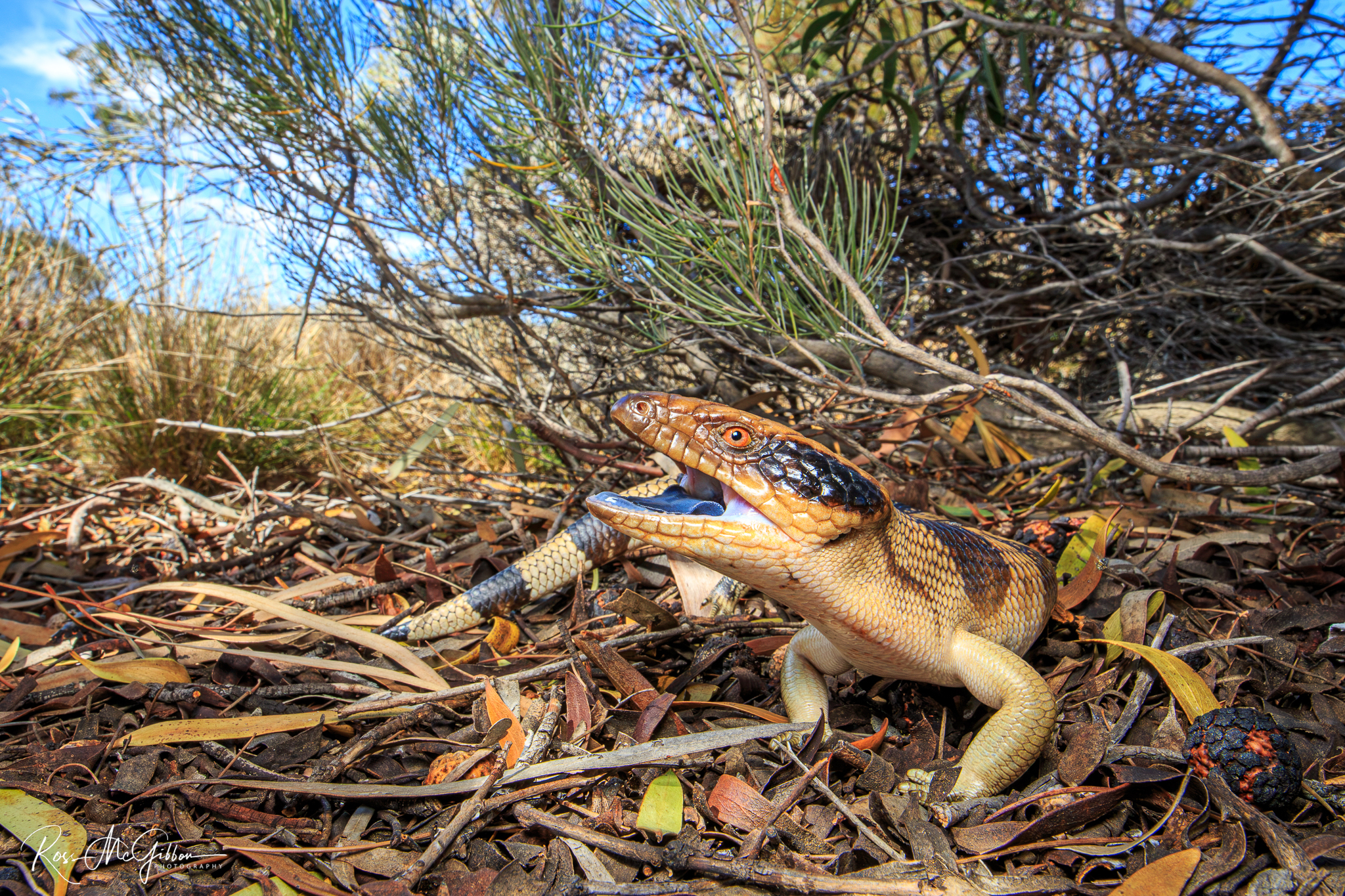
Western Blue-tongued Skink (Tiliqua occipitalis), near Moorine Rock, Western Australia. Our first live reptile of the trip and a fitting start to the journey into the outback.
As we travelled further east, we entered the Goldfields. The country became increasingly dry and unforgiving, with sparse vegetation growing from poor soils and long stretches of road separating one patch of suitable habitat from the next. To the average person, this might seem like an inhospitable place for wildlife, but it is remarkable how well reptiles have adapted to these harsh conditions. Look a little closer and the Goldfields reveals a surprising diversity of life, including some remarkably colourful species whose bold patterns and contrasting colours seem almost exaggerated against the region’s rich red soils. The Goldfields Shingleback is perhaps the best example, with some individuals displaying striking black and orange colouration. We were hoping to encounter one along the way.
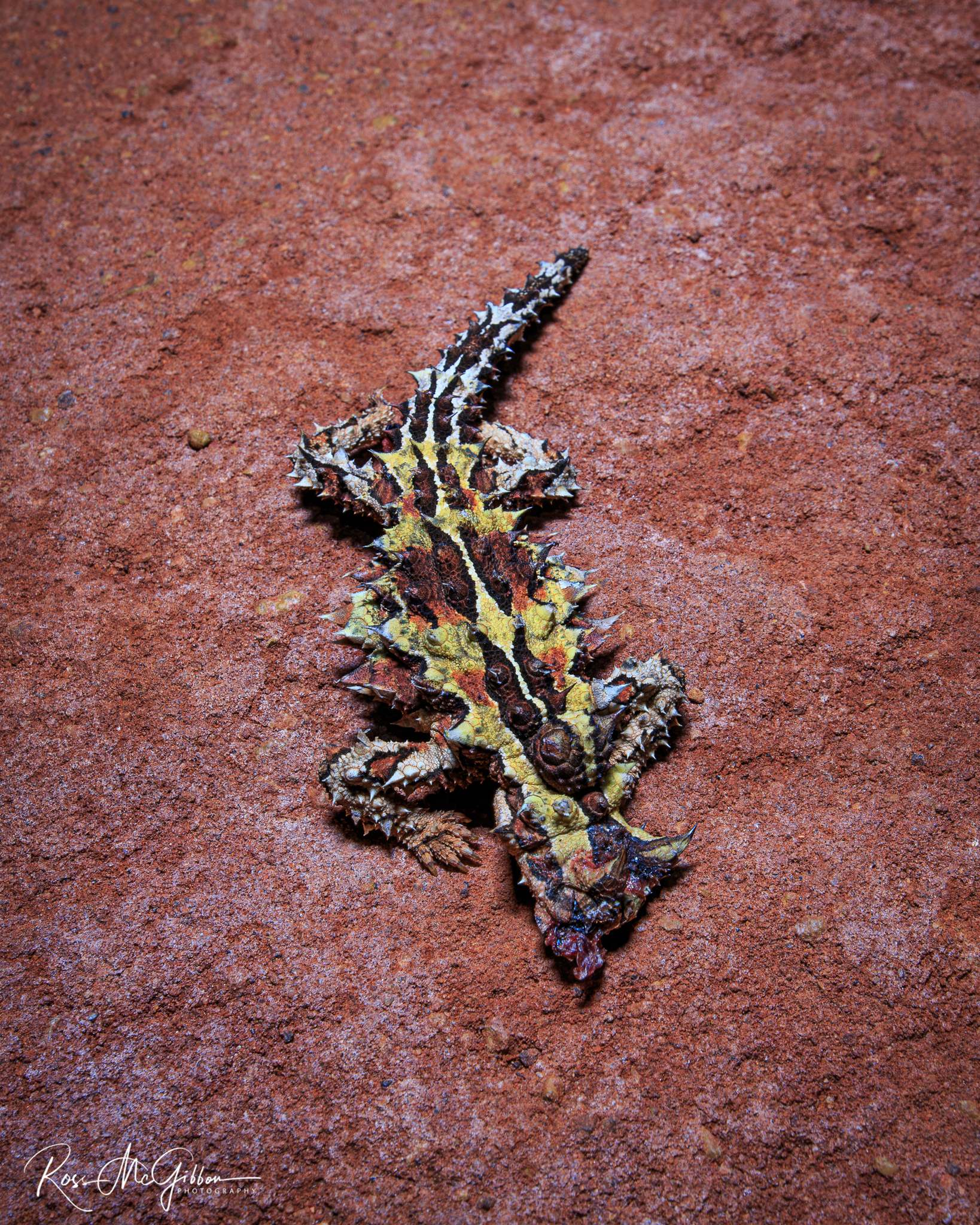
Other than the taipan, Tim’s most desirable target for the trip was one of the region’s striking orange and black-headed Western Brown Snakes. He had never seen this colour form before and was hoping we might get lucky. A short time later, just as the bitumen gave way to dirt outside Kalgoorlie, Tim shouted, “Stop! Snake!” I hit the brakes. We hurried over, only to discover that his wish had been granted in the worst possible way. The Western Brown Snake was dead on the road. There was little we could do except shake our heads at the irony and continue. The rest of the afternoon followed the familiar pattern: drive, brake, disappointment, accelerate, repeat. Three dead Sand Goannas and a squashed Thorny Devil added to the tally before, finally, a live Goldfields Shingleback appeared beside the road, with the exact striking black and orange patterning we had been hoping to find. After so many dead reptiles, it felt like a small victory.
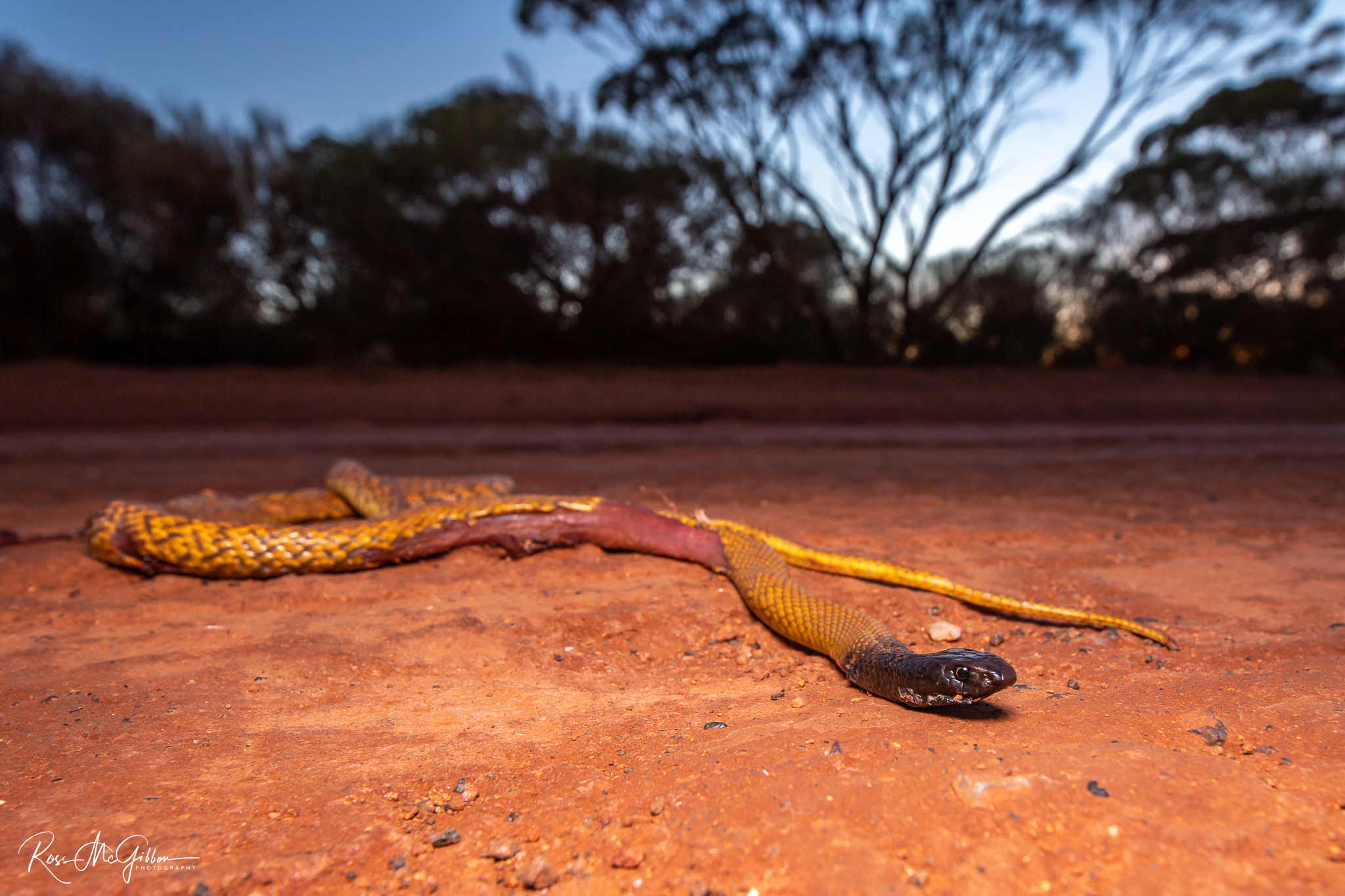
Above: Road-killed Western Brown Snake (Pseudonaja mengdeni). Few things are more frustrating than finding the very species you’ve travelled hundreds of kilometres to photograph lying dead on the road.
Below: Road-killed Thorny Devil (Moloch horridus). Finding dead reptiles is an unavoidable part of travelling the roads in search of wildlife, but it hits differently when the victim is an iconic and much-loved species like the Thorny Devil.
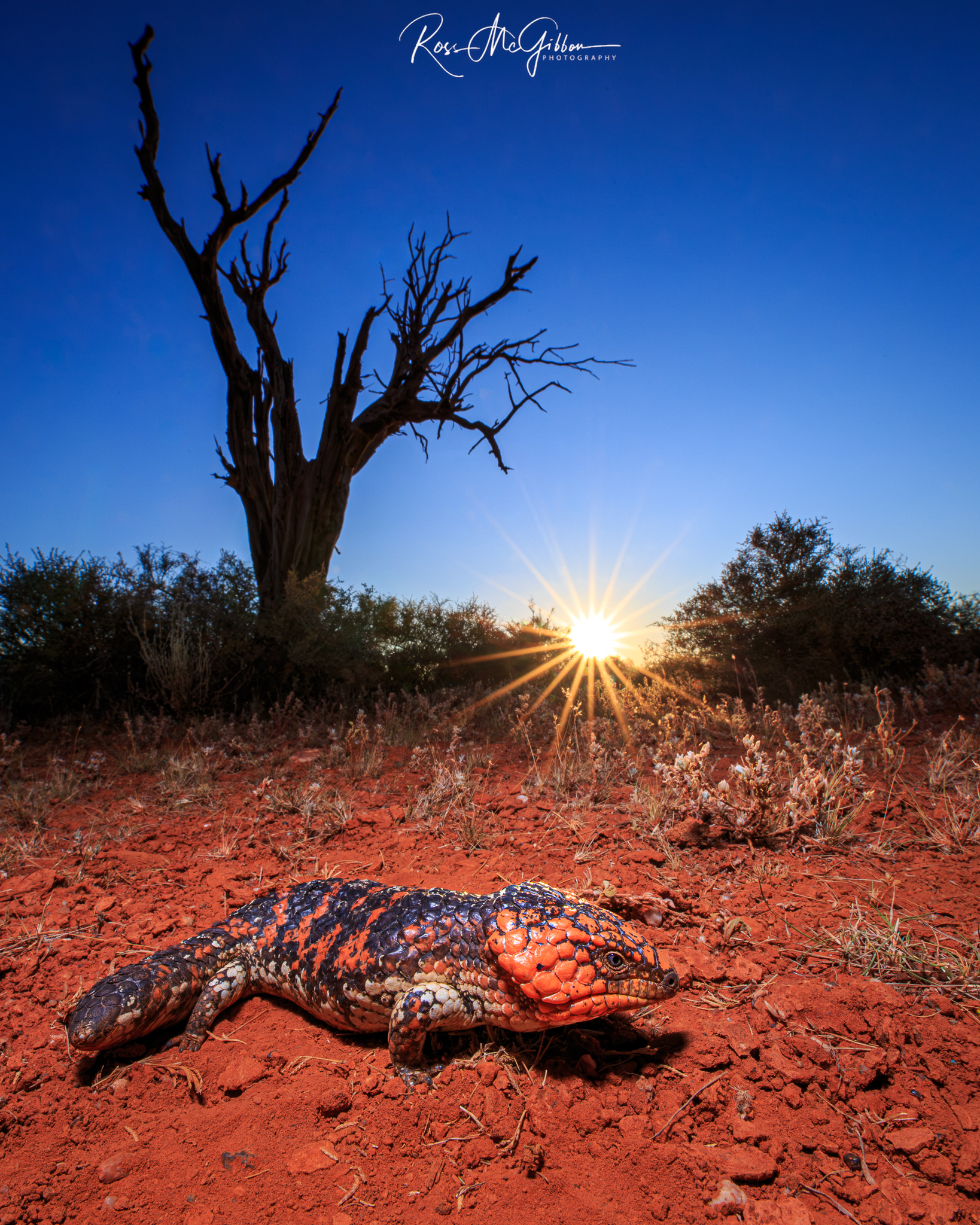
Goldfields Shingleback (Tiliqua rugosa), displaying the striking black and orange colouration that makes this form so distinctive against the rich red soils of Western Australia’s Goldfields.
That evening we stopped for dinner as the sun disappeared and discussed what we might find after dark. Desert Death Adders were high on the wish list, but the falling temperature was not encouraging. Our instincts proved correct. By around 11 pm, a few geckoes were all we had found and the swags were looking increasingly attractive.
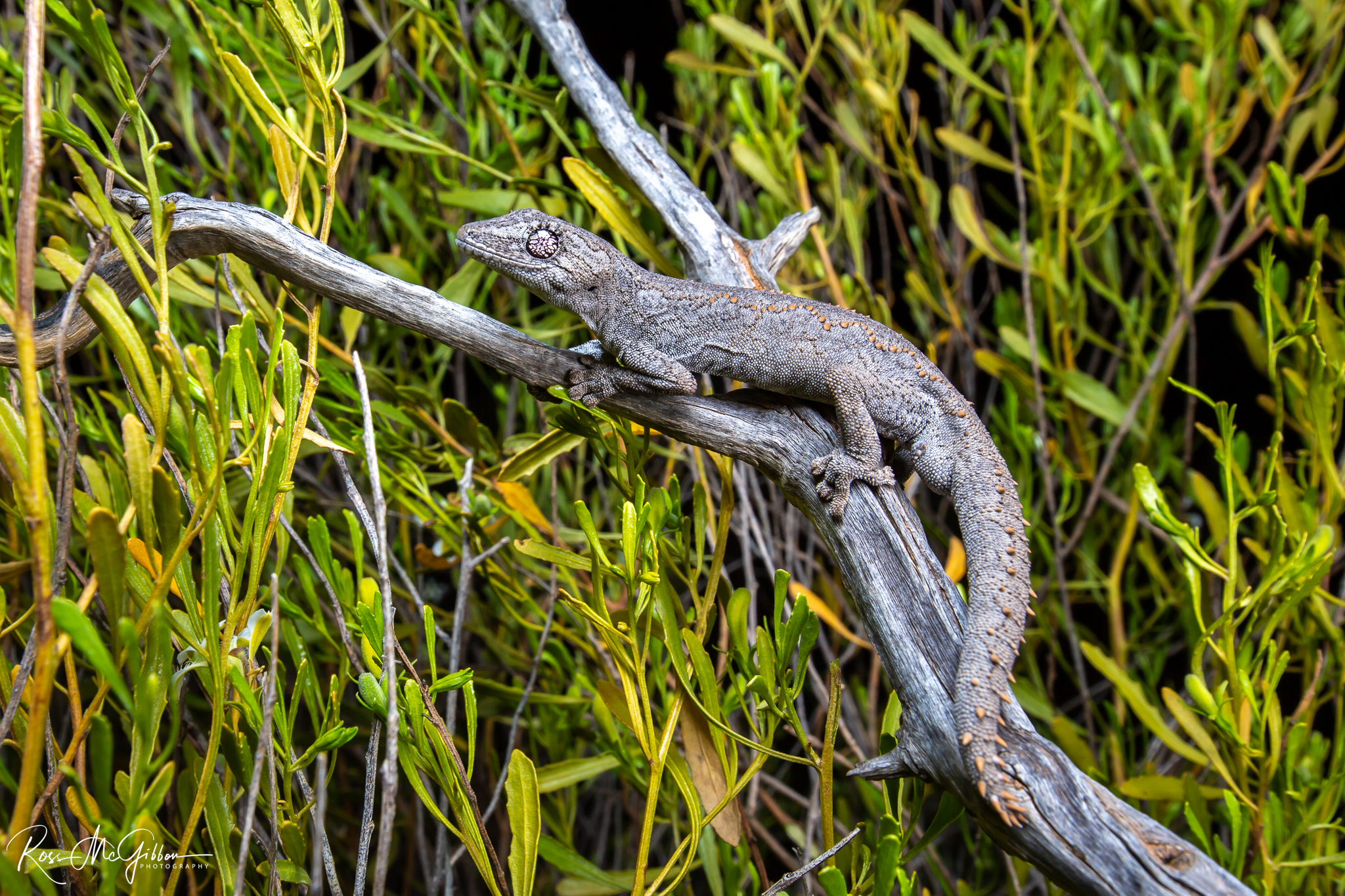
Thorn-tailed Gecko (Strophurus assimilis), one of the few reptiles active during an otherwise unproductive first night near Kalgoorlie as we made our way towards the Great Victoria Desert.
The next morning we were up early, with close to 1,000 kilometres of driving ahead of us if we were to reach taipan habitat by the following morning. Laverton was our final stop for fuel, supplies and, importantly, phone reception. Tim called home to let his partner, Amanda, know that we were about to disappear into the desert and might be out of contact for up to a week. Given what had happened to Tim on the previous taipan expedition, I had to admire Amanda’s understanding of his passion.
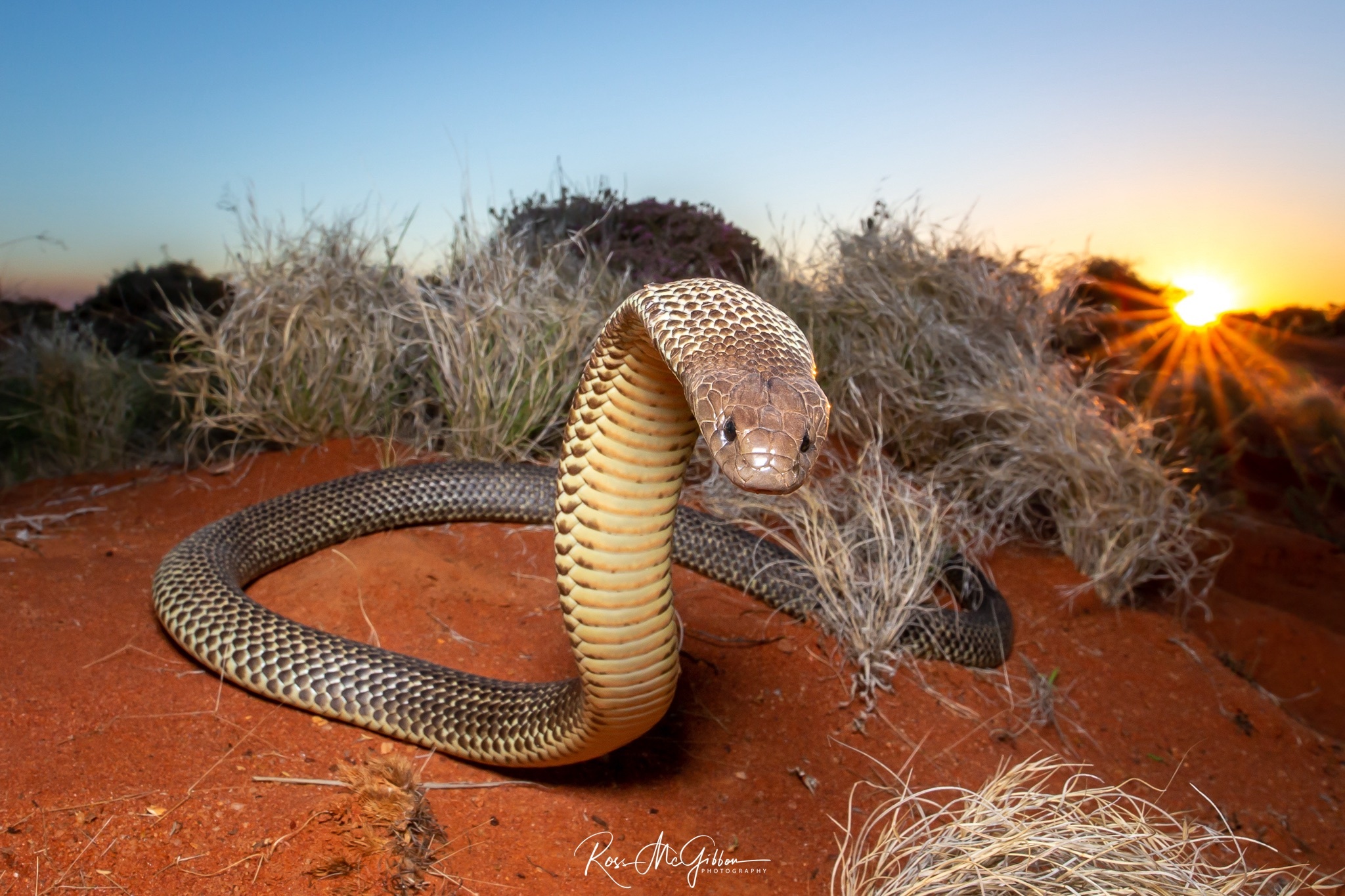
From Laverton, the sealed road eventually gave way to dirt as we headed deeper into the Great Victoria Desert. The road was surprisingly good in places, allowing us to make decent progress, until we had to brake for our first live snake. A Mulga Snake was sitting on the roadside berm with its head tucked into the vegetation. We pulled up in a cloud of dust and scrambled to ready our cameras. The snake had barely noticed us before suddenly realising it had company. Instead of fleeing, it reared up and advanced towards us, flattening its neck in a dramatic defensive display. The transformation was impressive. One moment it was an inconspicuous snake beside the road; the next it was behaving like a cobra, trying to make itself look larger and more intimidating. We photographed the display before the snake eventually decided we were not worth the effort and disappeared into the vegetation. Nothing like a fast-and-furious shoot with a highly venomous Mulga Snake to get the adrenaline going. “No Red Bull needed for this drive,” I joked.
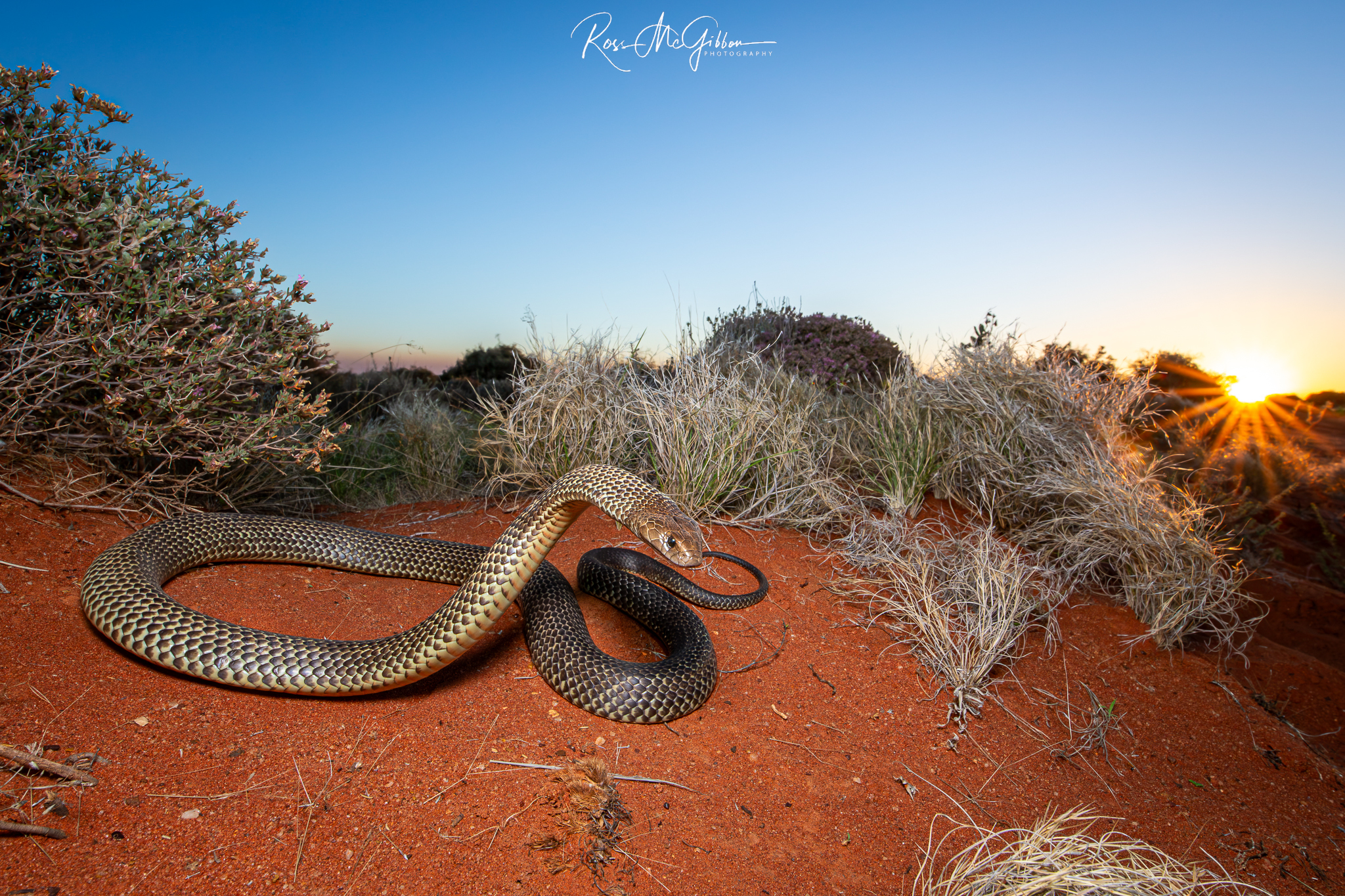
Above: Mulga Snake (Pseudechis australis). A glimpse of one of Australia’s most impressive elapids in the vast Great Victoria Desert, Western Australia.
Below: Mulga Snake (Pseudechis australis), Great Victoria Desert, Western Australia. Advancing with its head raised and body flattened in a defensive display, resulting in one of my all-time favourite photographs of this species.
By nightfall, we were only partway to where we needed to be. We still had hundreds of kilometres to cover, yet the desert was producing enough reptiles to make stopping irresistible. We encountered two more Mulga Snakes and numerous geckoes along the way before finally reaching taipan territory at around 1 am. It was time for some much-needed rest before the big day ahead.
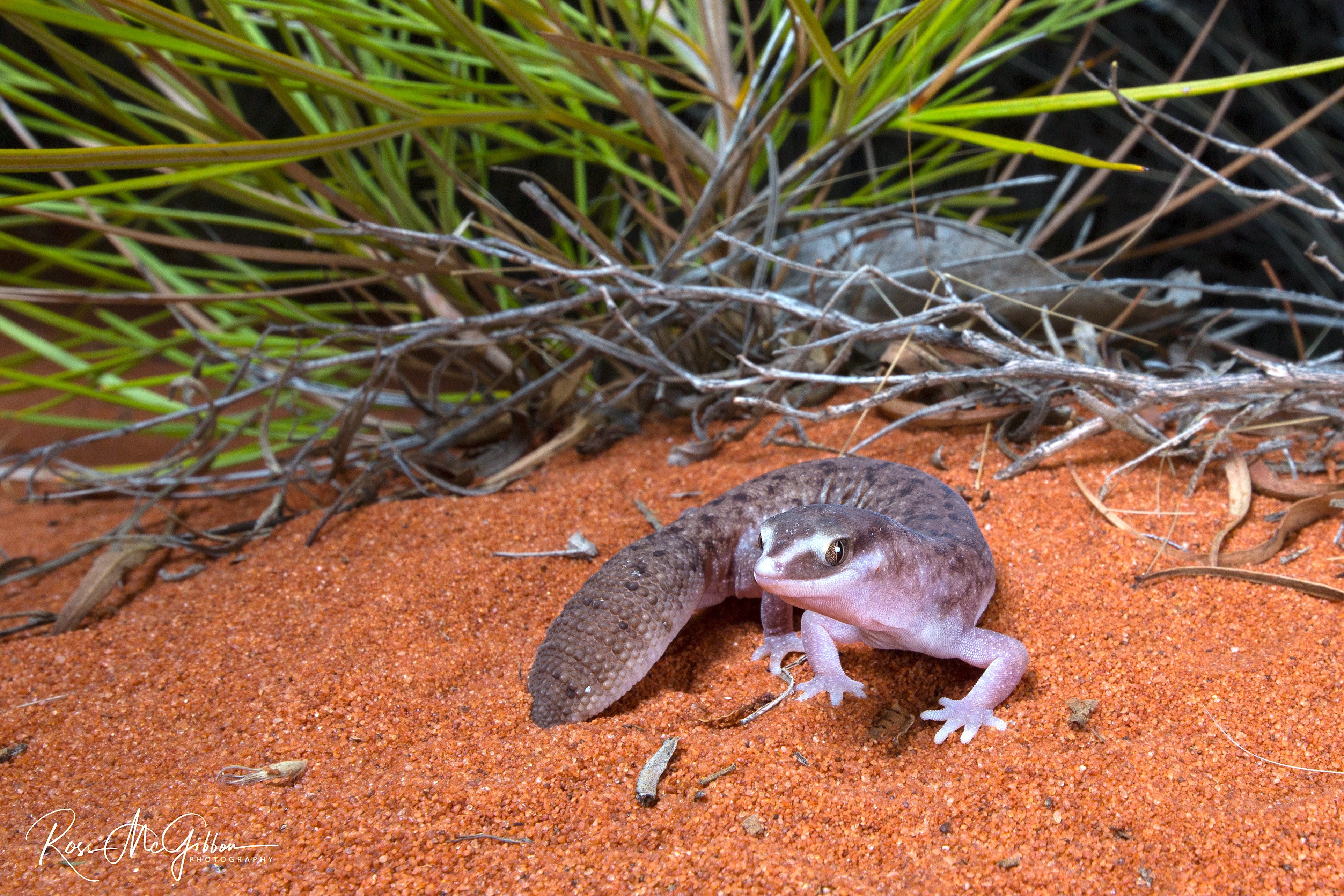
Desert Fat-tailed Gecko (Diplodactylus laevis), Great Victoria Desert, Western Australia. Like many desert geckoes, this species shelters in underground burrows, often those excavated by spiders. Its distinctive fleshy tail can act as a plug at the entrance, helping keep predators out and moisture in.
My alarm went off at 5 am. On any other morning, after only a few hours of sleep, I would have been tempted to throw it into the nearest patch of Spinifex, but this was different. I sprang from my swag and woke Tim with a drawn-out call into the darkness: “Tiiiiiim. Taiiiiiiiiiipans.” A weary but enthusiastic “Yewww” came from his swag. By 5.30 am we were on the road.
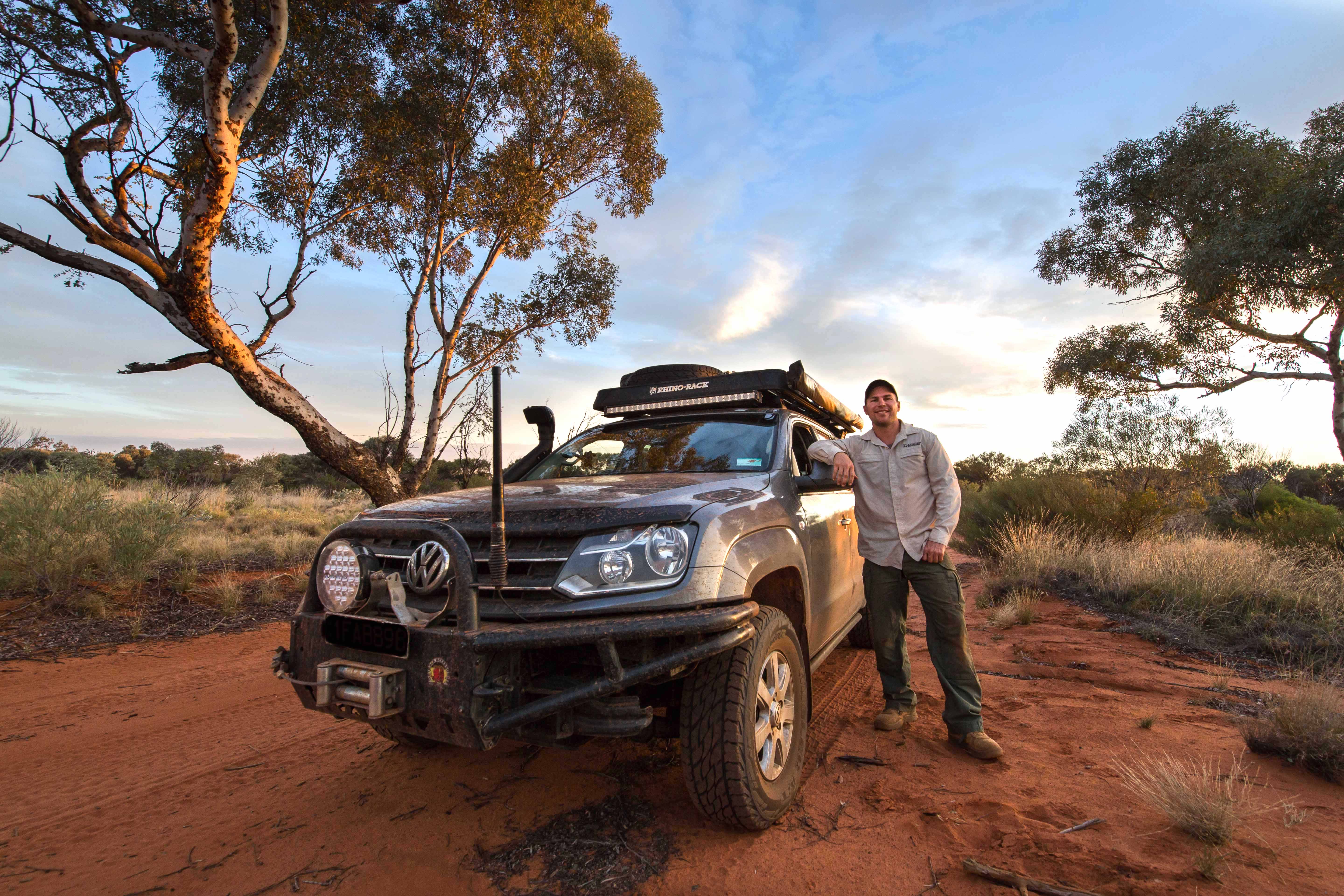
The central deserts of Australia are among my favourite places on Earth. There’s an inexplicable sense of freedom in all that open space. After thousands of kilometres on the road, I couldn’t have been happier to finally be in the Great Victoria Desert.
Finding a Western Desert Taipan was never going to be a matter of simply walking around until one appeared. We needed to cover ground and hope that we happened to be in the right place at the right time. Road cruising offered our best chance. Once warmed by the morning sun, a taipan may move across the landscape in search of prey, and a vehicle travelling slowly along suitable tracks allows a huge amount of country to be scanned for a snake crossing or basking on the road.
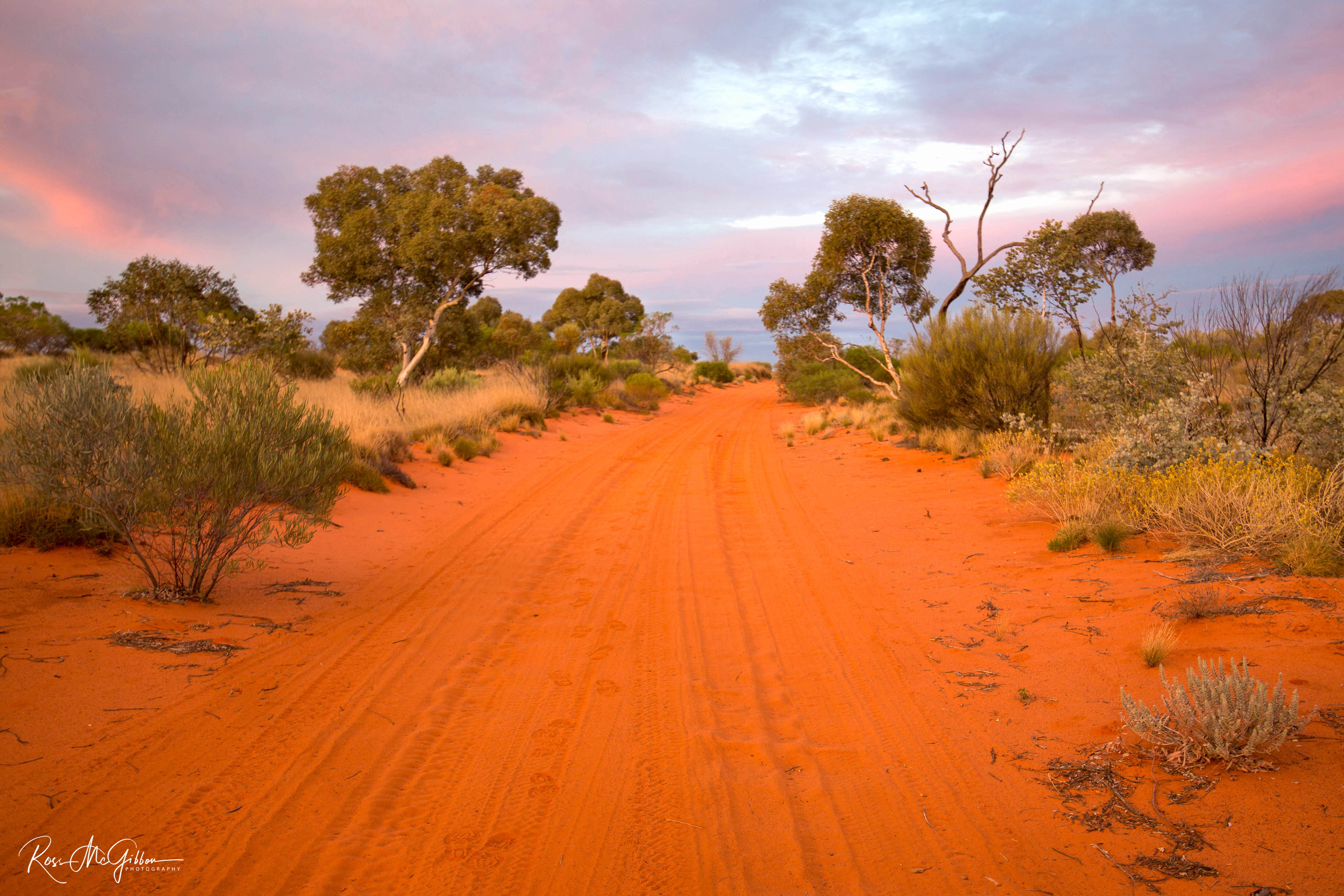
A typical stretch of red dirt track through the Great Victoria Desert, where slow road cruising gave us the best chance of spotting a Western Desert Taipan crossing or basking on the road.
It is also an exercise in patience. We drove. Nothing. We drove some more. Still nothing. After almost three hours, we stopped for a short break. Ten minutes later, the fear of missing the snake became stronger than the desire to rest. “Shall we?” We climbed back into the vehicle.
About fifteen minutes later, everything changed.
I spotted a long, dark snake moving slowly across the track ahead. At that size, there was no mistaking it. I was out of the passenger door before Tim had even properly stopped the vehicle, with him close behind, camera in hand. There it was. The Western Desert Taipan. Around 1.8 metres long, it continued steadily across the track. As we approached, it raised its head and appeared to assess us before slowly continuing on its way, seemingly unfazed by our presence. Given their speed and agility, I had expected the snake to regard us as a potential threat and make a rapid escape. Instead, it seemed almost indifferent. I couldn’t help wondering whether it was simply a calm individual or whether its remote existence meant it had less reason to be wary of people than snakes in more urban areas.
My first photograph was deliberately wide. I wanted the snake in the middle of the road, surrounded by its enormous desert landscape. It was a record of my first glimpse of Oxyuranus temporalis, and somehow that felt more important than immediately chasing the perfect portrait. We slowly moved closer until we were within about two metres. The snake continued travelling through the patchy Spinifex, and we photographed it while occasionally pausing to adjust our position and allow it to continue. The encounter was becoming surreal. I had spent months thinking about this moment, travelled roughly 1,500 kilometres from Perth and driven deep into one of the most remote landscapes in the country, and the snake was behaving as though we were barely worth noticing.
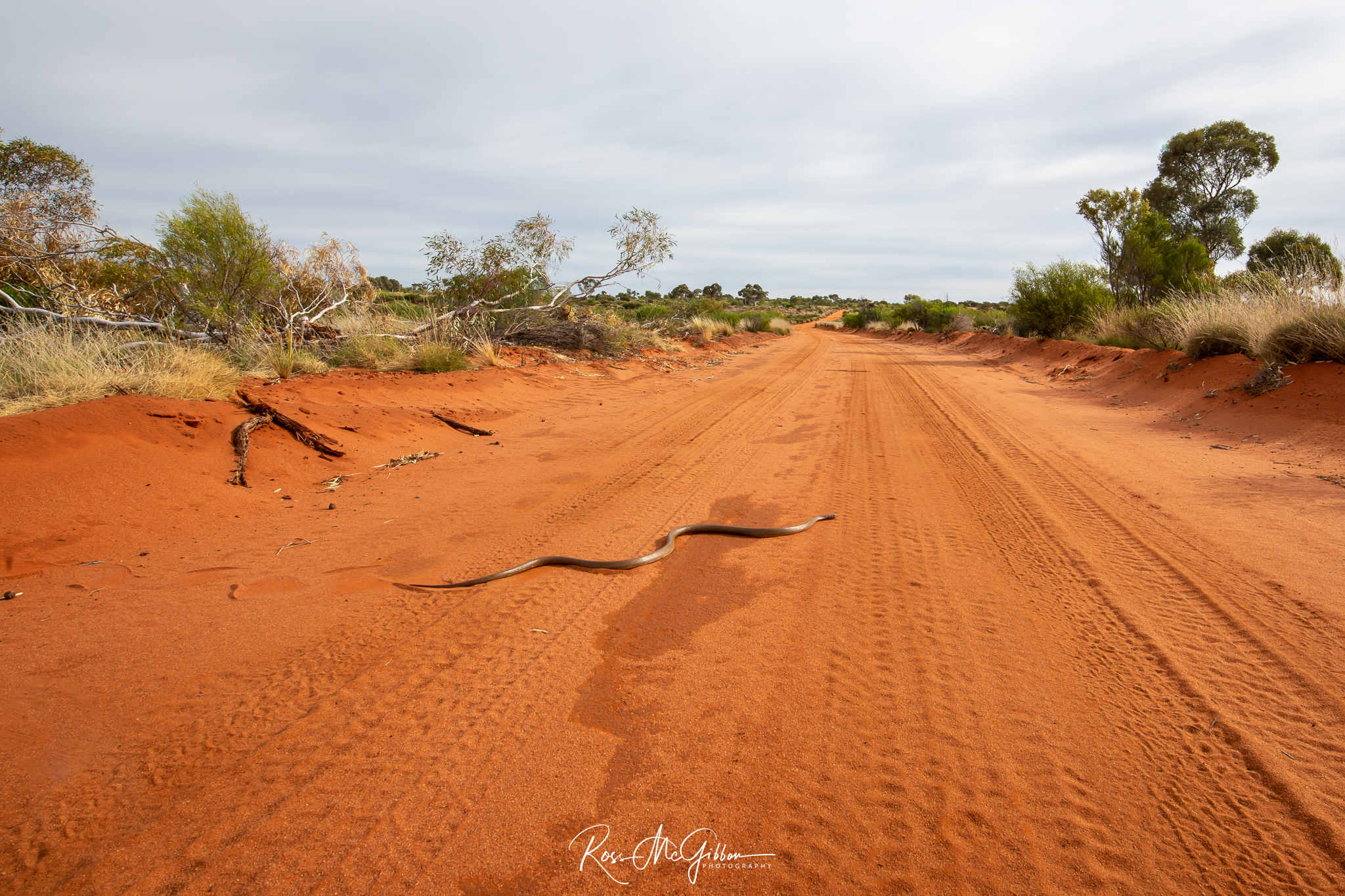
Western Desert Taipan (Oxyuranus temporalis), Great Victoria Desert, Western Australia. After years of wondering and months of anticipation, there is no better sight on an expedition like this than your target finally appearing on the track ahead.
Eventually I positioned myself in its path. As it approached to within about a metre, it raised its head and opened its mouth slightly, revealing the upper portions of its fangs. That was enough of a warning for me, and I allowed it to continue on its way. The resulting photograph became one of my favourite images from the expedition, not because it showed a spectacular strike or dramatic defensive display, but because it captured a fleeting moment of communication between an animal and a human who had pushed close enough to receive the message.
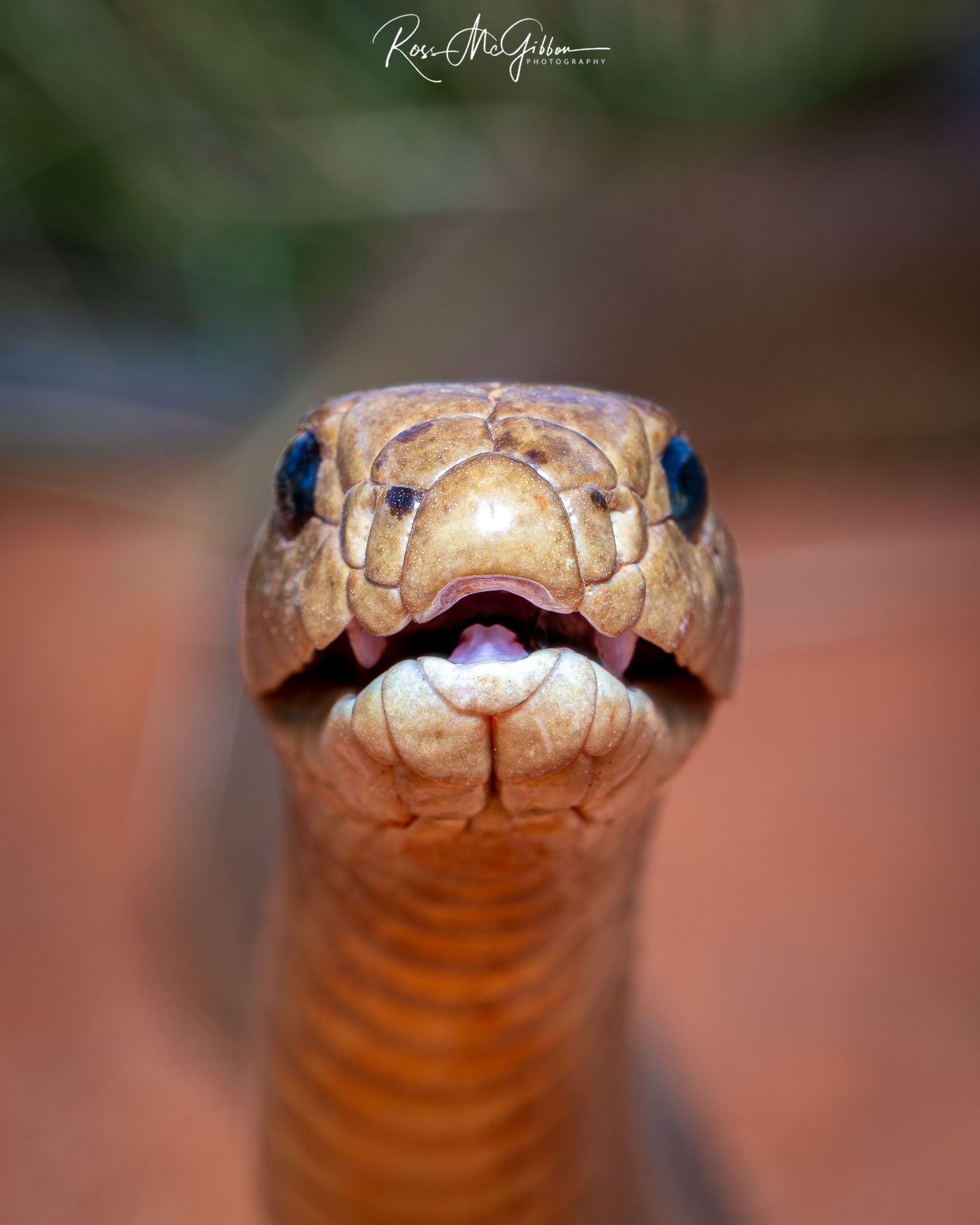
Western Desert Taipan (Oxyuranus temporalis), Great Victoria Desert, Western Australia. A moment of mutual communication at close quarters, resulting in one of my favourite photographs from the expedition.
By mid-morning, the mission had been accomplished and we could hardly stop grinning. We had found the snake we had travelled so far to see and, better still, had been given an extraordinary photographic encounter. For a species so rarely encountered by Western naturalists, the opportunity felt almost absurdly fortunate. But our success created a new problem. Now we wanted another one. We resumed searching immediately.
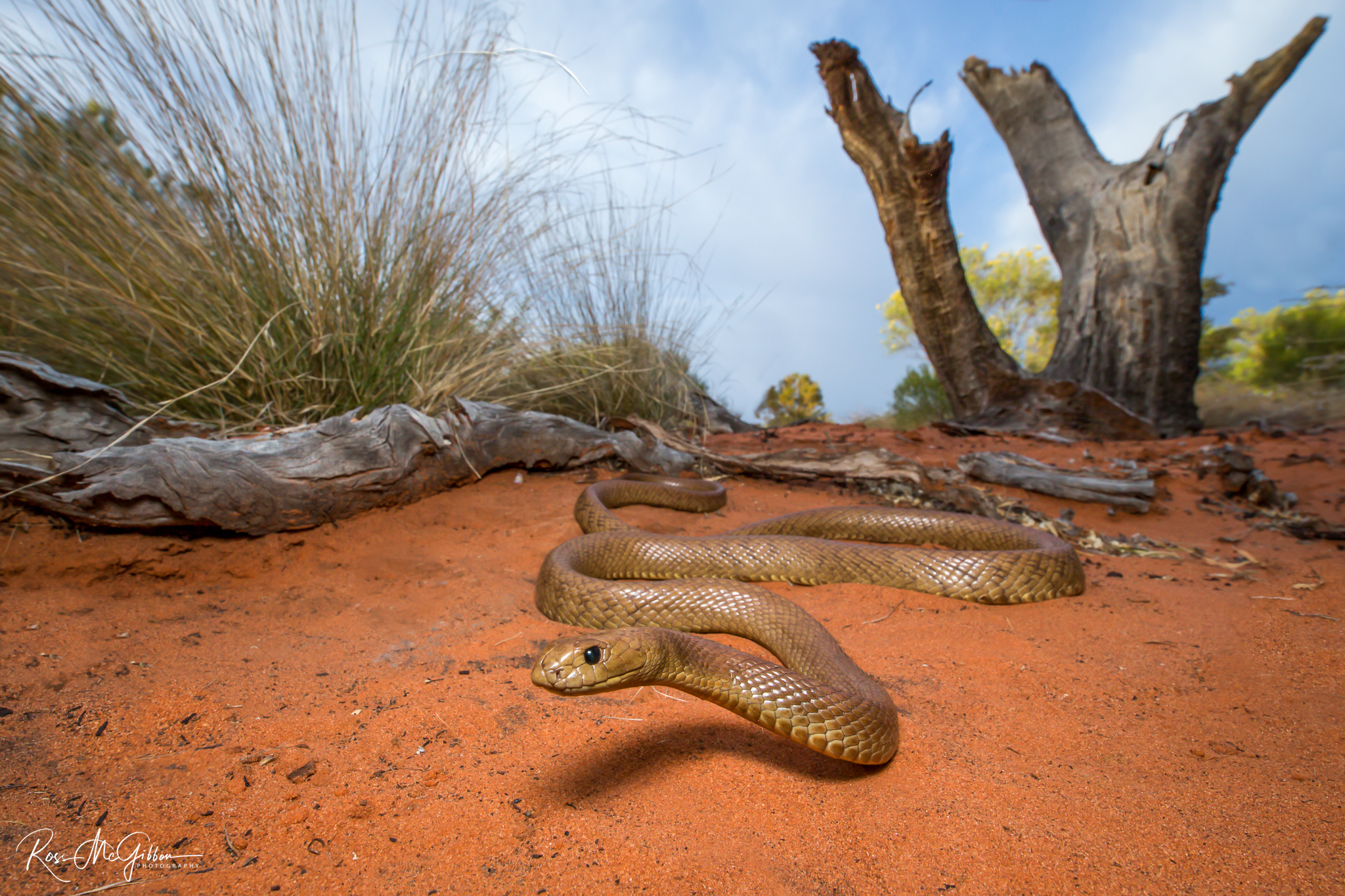
Western Desert Taipan (Oxyuranus temporalis), Great Victoria Desert, Western Australia. A rare glimpse of one of Australia’s least-known snakes in the vast, remote landscape it inhabits.
Surely, after finding one taipan so quickly, the next one could not be far away. For the next three days we searched the same habitat in all directions, driving track after track and scanning the road, Spinifex and sandy margins. But finding another large, mobile elapid during the day proved far harder than we had hoped. There were no more taipans, Mulga Snakes or Western Browns. A few Military Dragons scurried across the tracks, while a handsome male Crested Dragon in full breeding colours provided one worthwhile photographic encounter, but otherwise the desert was remarkably quiet. Finding that first taipan so soon in the trip had made the species suddenly feel common, but in reality nothing had changed. We had simply been extraordinarily lucky to be in exactly the right place at exactly the right time. The Great Victoria Desert did not owe us another sighting, and looking back, that was part of what made the first encounter so special.
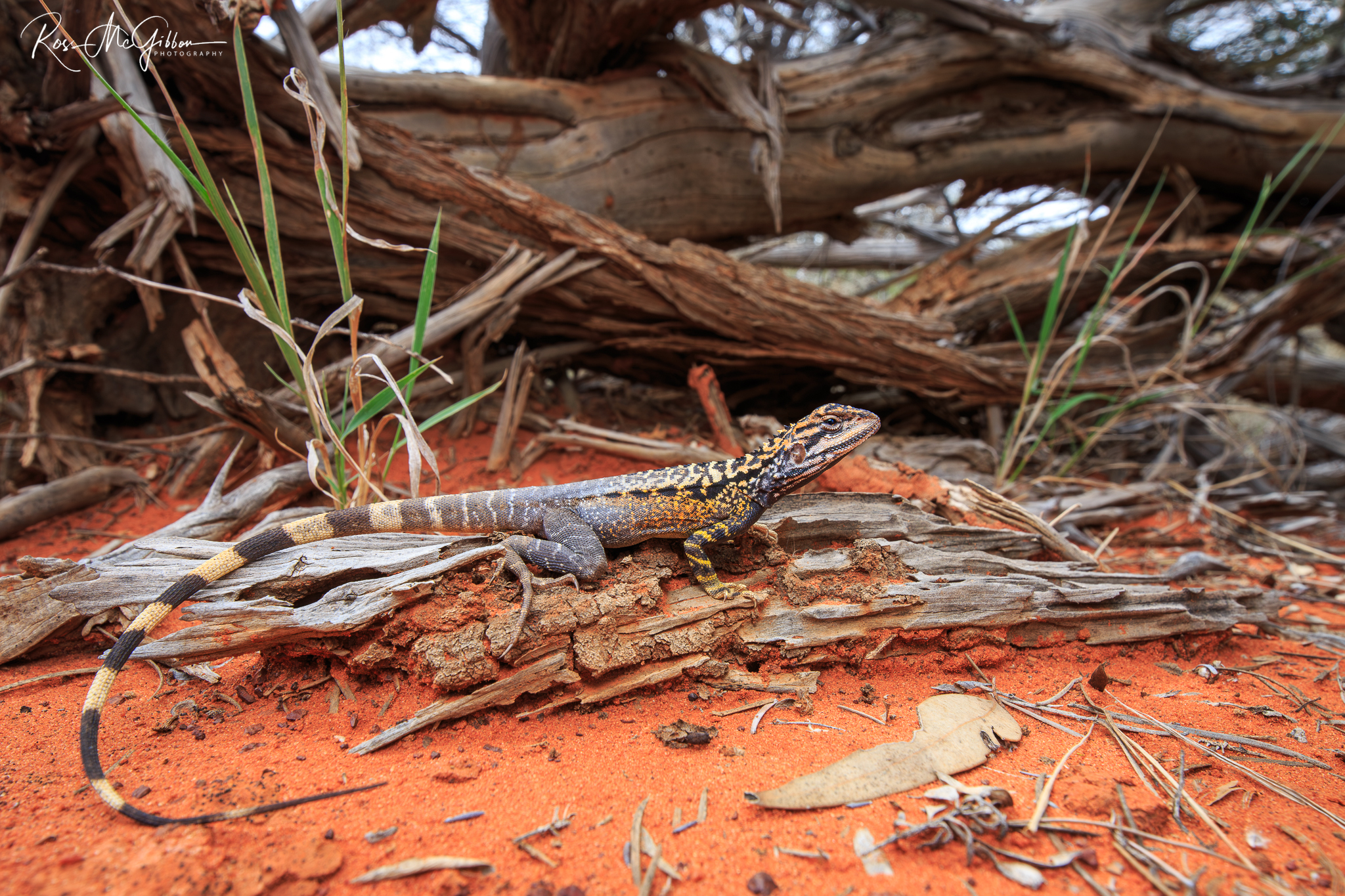
Above: Crested Dragon (Ctenophorus cristatus), Great Victoria Desert, Western Australia. A handsome male displaying his full breeding colours, a welcome find during an otherwise quiet few days of searching for the Western Desert Taipan.
Below: Tim enjoying a well-earned cold one as the sun sets over the outback. After long days searching for taipans, there are few better ways to wind down than a cold beer and a desert sunset.
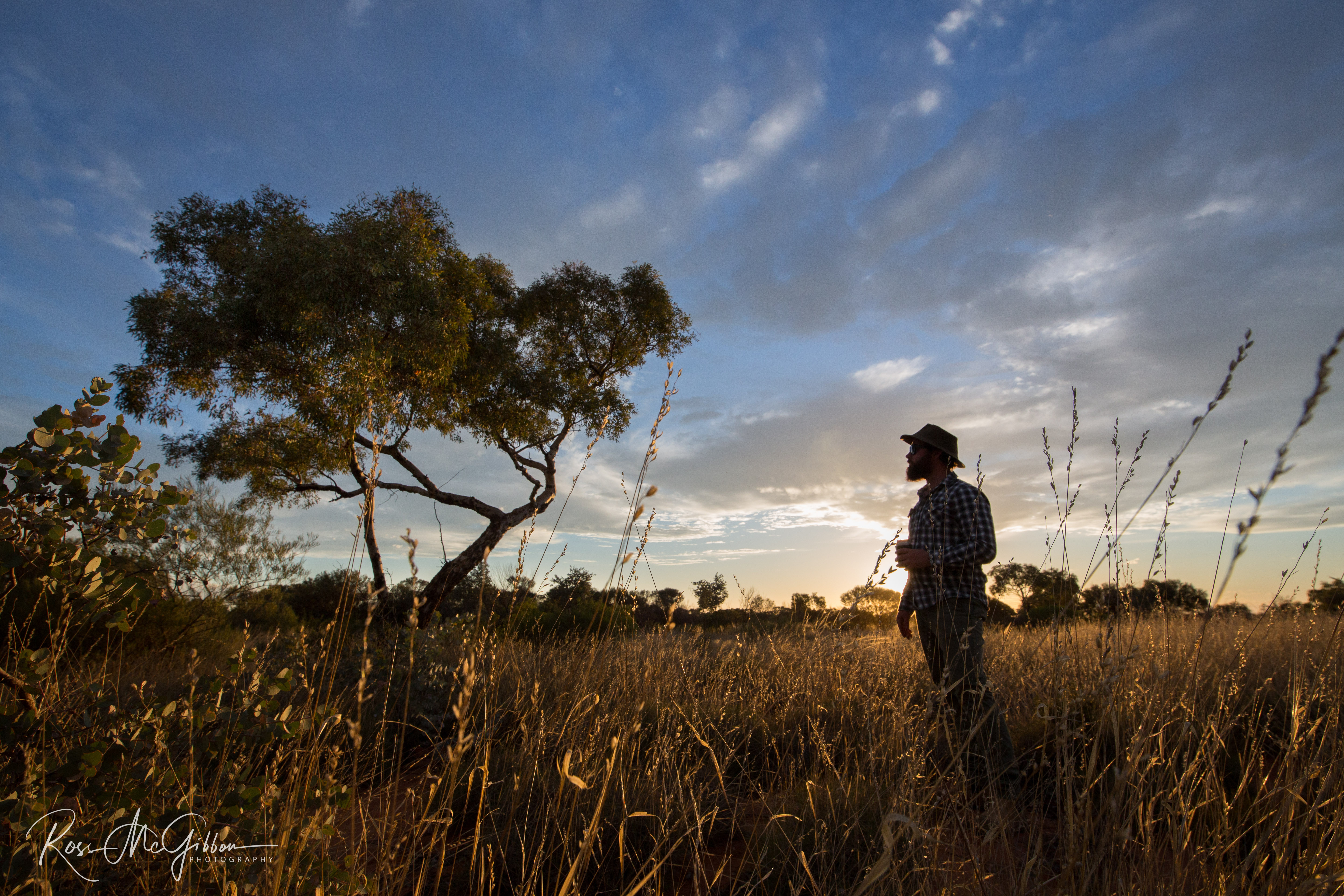
After dark, there was a little more to see, with a handful of geckoes and a lone Desert Banded Snake putting in an appearance.
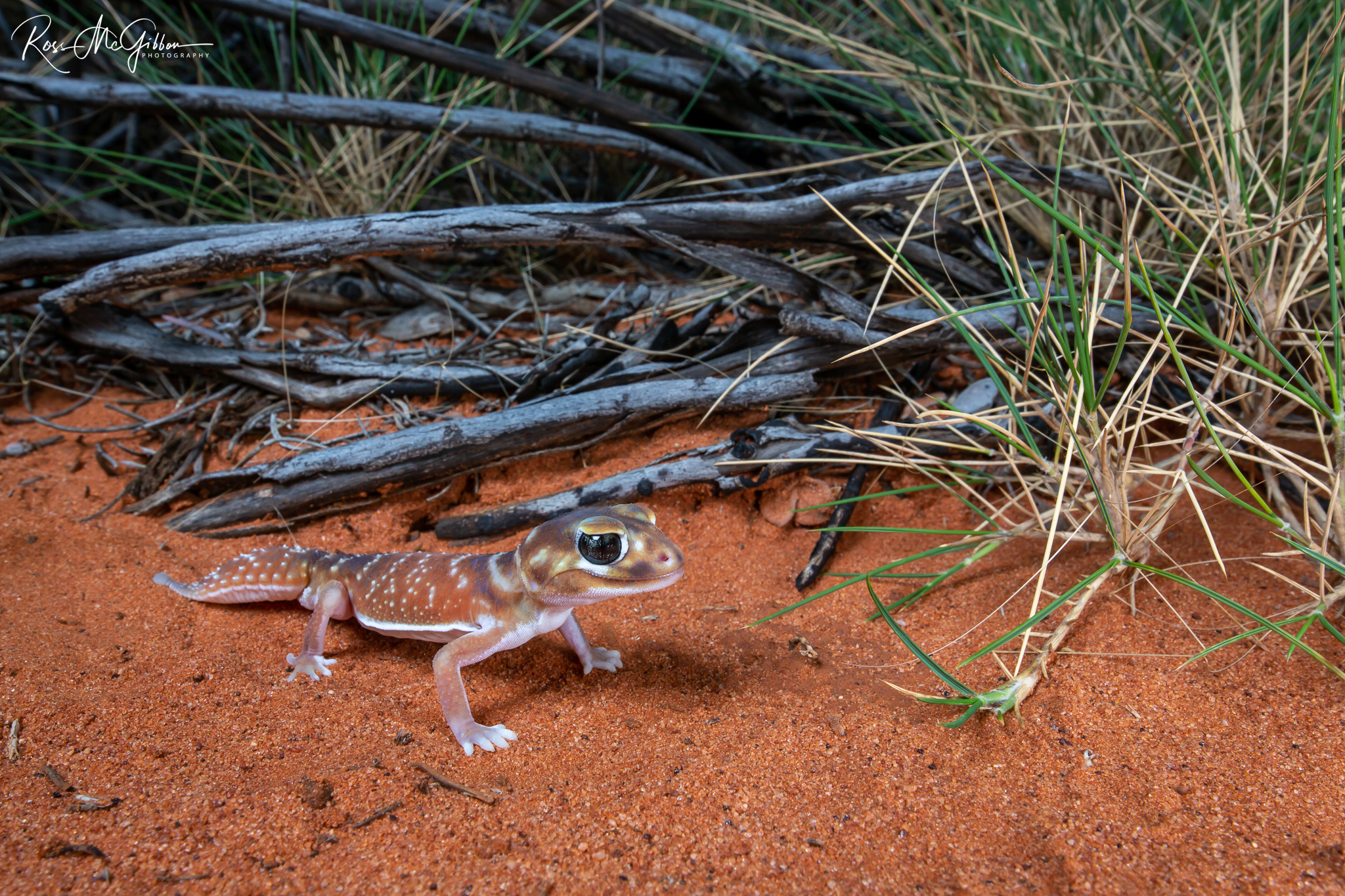
Above: Smooth Knob-tailed Gecko (Nephrurus levis), Great Victoria Desert, Western Australia. A wonderfully distinctive nocturnal gecko, with intricate skin texture and a tail that gives the species its name.
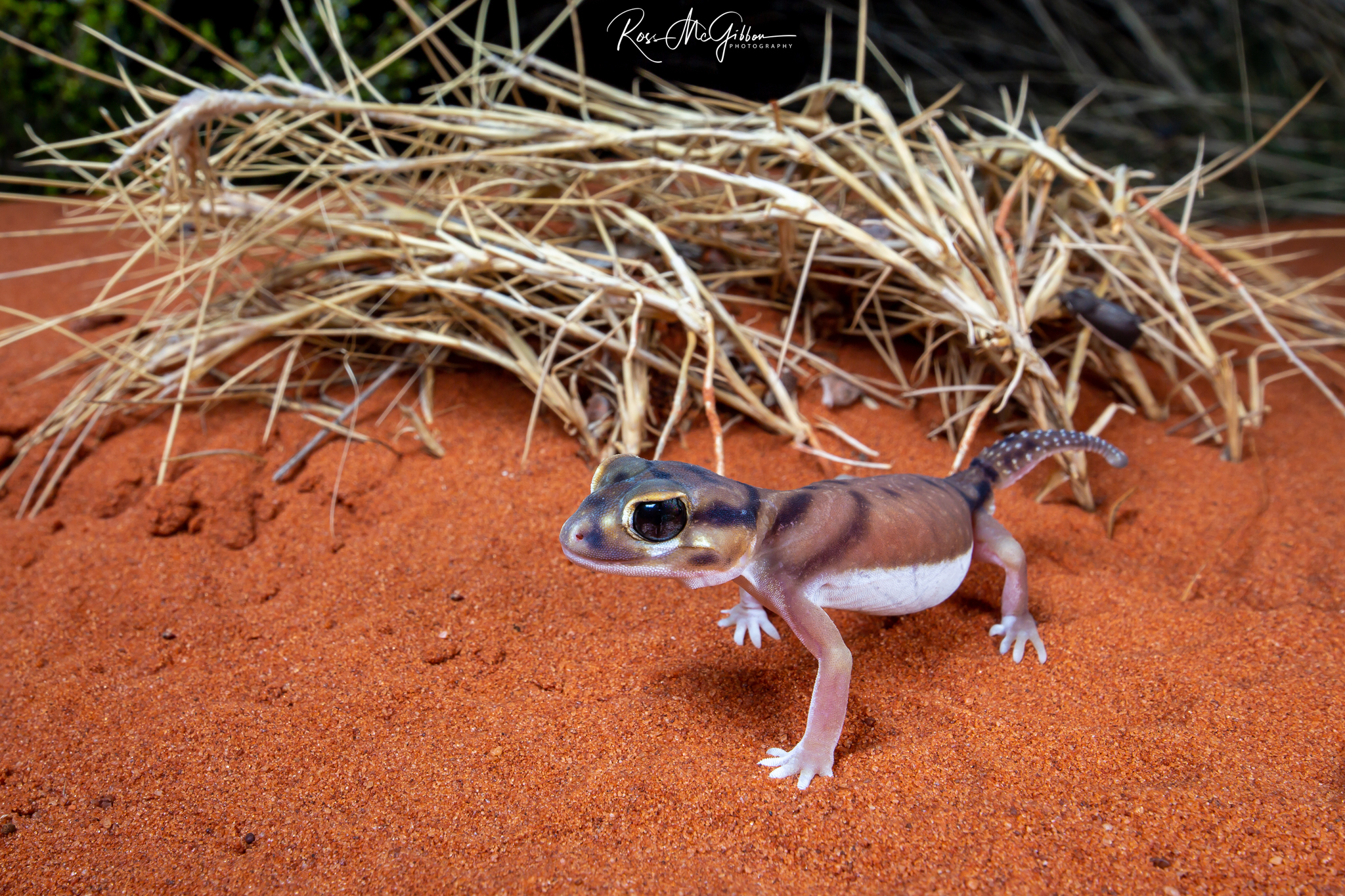
Below: Pale Knob-tailed Gecko (Nephrurus laevissimus), Great Victoria Desert, Western Australia. One of the many vibrantly patterned individuals we encountered during our time exploring the desert after dark.
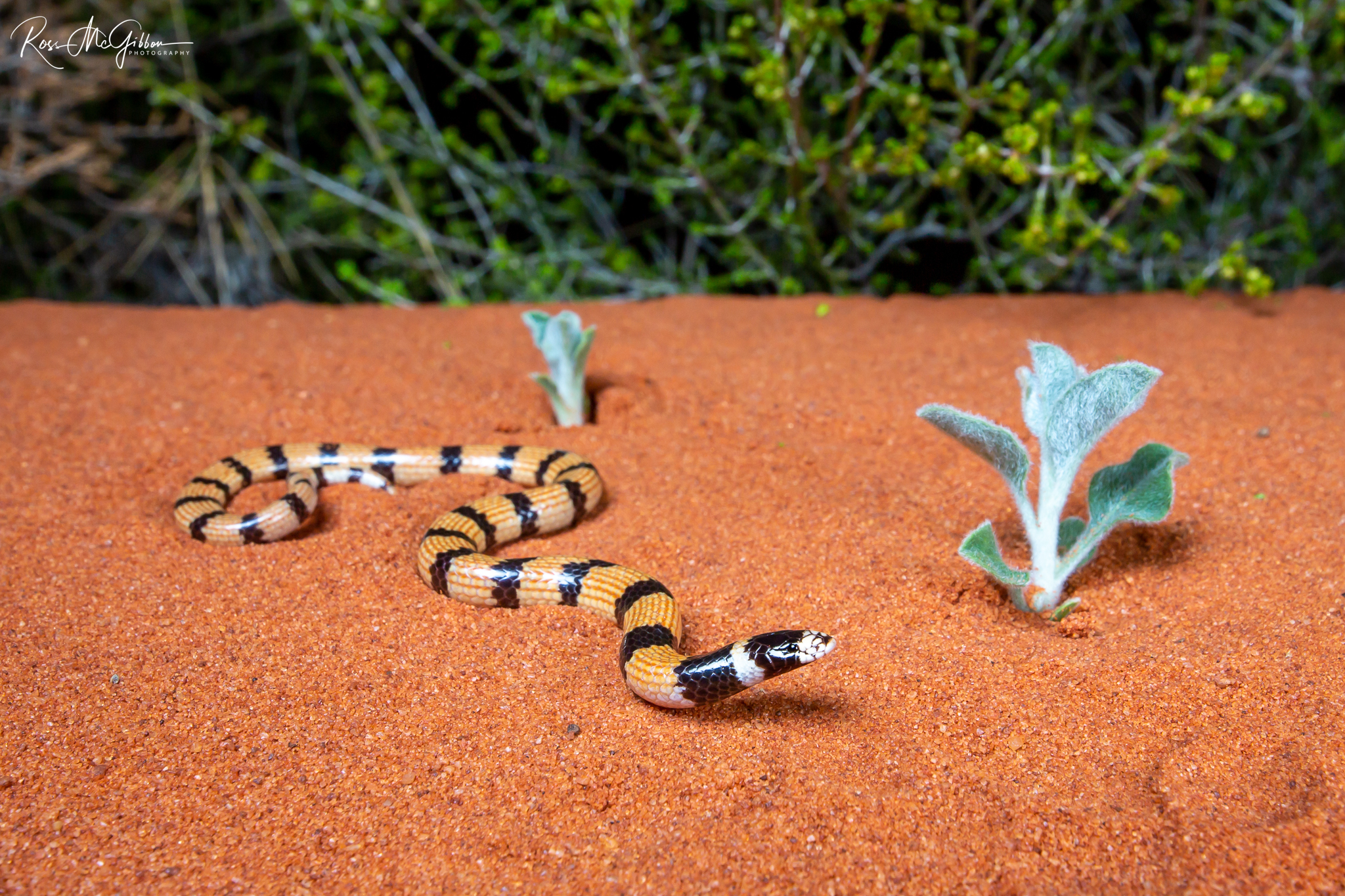
Desert Banded Snake (Simoselaps anomalus), Ilkurlka, Western Australia. A small, secretive elapid that spends much of its life hidden beneath the surface, making every encounter a welcome find.
There were still reptiles to find, landscapes to photograph and long stretches of desert to explore, but eventually the expedition had to turn towards home. As every herper does on a serious reptile trip, we had been closely watching the weather throughout the expedition, using temperature and conditions to gauge where and when reptile activity was likely to be at its peak. Laverton was already one of my favourite areas because it sits where the stony soils and Mulga country begin to merge with the red sand and Spinifex that stretches east into the Great Victoria Desert. When the conditions line up, the transition zone can produce an impressive diversity of reptiles.
The forecast was looking particularly promising. Throughout October I had been watching the daytime temperatures steadily climb, and they were now jumping from the low 30s into the low 40s. I knew this was the first major surge towards summer, and expected it to trigger a corresponding spike in reptile activity. My prediction proved correct. As we began lapping the roads around dusk, we were stopping every few metres for something new crossing the road. It was some of the highest reptile activity either of us had ever experienced.
There was another factor contributing to the unusually high traffic. One side of the road had recently been completely burnt out, displacing the countless geckoes, Delmas and other small reptiles that normally use the Spinifex for shelter. With their habitat suddenly gone, huge numbers appeared to be moving across the road in search of somewhere to settle. We quickly lost count of Sharp-snouted Delmas (Delma nasuta) and Jewelled Geckoes (Strophurus elderi), along with various skinks and other geckoes. Every few metres brought something new, and neither of us wanted to stop.
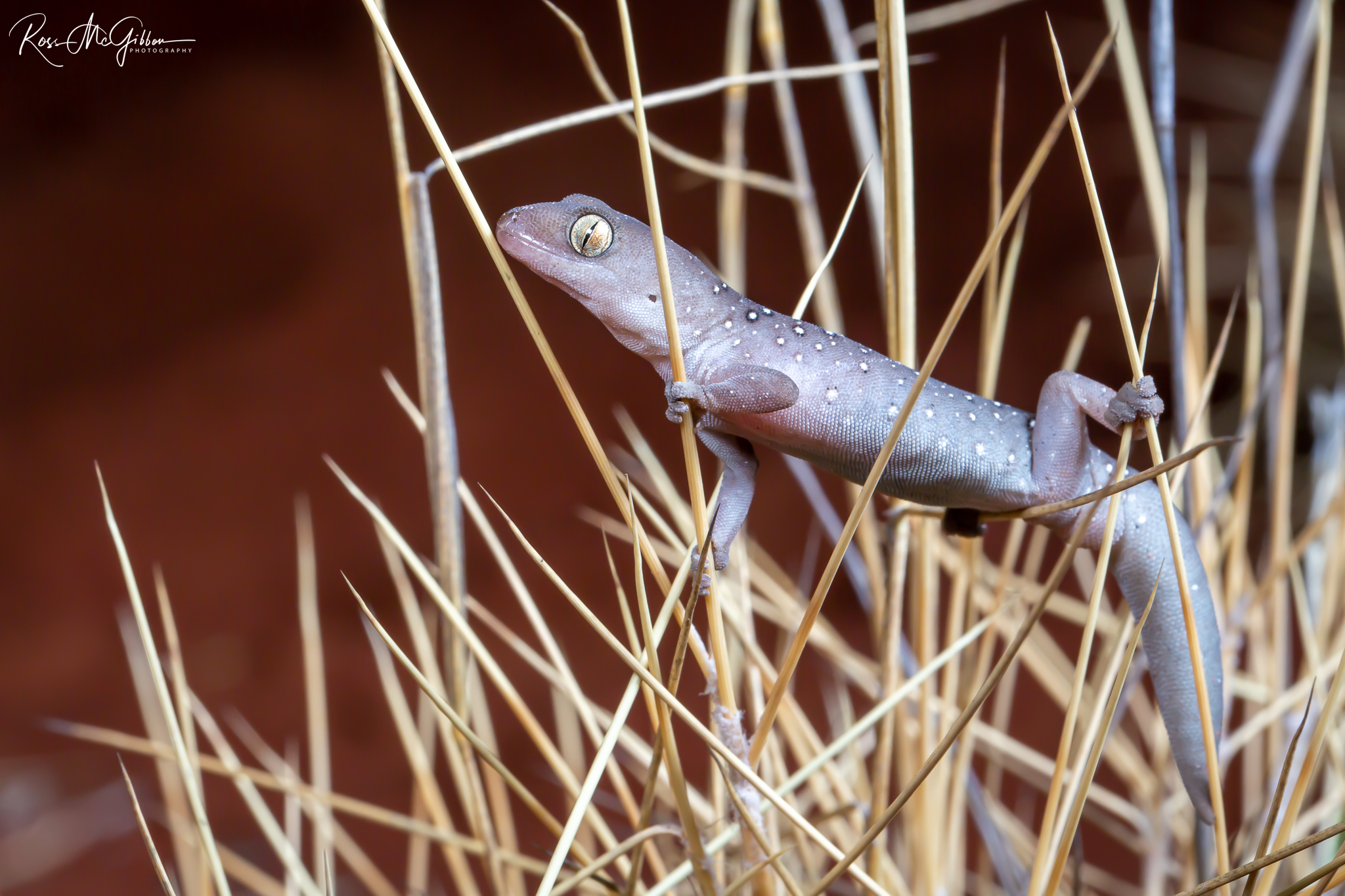
Jewelled Gecko (Strophurus elderi), Laverton, Western Australia. One of our most numerous finds, we eventually lost count. These geckoes shelter in spinifex by day, so after fire burnt away large areas, many were displaced and searching for alternative living arrangements.
Then we encountered a Mulga Snake. It was only about 30 centimetres long. With a vehicle approaching in the distance, I quickly moved in to get it out of harm’s way. I successfully shifted it off the road, but as we watched, it doubled back and headed straight onto the road again. By then the same vehicle was getting much closer, forcing me into a more hurried second attempt. This time, the snake bit me on the little finger of my right hand. Until then, one of the questions I was most often asked was, “How many times have you been bitten?” My answer had always been, “I’ve been bitten by more reptiles than I can remember, but never by anything dangerously venomous.” That was about to change. As my finger began to throb from the venom, I immediately recognised the seriousness of the situation.
A Mulga Snake bite can cause medically significant envenoming, and the first priority was to apply first aid, slow the spread of venom and get medical attention. I bandaged and immobilised the arm, then lay back in the passenger seat while Tim drove. We were only about fifteen minutes from the medical centre at Laverton, so I phoned ahead to alert the staff that a snakebite patient was on the way, giving them time to prepare. We arrived at around 7 pm. At that stage, the pain in my finger and hand was low to moderate, and the bite itself looked deceptively minor with only one small puncture wound. Laverton did not have the appropriate antivenom available, nor did the nearest larger towns such as Kalgoorlie, so the Royal Flying Doctor Service was called.
For the next few hours, I lay in the hospital with the pressure bandage in place, watching and waiting. The most surprising thing was how well I felt. Apart from the local pain slowly radiating up my arm, I had few symptoms. I also felt for Tim. My bite was nowhere near as serious as his had been, but I could only imagine what it was like to watch his expedition partner facing a situation that would have brought back memories of his own ordeal.
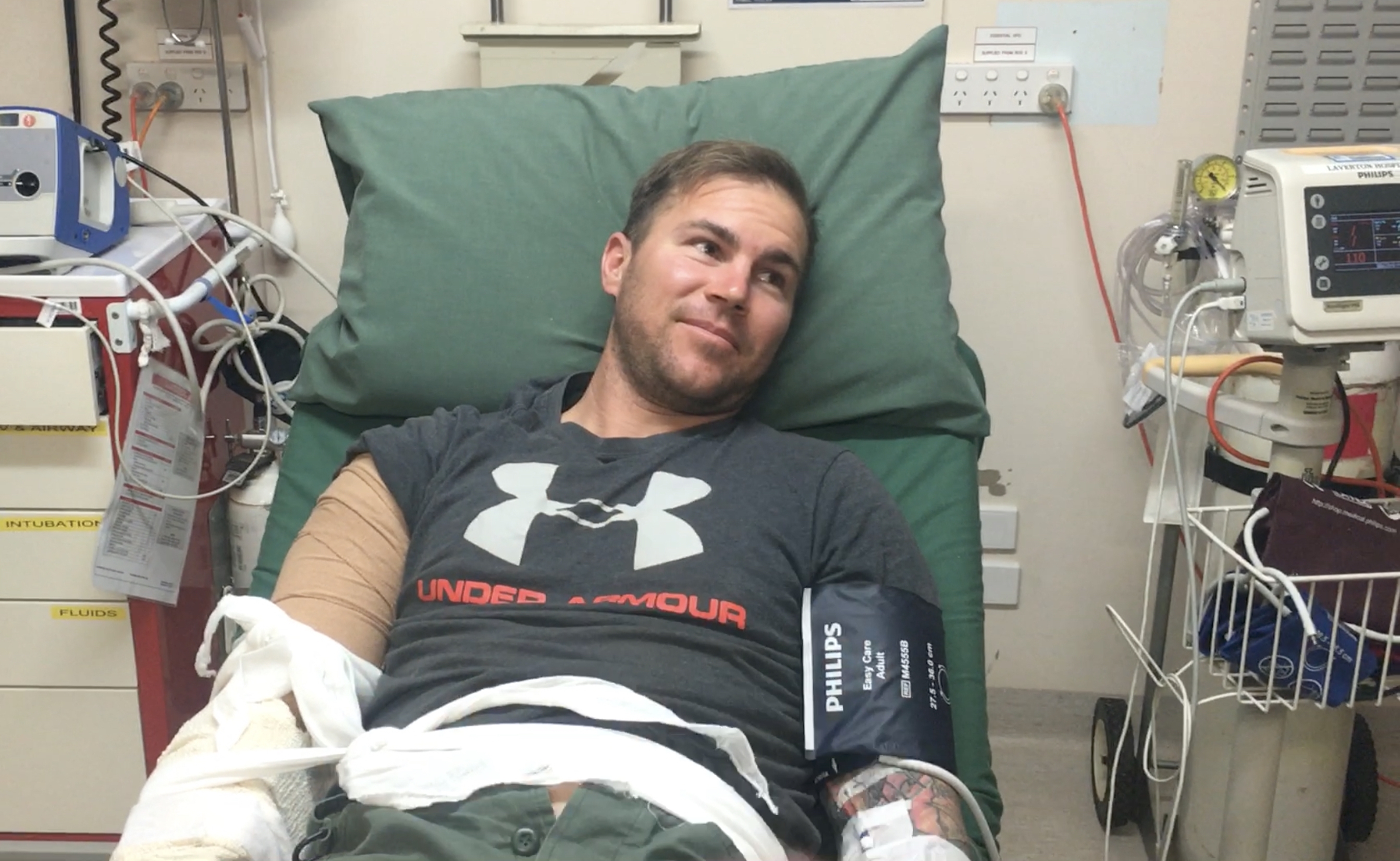
At Laverton Hospital, waiting to be airlifted to Perth after a bite from a juvenile Mulga Snake. Thankfully, the pain was manageable and I was experiencing few other symptoms, although the next few hours would determine how the situation unfolded.
Eventually, the RFDS aircraft arrived to take me to Perth. As we lifted off, I had plenty of time to reflect on how quickly things can go wrong. Only a few hours earlier, we had been experiencing one of the most exciting nights of herping either of us could remember, coming off the highest of highs after our incredible taipan encounter. Now I was being flown hundreds of kilometres to a major hospital, uncertain about what the next few hours might bring. The experience also gave me a new appreciation for the importance of the RFDS in remote Australia.
At Royal Perth Hospital, the pain had spread from my finger into my hand and up my arm, eventually becoming significant but still manageable. Blood tests did not show the systemic effects the doctors were looking for. Seven hours post-bite, the pressure bandage had to come off so the medical team could monitor what happened next. I remember thinking, “Here we go.” But the expected systemic symptoms did not develop, and I ultimately did not require antivenom. There was no nausea, vomiting, abdominal pain, bleeding or other deterioration. After several hours of observation, I was eventually cleared to leave. The snake had delivered venom, but the envenoming appeared to have been limited. I had got away with it.
For practical information on Australian snake behaviour, avoiding snakebite and how to respond to a snake encounter, see my Snake Safety & Awareness guide.
While I rested, Tim drove my vehicle the roughly 1,000 kilometres back towards Perth. After everything that had happened, I was exhausted. When we finally made it home, I had been through a full spectrum of emotions: excitement, stress, relief and exhaustion, along with a very healthy respect for a snake I would never again treat as routine. Once I had recovered enough, we ended up at the local pub for dinner. I had not eaten properly for around 24 hours. The first meal was accompanied by what I remember as a particularly satisfying beer. It was, in every sense, a celebratory not-dying beer.
You might think that would have been enough to convince me to leave reptiles alone for a while. It wasn’t. Tim still had three days to kill before flying home, and we had seen an extraordinary amount of reptile activity on the night of the bite. The conditions were equally good, and the prospect of walking away from that level of activity was simply too much. After resting for the night, we made a decision that probably says more about reptile obsession than any explanation ever could: we drove the 1,000 kilometres back to Laverton to finish what we had started. The allure was simply too strong.
They say fortune favours the bold. I’m not sure about bold, but we were certainly keen. What followed was an extremely productive final three days. The region came alive with reptiles, from Desert Whip Snakes (Demansia cyanochasma) and a sub-adult Perentie (Varanus giganteus) to Laverton Ring-tailed Dragons (Ctenophorus infans) and Goldfields Pebble-mimic Dragons (Tympanocryptis pseudopsephos), along with an assortment of other geckoes, skinks, dragons and harmless burrowing snakes. On our first night back, we stayed out until 3 am, finding and photographing reptiles almost continuously. It was hard to believe that only days earlier I had been flown to Perth after a Mulga Snake bite, yet there we were, back on the same roads and enjoying some of the best herping of the entire expedition.
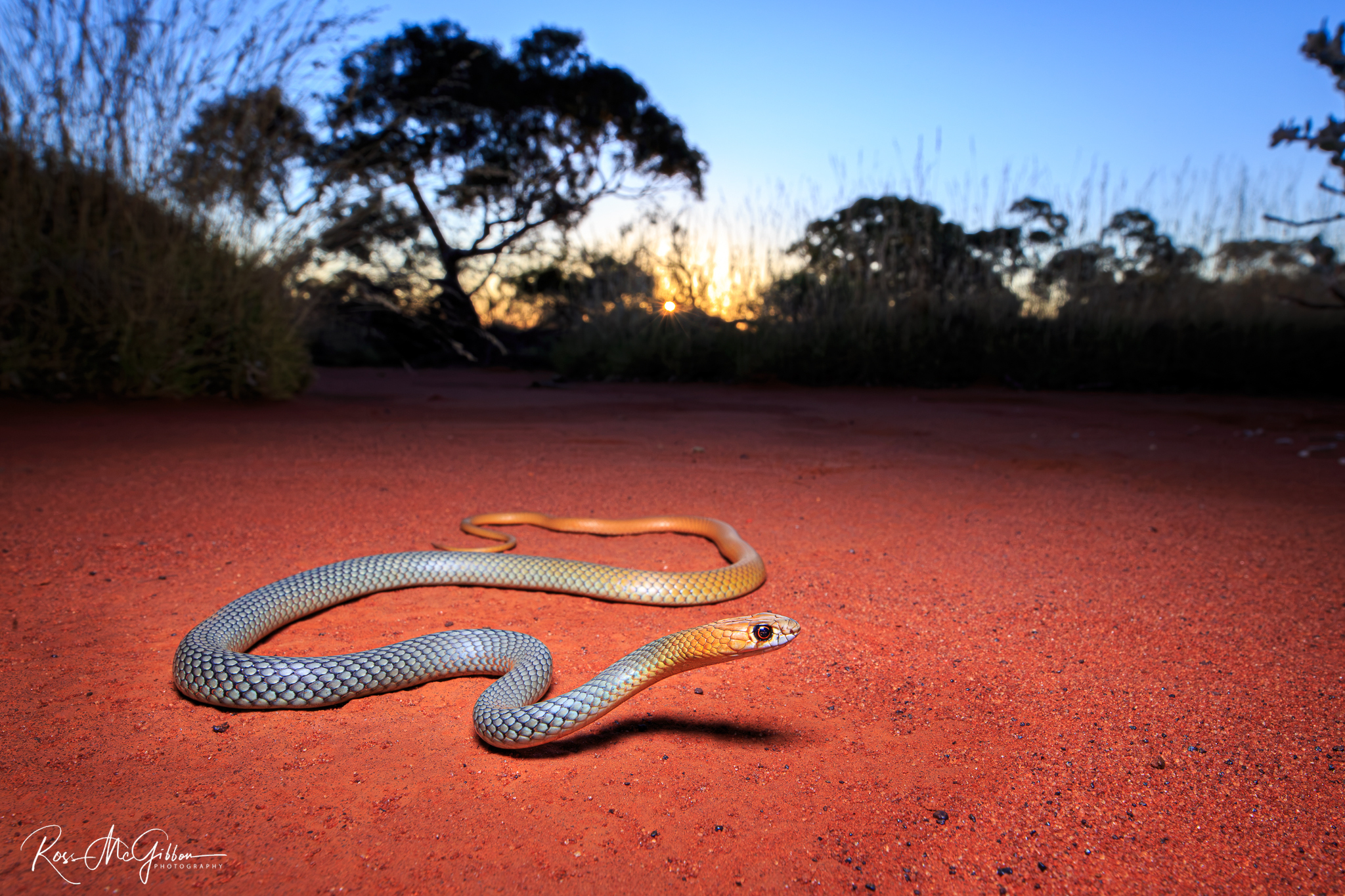
Desert Whip Snake (Demansia cyanochasma), Laverton, Western Australia. Among the most stunning of Australia’s whip snakes, with the colours of the horizon seemingly poured across its scales. Its scientific name combines Greek words meaning “blue” and “expanse”, a fitting reference to the blue-grey tones that fill the gap between its copper-coloured head and tail.
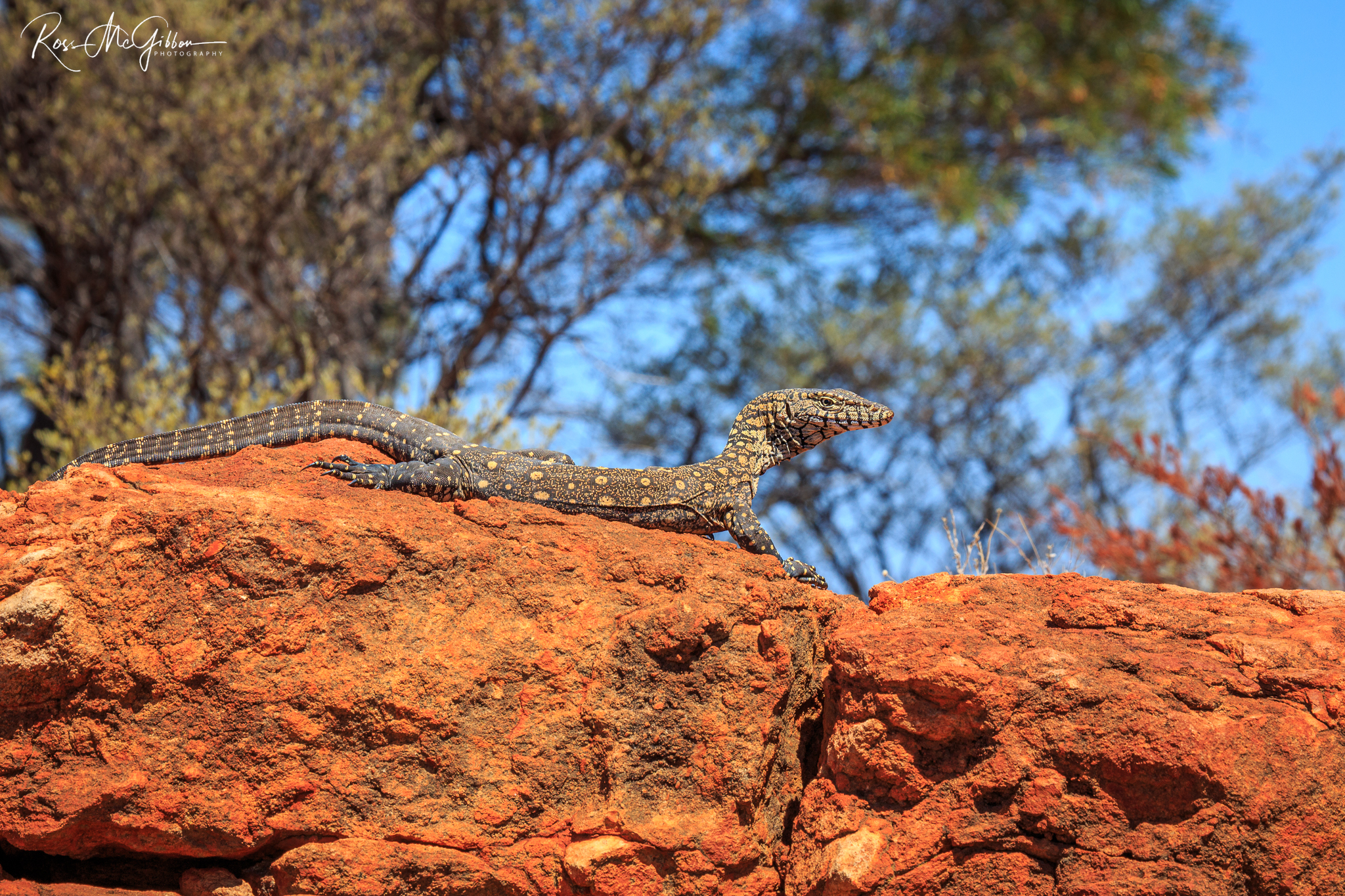
Perentie (Varanus giganteus), Laverton, Western Australia. Spotted basking on a small escarpment and photographed from a distance with a long lens. This young individual still has some growing to do before reaching the impressive size that makes the Perentie Australia’s largest lizard.
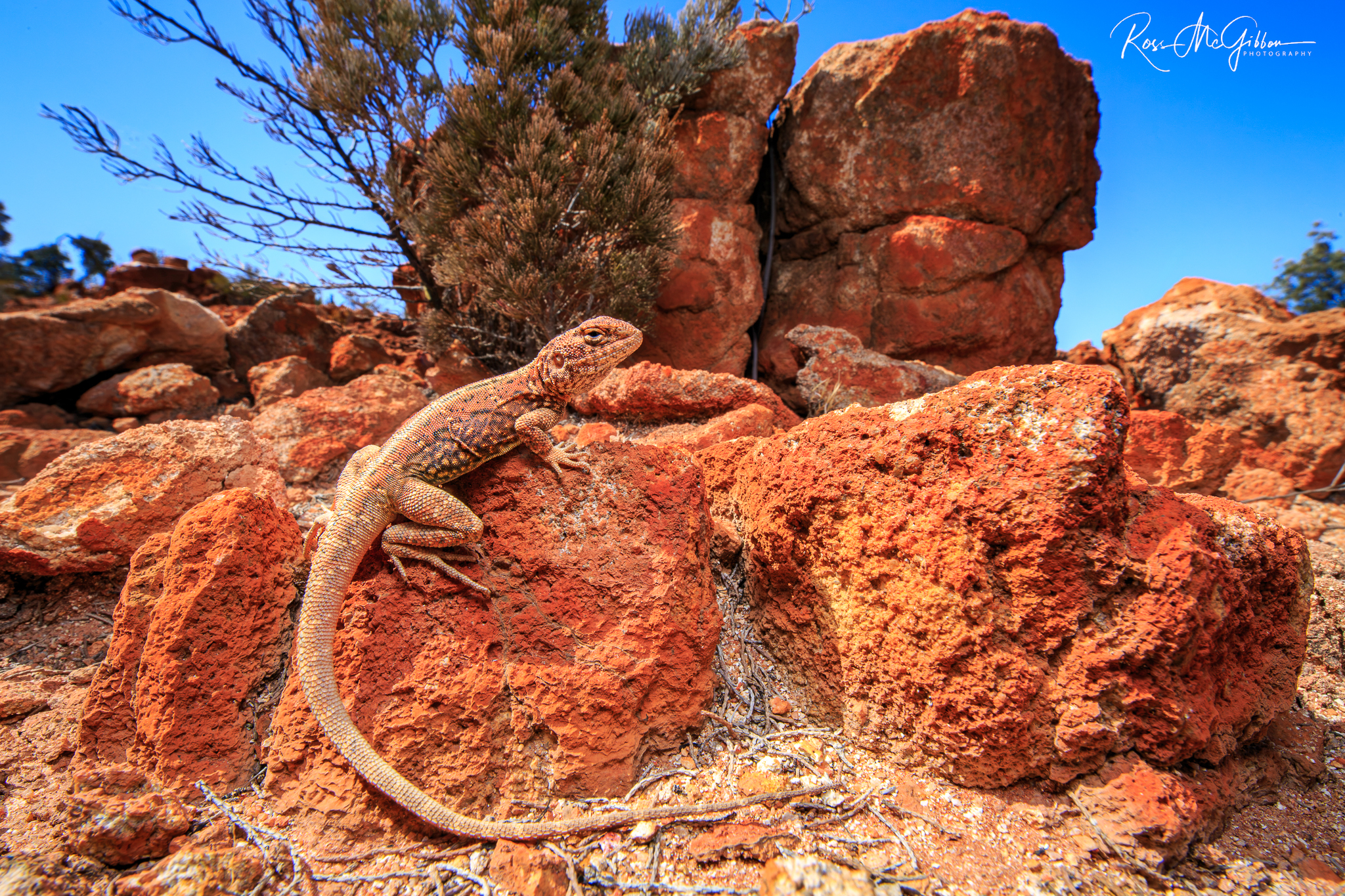
Laverton Ring-tailed Dragon (Ctenophorus infans), Laverton, Western Australia. A seldom-photographed species with a highly restricted distribution, found only in the Laverton region. Once considered a subspecies, it was recognised as a distinct species in 2016.
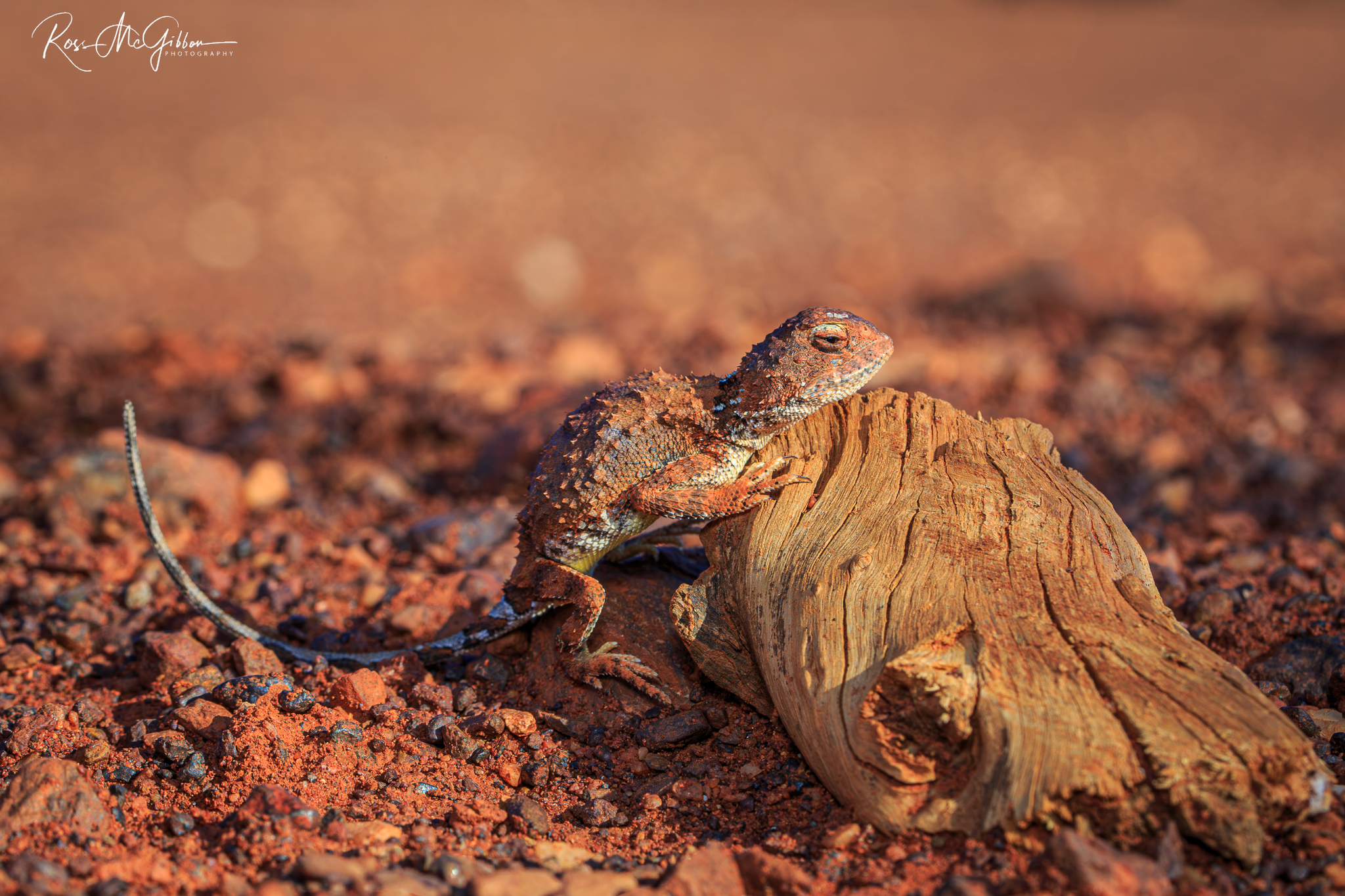
Above: Goldfields Pebble-mimic Dragon (Tympanocryptis pseudopsephos), Leonora, Western Australia. A cryptic little dragon whose name means “false pebble”, reflecting its remarkable ability to blend into its surroundings.
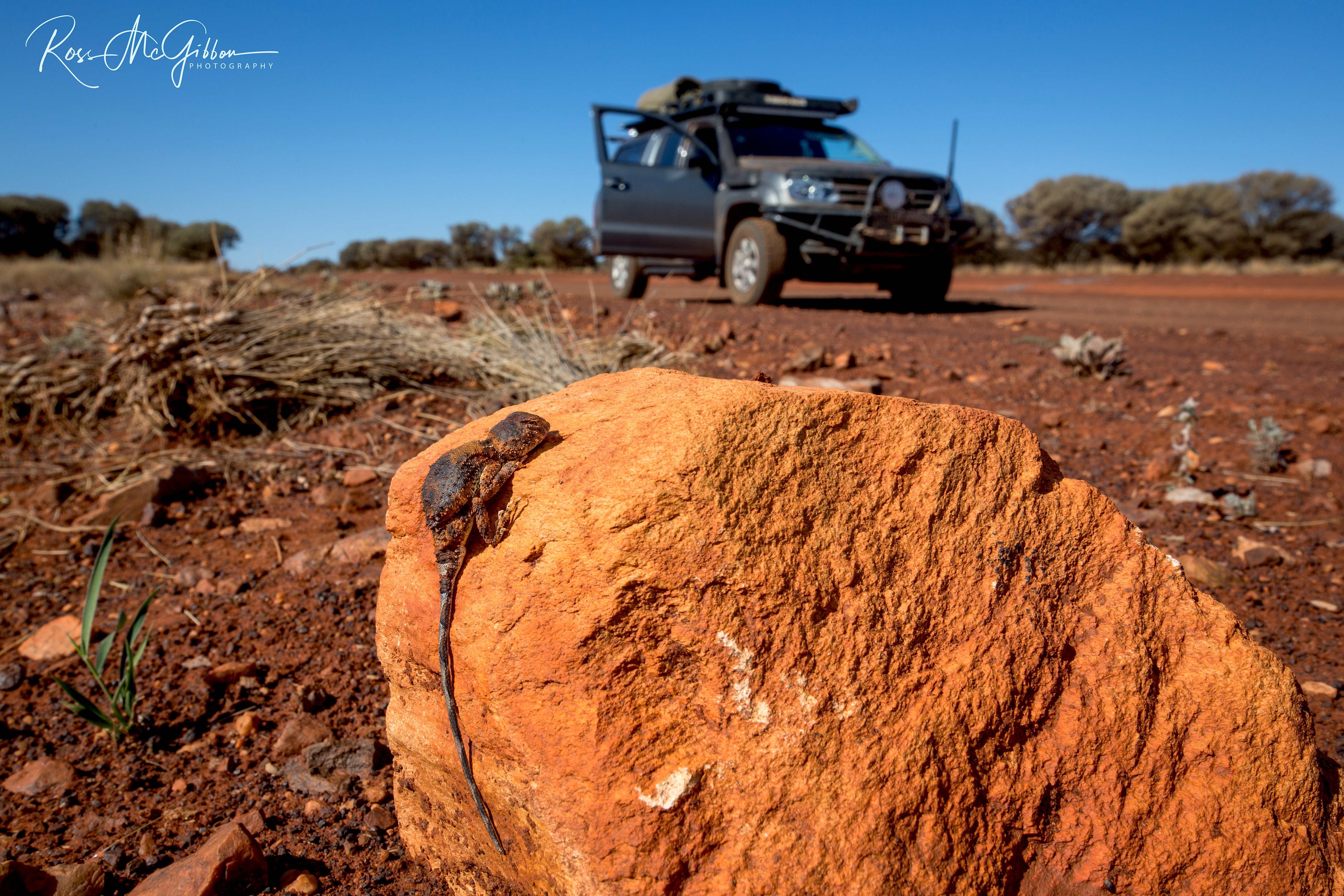
Below: A seceond Goldfields Pebble-mimic Dragon (Tympanocryptis pseudopsephos) in the same area. The trick to spotting these cryptic little dragons is to look for the head protruding above a rock. Once approached, they crouch low and use the rock for cover, before sometimes darting a short distance to disappear among the surrounding pebbles.
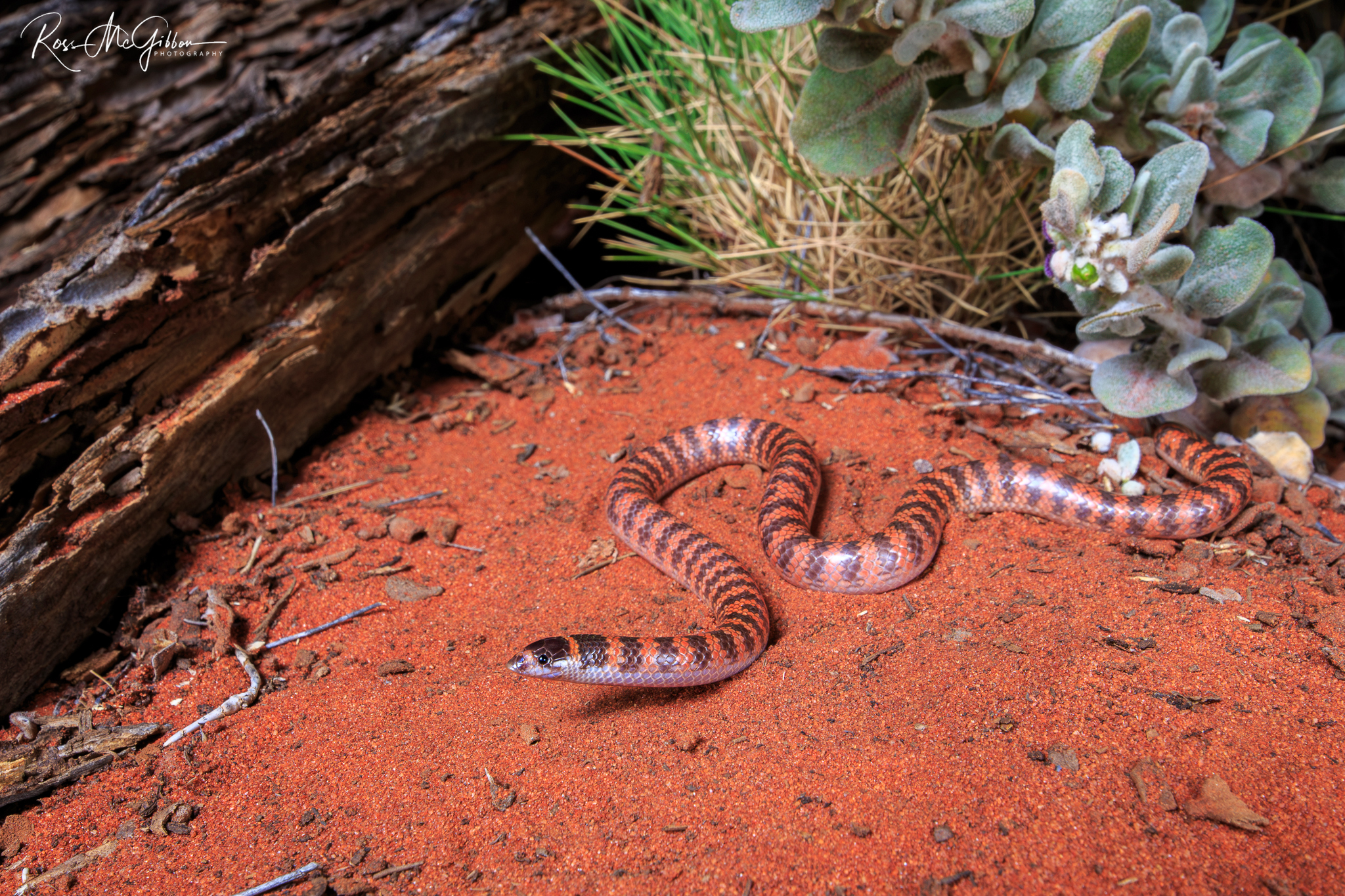
Above: Southern Shovel-nosed Snake (Brachyurophis semifasciatus), Laverton, Western Australia. A small, secretive burrowing snake with a specialised diet of reptile eggs, which it searches for beneath soil and leaf litter.
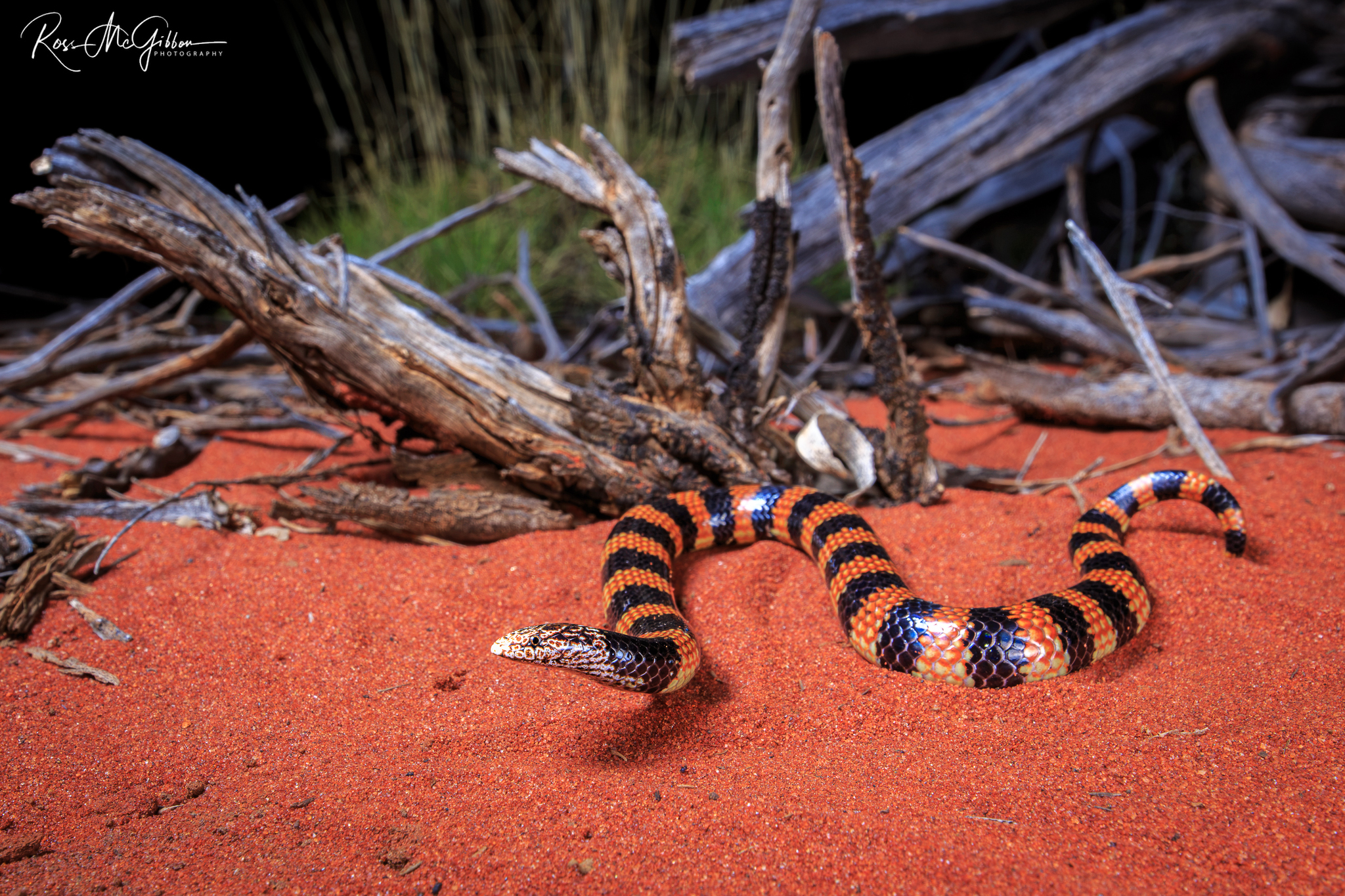
Below: Jan’s Banded Snake (Simoselaps bertholdi), Laverton, Western Australia. This small, boldly banded elapid is adapted for life underground, where it hunts small skinks rather than reptile eggs.
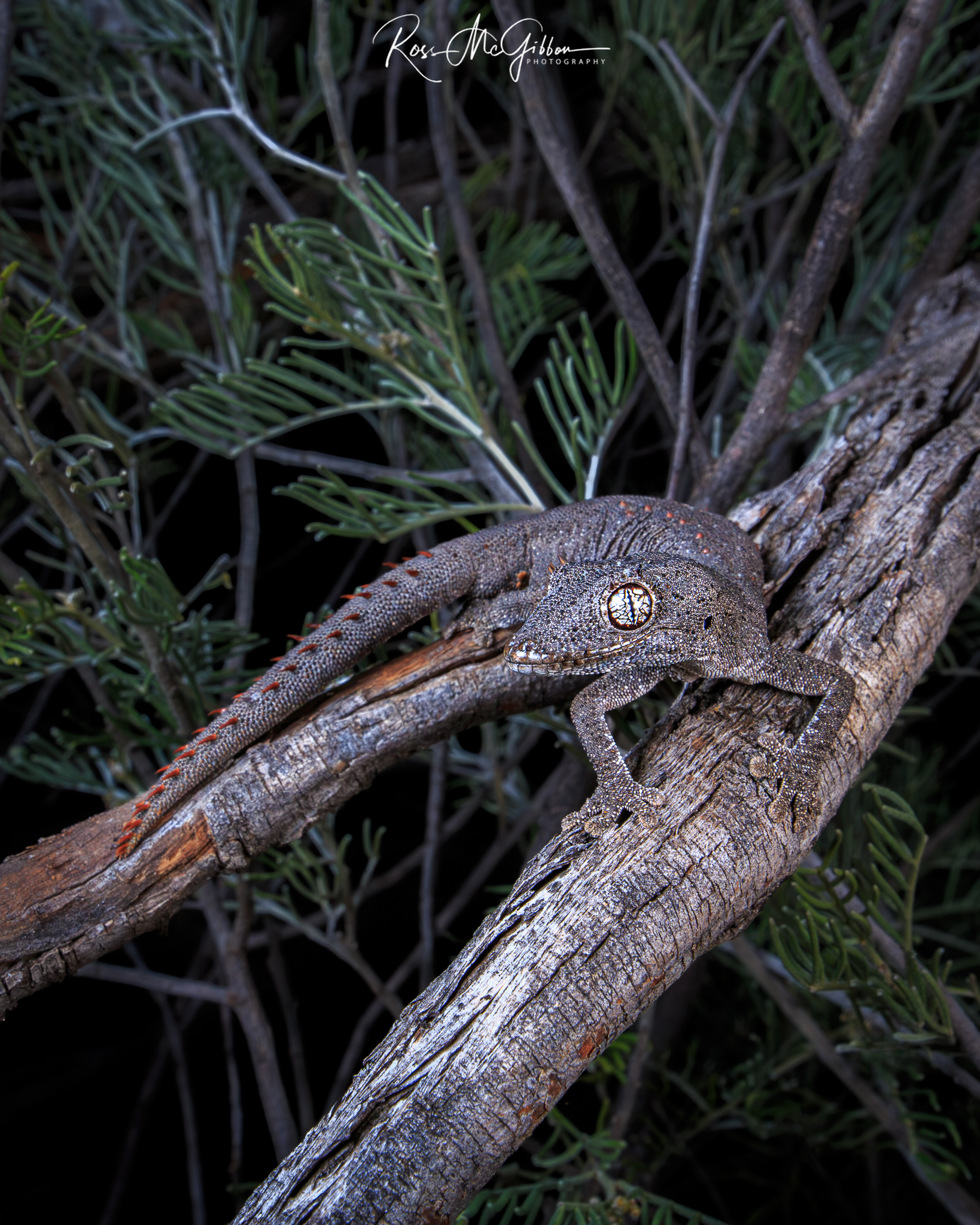
Western Shield Spiny-tailed Gecko (Strophurus wellingtonae), Laverton, Western Australia. A distinctive arid-country gecko with prominent spines above its eyes and along its tail. When threatened, it can squirt a foul-smelling fluid from its tail glands, providing an effective chemical defence against potential predators.
Eventually, among all that activity, we encountered a beautiful golden Mulga Snake. It was big, healthy and exactly the sort of animal I would normally have been eager to photograph. I didn’t. The bite only days earlier had changed the calculation. I knew exactly where another mistake could lead, and I could not live with myself if I ended up back in hospital two nights later. So I left the snake alone. For once, the photograph was not worth it.
A snakebite is not a fundraising strategy I’d recommend. There are much easier ways. But the experience gave me an enormous appreciation for the RFDS, and I was keen to give something back, partly out of gratitude for their service and partly from feeling a little guilty about causing such a fuss from my bite. I went on to raise funds through an annual photography calendar, later adding the Global Snakebite Initiative after reflecting on how few people in developing countries have access to the emergency care and snakebite treatment we’re fortunate to have in Australia. Across more than five annual calendars, the fundraiser raised over $10,000 for charity.
Years later, I still think about that first glimpse of the Western Desert Taipan: a long, dark snake crossing a dirt track, desert stretching in every direction, and the immediate rush of excitement and adrenaline. The encounter lasted only minutes, but it was the culmination of years of wondering, months of planning and anticipation, and thousands of kilometres of driving, all with no guarantee we would see the snake at all.
That uncertainty is part of the attraction. We found the taipan on our first morning, then spent three frustrating days searching for another. The bite on the journey home brought an altogether different experience, but we returned to Laverton and went on to enjoy some of the most productive herping of the trip. The expedition had delivered memorable highs, considerable setbacks and plenty of reasons to keep going. Yet one of its most telling moments came at the end, when I encountered a beautiful golden Mulga Snake and chose not to photograph it. After thousands of kilometres spent chasing reptiles and a trip full of photographs I’ll never forget, this was one encounter I was content to leave undocumented.
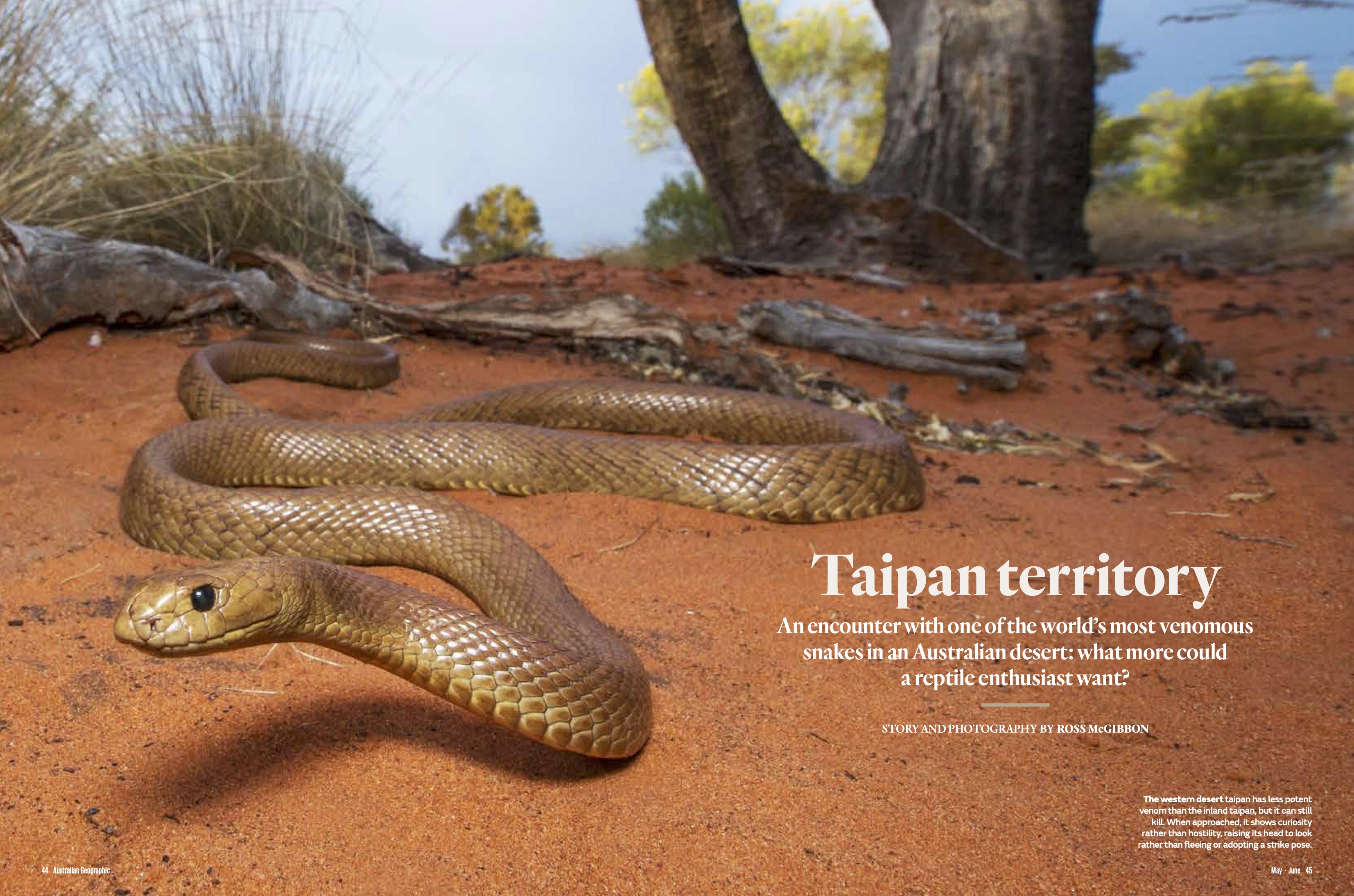
From a long shot in the Great Victoria Desert to a published story in Australian Geographic. After all the kilometres, the searching and the unexpected detours, it all turned out pretty well in the end.
The expedition was also featured in Australian Geographic Issue 144 in 2018, under the title Taipan Territory. I've shared more about that publication milestone in a separate post.